How to Tell If Your Child Is Improving in Jiu Jitsu—Beyond Belts and Stripes
How can you tell whether your child is improving in Jiu Jitsu when their belt hasn’t changed? Look for specific signs: remembering a starting position, applying a correction, asking for help, or practicing with more control. This week, Houzn Jiu Jitsu Academy in Mount Pleasant, SC looks at progress beyond stripes and round outcomes. Drawing on the practical parenting ideas in Raising Mentally Strong Kids, we explain why developing real abilities matters—and how parents can recognize learning without evaluating every class. Start by noticing one small improvement, or ask an instructor which skill is becoming more consistent for your child.
How to Tell If Your Child Is Improving in Jiu Jitsu—Beyond Belts and Stripes
Your child can be improving in Jiu Jitsu without earning a new stripe or getting the better of a training partner. Look for specific changes: recognizing a position, remembering part of a technique, responding to a correction, asking for help, or practicing with more control.
These signs do not replace technical development. They help you see it more clearly.
For our current families at Houzn Jiu Jitsu Academy in Mount Pleasant, SC, we want progress to be something you can discuss and understand—not something you have to guess at by watching a belt.
A promotion is a visible moment. Much of the learning that makes it possible is quieter.
Why progress can be hard to see
Brazilian Jiu Jitsu asks a child to manage several things at once. They are learning where to put their hands and feet, how to move their body, what their partner is doing, and when to change direction.
A movement may make sense during a demonstration but become difficult when it is their turn. It may work with a cooperative partner and disappear when that partner starts offering resistance.
That difference does not automatically mean the lesson failed. Remembering a movement and using it against resistance are different demands.
A child might understand the starting position this week but still forget the next step. Later, they may connect those steps during practice. Applying them during a moving round can take longer.
From the sidelines, all three stages can look like a child who has not yet completed an escape. From a teaching perspective, there are important differences between them.
Look for something your child can do more independently
One useful idea in the book Raising Mentally Strong Kids by Daniel G. Amen and Charles Fay is that confidence develops through competence and contribution.
In plain language, children benefit from learning to do things and having meaningful ways to help. Encouragement supports that process, but it does not replace the experience of becoming more capable.
For kids Jiu Jitsu, a practical question is: what can your child now do with less help?
Perhaps they previously needed an instructor to place their arms during a drill. Now they find the starting position after one reminder. Perhaps they used to wait silently when confused. Now they ask which direction to turn.
Neither example means the skill is finished. Both give us something concrete to recognize.
Independence also does not mean never needing help. Recognizing a problem and asking a useful question can be a step forward.
A round’s outcome tells only part of the story
It is understandable to watch a round and notice who ended up on top. That is often the easiest part to follow.
But a practice round is not a complete assessment of either child.
Partners differ in size, experience, familiarity with the position, and how much resistance they provide. The task matters too. A child working on an unfamiliar escape may look less successful than when using a movement they already know.
Consider a student practicing from underneath a partner. They may not complete the escape, but they might remember to create space with their arms rather than simply push harder. That is a technical improvement, even if the final position looks unchanged.
This does not mean every difficult round should be described as a success. Some attempts reveal confusion or show that the task needs adjusting. The point is to identify what actually happened rather than reduce the whole experience to winning or losing.
Partner care belongs in the picture
Jiu Jitsu is practiced with another person. Learning to train responsibly is part of learning the activity.
Releasing immediately when a partner taps, stopping when directed, and controlling a movement all matter. So does giving a partner the opportunity to practice instead of turning every drill into a contest.
These behaviors should not be treated as substitutes for technique. They are part of learning how to use technique responsibly.
A child who performs a movement with more control is developing something valuable, even if speed or effectiveness still needs work.
For parents considering what progress in martial arts for kids should include, this is worth remembering: being a trustworthy training partner matters alongside being a capable one.
Notice specifically, without grading every class
There is a difference between helping a child recognize progress and making them feel constantly evaluated.
A detailed review after every class can make training feel like another performance they need to explain. Children may also be tired, hungry, or simply ready to talk about something else.
A short, accurate observation is often enough. You might mention that they remembered the starting position or asked for another demonstration when they were unsure.
Keep the observation tied to something you actually saw. If you could not follow the activity from the sidelines, there is no need to manufacture praise.
You can invite your child to share what felt more familiar, but they do not owe you a lesson summary after every class. Sometimes the most helpful response is to listen—or let the conversation wait.
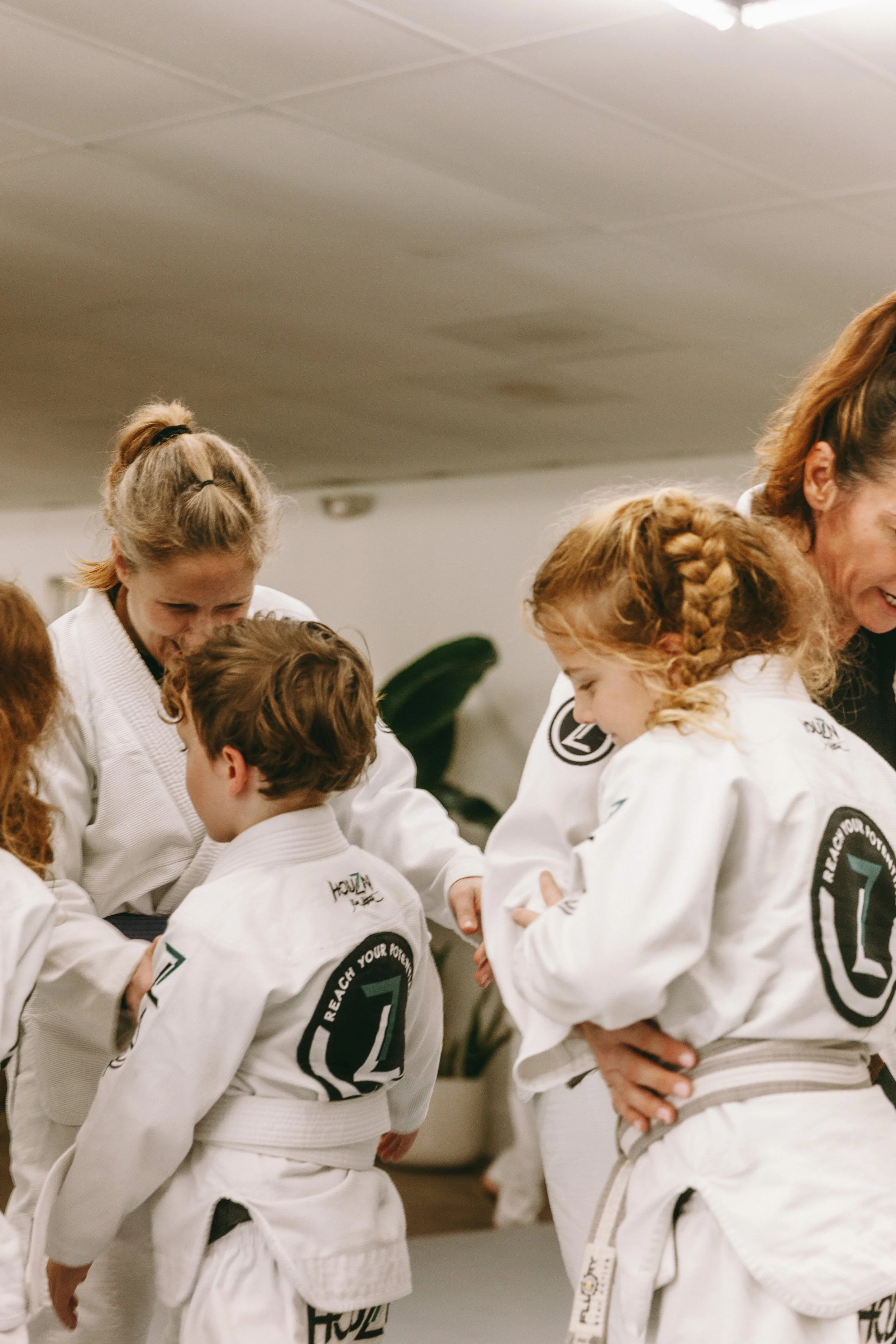
Give the same idea room at home
You do not need to coach Jiu Jitsu techniques at home to support this week’s theme. Household routines provide simpler opportunities to practice competence and responsibility.
A younger child might take responsibility for putting one item in their training bag, with an adult checking afterward. A child ready for more independence might prepare the bag and ask for help if something is missing.
The useful part is not getting the task perfect immediately. It is learning the steps and gradually needing less guidance.
You might notice the same pattern in an unrelated task: putting materials away, helping prepare for dinner, or beginning homework with an appropriate amount of support.
These are not guaranteed results of training. They are separate opportunities to reinforce a shared idea: children can learn useful skills when adults provide clear expectations, manageable responsibility, and patient help.
Avoid making basic care a test of toughness. A forgotten water bottle, for example, is a planning problem to work on—not a reason to deny water.
What if progress still seems stalled?
Sometimes a child needs more repetition. Sometimes they need a smaller task, a different explanation, or help with something that is making class difficult.
Patience matters, but patience should not mean ignoring a concern.
If you are unsure how your child is doing, ask an instructor for a specific example of something becoming more consistent and something that still needs support. That creates a more useful conversation than comparing your child’s belt with another student’s.
You can also share what your child is telling you. An instructor may see participation on the mats while a parent hears discouragement afterward. Both perspectives matter.
Repeated distress, pain, or a safety concern should not be dismissed as part of the learning curve. Those concerns deserve attention in their own right.
Take the longer view without missing today’s details
There is no fixed timetable for every child to become comfortable, coordinated, or technically consistent. A skill may appear one day and need reminders the next.
That is why it helps to look across several classes rather than ask each class to prove that training is working.
The longer view is not a promise that time alone solves every difficulty. It is a way to notice patterns while staying open to adjustments.
A belt matters. So does the growing ability to understand a position, respond to coaching, and practice responsibly with another person.
This week, look for one specific change in what your child can do or understand. If you are unsure what to look for, ask an instructor to help you identify one skill worth noticing.
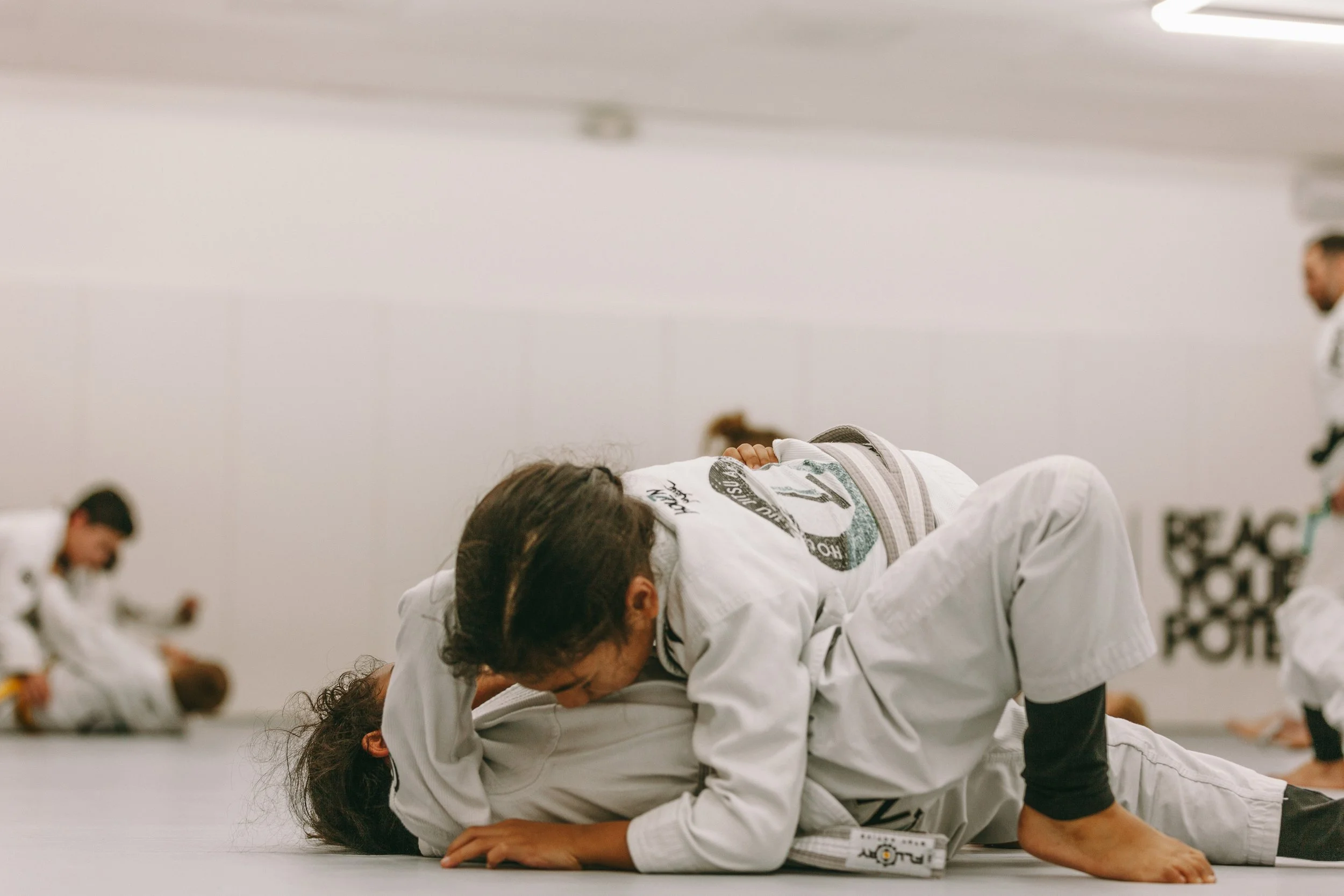
Kids Jiu Jitsu Progress After 4 Months: What to Expect Next
Around months 3–4, kids often shift from “just surviving class” to building real habits and confidence. This post from Houzn Jiu Jitsu Academy in Mount Pleasant, SC (serving Charleston families) explains what progress typically looks like by this stage, why motivation can fluctuate, and how parents can help kids set simple goals that keep training positive. You’ll also learn what the next phase of Brazilian Jiu Jitsu for kids focuses on: fundamentals under pressure, safe intensity, and consistent routines.
What Progress Looks Like After 16 Weeks of Kids Jiu Jitsu
The early phase of kids Jiu Jitsu is mostly about orientation. A child is learning how class works, where to stand, how to listen to the coach, and how to move safely around other students. They’re also getting used to close contact, trying unfamiliar movements, and receiving corrections.
That’s a lot to take in. Some children settle into the routine quickly. Others need more time before they feel at ease. Both are normal.
By around Week 16, many children begin to move into a new stage. They know more of what to expect, so class can shift from learning the routine toward building dependable habits and skills. This doesn’t mean every child will look confident or perform every technique the same way. Progress depends on age, temperament, attendance, and what a child is ready to learn.
It does mean there are useful signs to notice beyond whether they can show you a move at home.
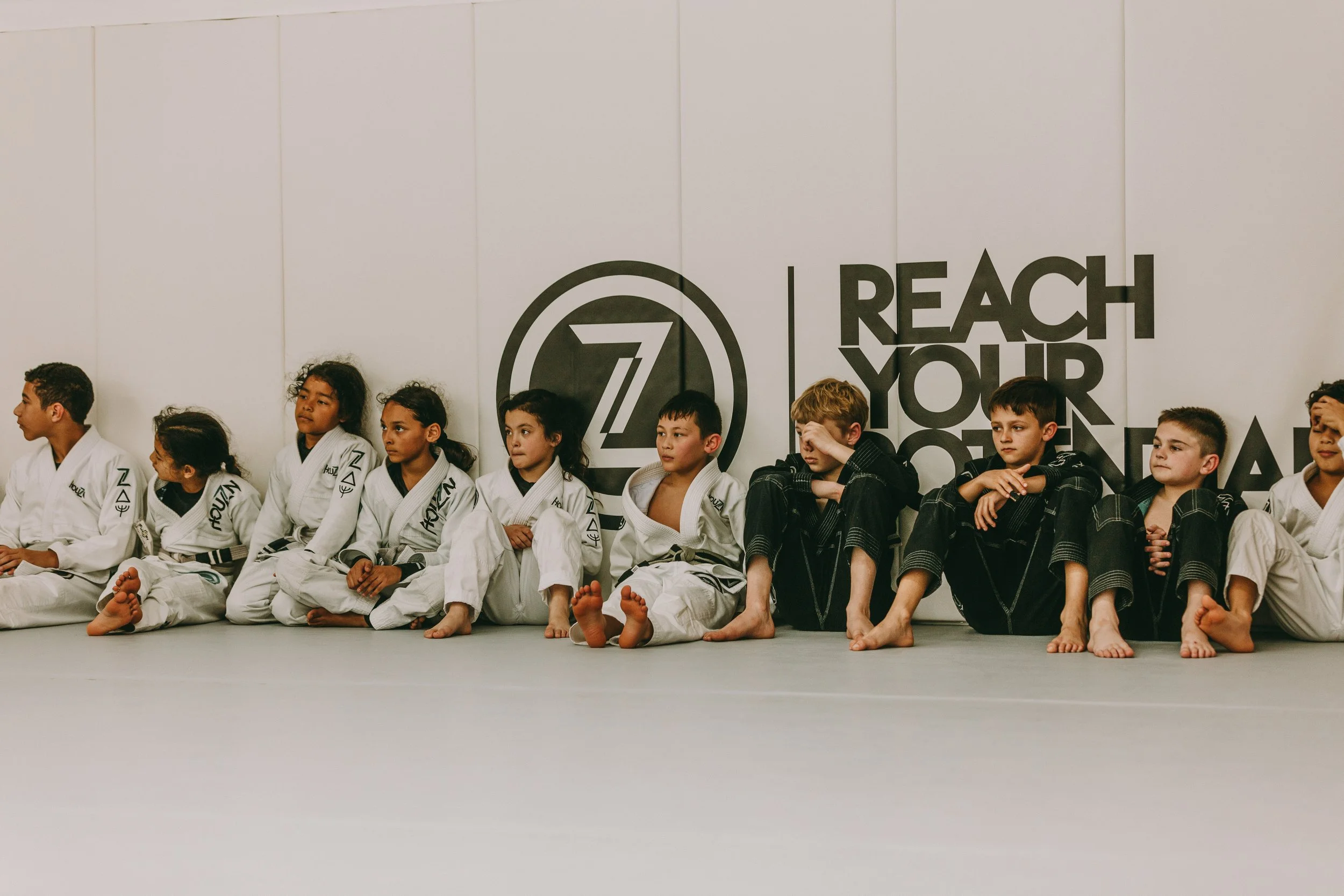
What real progress looks like
In Jiu Jitsu, a child’s progress often starts with how they move and respond—not with a long list of techniques. They may stand with better posture, keep their balance more often, or notice where their body is in relation to a partner. These details can look small, but they are the foundation for learning safely and effectively.
You may see your child becoming more aware of position. They might recognize when they’re on their back, understand which way to turn during an escape, or remember where their hands and feet should go. They won’t get it right every time. The important change is that familiar situations are beginning to make sense.
Partner behavior is another important measure. A good training partner pays attention, follows directions, uses appropriate effort, and gives the other person room to learn. Children are still learning what control feels like, so coaches guide them closely. When a child starts to move with more care, stop when asked, and adjust their intensity, that is meaningful progress.
You may also notice calmer reactions. A child might pause when a drill feels difficult, listen to a correction without shutting down, or try again after a mistake. This isn’t about expecting a child never to feel frustrated. Jiu Jitsu can be challenging, and frustration is part of learning. The goal is to help them respond to challenges in a way that lets them keep learning.
Finally, watch for more accurate repetition. A child may remember the order of a movement, use a better base, or repeat a technique with less prompting. They may still need reminders, and that’s part of practice. Repeating fundamentals carefully is how the body begins to understand them.
These are durable skills. They support learning on the mat, and they reflect the discipline and personal responsibility we work to build in class.
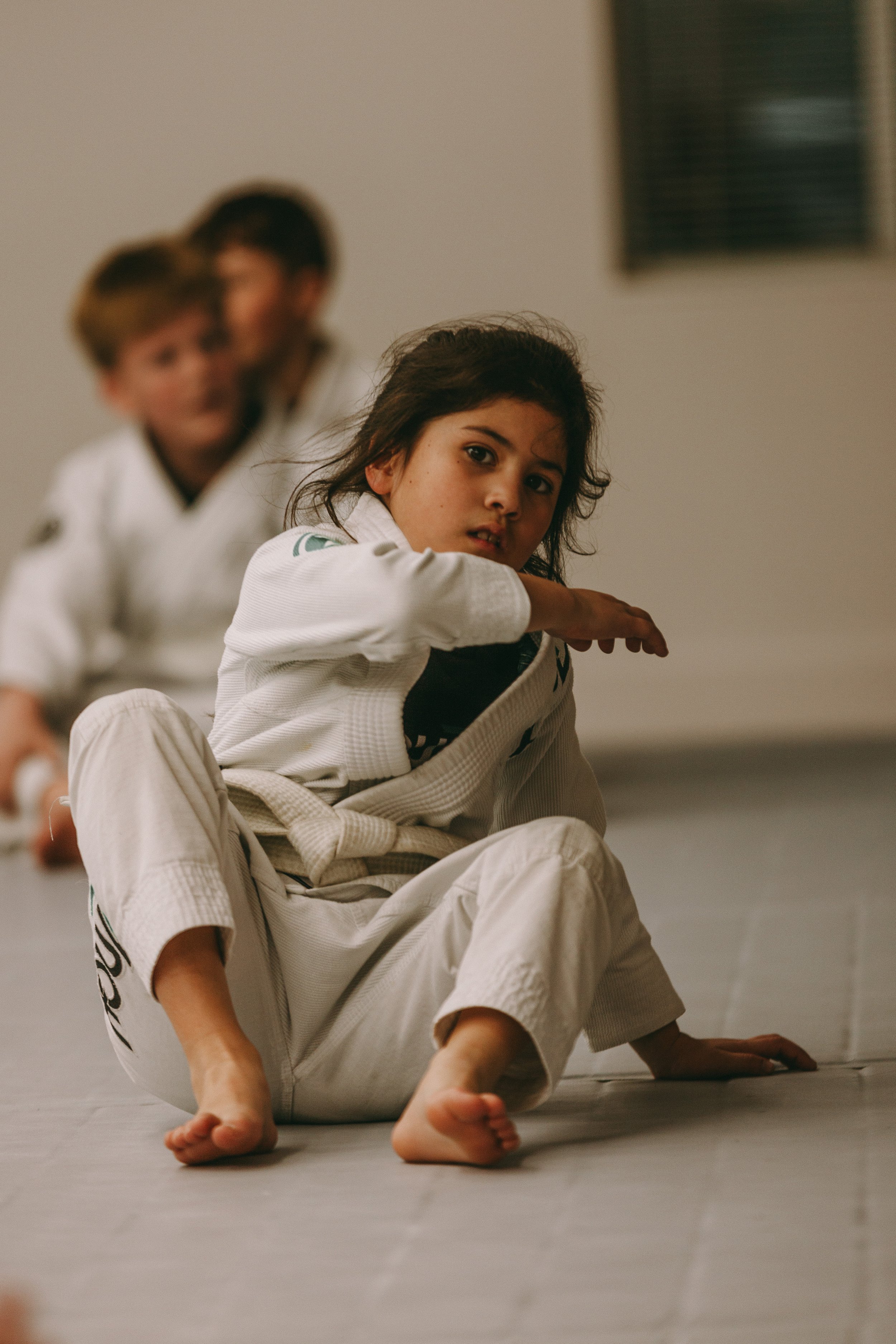
Why motivation can dip
It’s common for a child’s enthusiasm to change after the first few months. At the beginning, everything is new: the mats, the games, the uniform, the other students, and the movements. Once that novelty wears off, practice can feel more like practice.
Children may also start to notice that skill takes time. A technique that seemed easy during the demonstration may be hard to remember with a partner. They might see another student pick something up faster, or feel disappointed when a move doesn’t work right away. That can make a child wonder whether they’re good at Jiu Jitsu.
A dip in motivation doesn’t automatically mean a child should quit, and it doesn’t mean a parent needs to push harder. It may simply be a sign that the child is meeting the ordinary challenges of learning something new. The response that helps most is usually a calm one: maintain a predictable routine, notice effort, and give the child a goal they can understand.
It’s also worth checking in. A child may be tired, unsure about a partner, or confused about what they’re expected to do. They might be ready for a new challenge, or they may need more time with the basics. A short conversation with the coach can help you understand what is happening in class and choose an appropriate next step.
Choose a goal a child can work toward
A useful goal is specific, realistic, and within the child’s control. “Get better at Jiu Jitsu” is hard for a child to act on. “Remember the three positions we practiced” gives them something clear to work toward.
Depending on a child’s age and experience, a goal might be attending a consistent number of classes each week, learning to name three core positions, or practicing one escape with attention to the details. For another child, the next step may be following the class routine more independently or showing safe intensity during an age-appropriate sparring round.
Some goals are about being a teammate. A child could focus on listening to their partner, stopping when the coach says stop, or encouraging someone who is still learning. Coaches can also recognize a child for a specific action, such as using good control or making a thoughtful adjustment. Recognition works best when it’s sincere and tied to something the child can repeat—not just a reward for winning or being the most advanced.
A goal should fit the child, not a comparison. Two children can be at the same point in the program and need different next steps. One may be ready to connect techniques. Another may benefit most from developing balance and confidence in a familiar position. A coach can help identify a challenge that feels achievable without making class stressful.
How parents can support steady growth
Parents have a strong influence on how children understand progress. After class, it can help to ask what they learned, what felt challenging, or what they would like to practice next. These questions invite a child to reflect without turning every class into a test.
Try to avoid making the first question, “Did you win?” Jiu Jitsu includes live practice, but a child’s development is not measured only by the outcome of a round. A student can lose a position and still make a good decision, stay composed, listen to coaching, and treat a partner well. Those choices matter.
The same care applies to comparisons. Siblings and classmates develop at different rates. Comparing a child to someone who is taller, older, more experienced, or simply more comfortable on the mat can distract from their own progress. Instead, point out a real change you have noticed: “You remembered to make space before you tried that escape,” or “I saw you stop and listen when the coach gave you a correction.”
Consistency also matters. Regular attendance gives children the chance to revisit skills and become familiar with class expectations. Life gets busy, and occasional missed classes are normal. The aim isn’t perfection. It’s a routine your family can sustain.
At Houzn Jiu Jitsu Academy, we teach children that discipline is built through small, repeated choices: showing up, paying attention, practicing with care, and taking responsibility for how they treat others. We don’t expect every child to progress on the same timeline. We want them to learn well, train safely, and take pride in the work they put in.
Keep the next step simple
Around this stage, a child doesn’t need a complicated training plan. They need a clear direction and the support to keep working at it. A small goal can give practice a sense of purpose without adding pressure.
If you want to understand what your child is working on, ask their coach what progress they’re seeing and what would be a good next goal. We can help you choose something that fits your child’s age, experience, and personality. Grab your kids coach after class or ask for a conference with the coach. We’ll keep it simple, specific, and motivating.
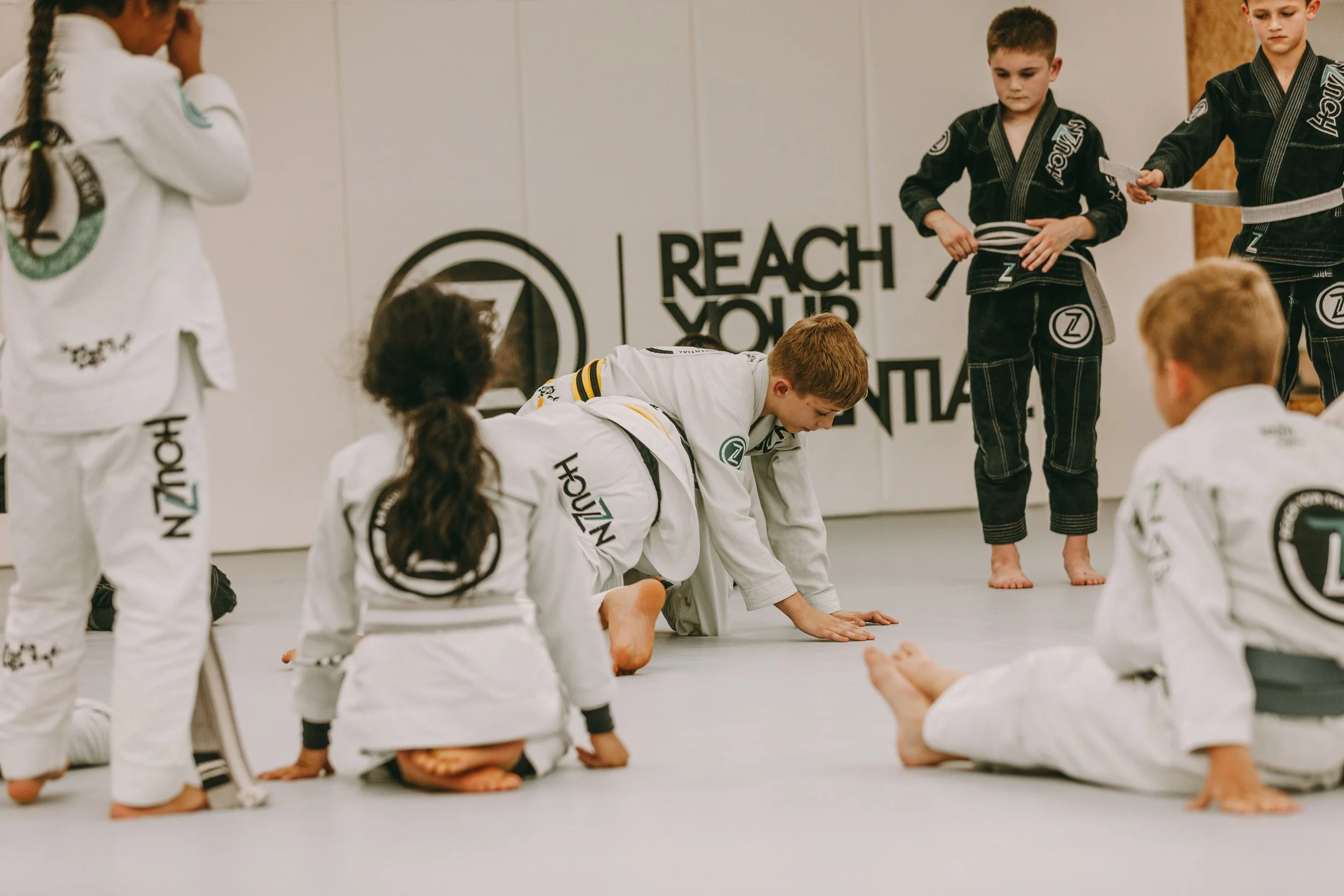
Kids Jiu Jitsu Leadership: How Training Builds Good Teammates
Leadership in Kids Jiu Jitsu isn’t about dominance—it’s about responsibility and being a good teammate. In Brazilian Jiu Jitsu for kids, students learn to partner safely, welcome new classmates, handle wins and losses with maturity, and set a positive tone in class. This post from Houzn Jiu Jitsu Academy in Mount Pleasant, SC (serving Charleston families) explains how coaches develop leadership across ages, what parents can look for, and how leadership shows up at home and school.
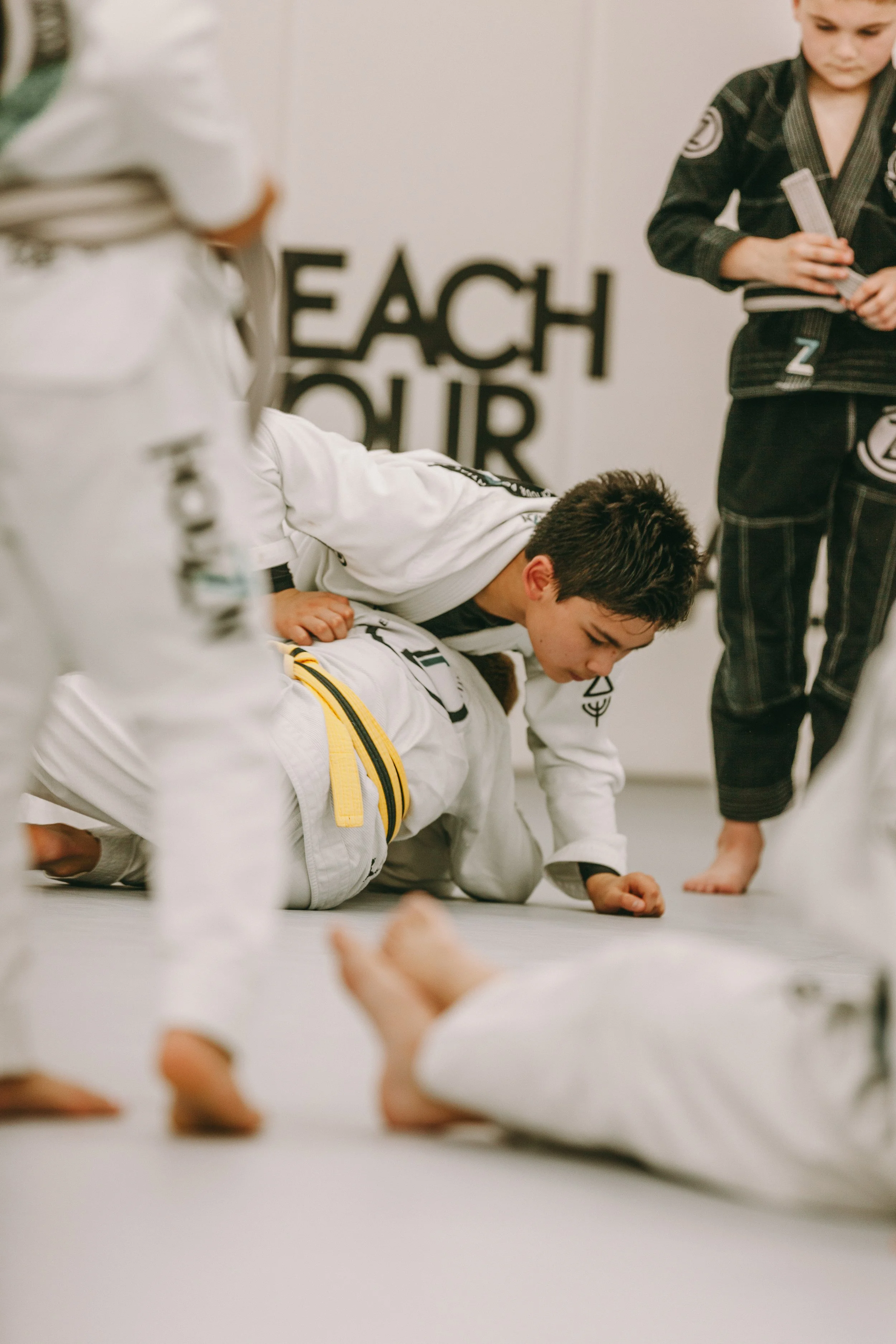
Parents tell us all the time that they want their child to be a leader. Not the “alpha kid” who has to be right, dominate the room, or control other people. They mean a child who can handle responsibility, treat others well, and stay steady when things get hard. That’s a healthy goal, and it’s one of the reasons Kids Jiu Jitsu works so well when it’s taught the right way.
At Houzn Jiu Jitsu, we think leadership is earned through behavior. It’s not a personality type. It’s not about being extroverted. It’s not even about being the most athletic kid in class. Leadership is about being trustworthy, and trust is built in small moments, repeated a lot.
Jiu Jitsu gives kids a clear pathway to that kind of leadership because the environment is real. The mat gives honest feedback. Your child can’t talk their way around it, and they can’t shortcut it. They have to learn to work with other kids, listen to a coach, manage emotions, and train safely with a partner. That’s leadership training, even if nobody uses the word.
When we talk about leadership in class, we put it into simple behaviors kids can understand and practice. Safety comes first, because if your child can’t be trusted to train with control, they can’t be trusted to lead. We teach them how to match intensity to the partner, how to move with awareness, and how to stop when they’re supposed to stop. That’s not just a Jiu Jitsu skill. That’s a maturity skill.
Humility is next. In Jiu Jitsu, everyone gets humbled. That includes the talented kid, the strong kid, and the kid who wins a lot. The question isn’t whether your child will face frustration. The question is what they do when they feel it. Humility shows up when a kid can learn without needing to prove something. It shows up when they can be corrected without arguing. It shows up when they can win without rubbing it in, and lose without shutting down.
Consistency matters because it’s the foundation of self-respect. A consistent kid is building a quiet kind of confidence. They show up. They try again. They accept that learning takes time. In a world where kids are surrounded by instant gratification, Jiu Jitsu teaches them that progress is something you build. When a child trains consistently, other kids notice. Coaches notice too. That child becomes dependable, and dependability is one of the most underrated forms of leadership.
Encouragement is a big one, and it’s often misunderstood. Encouragement isn’t cheerleading or being fake positive. It’s simply using your presence to make the room better. For kids, it can look like helping a new student find the right spot in line, giving a partner a high five after a round, or saying, “Good job” when someone finally gets a drill right. Encouragement takes the focus off ego and puts it on community. That’s directly in line with our values of giving before getting and treating others the way you’d like to be treated.
Emotional control is where you really see leadership developing. A child doesn’t need to be emotionless. They just need to be able to feel emotions without letting those emotions drive their behavior. Jiu Jitsu creates pressure in a safe, supervised way. Kids experience the discomfort of being stuck, the frustration of losing position, the disappointment of not getting the move, the excitement of success, and the temptation to get rough when they’re tired. We coach them through those moments. Over time, they learn how to breathe, reset, and keep going. That’s a skill they will use in school, at home, and in friendships.
Coachability might be the most important leadership behavior in the room. Coachable kids can take instruction, apply it, and adjust. They don’t take feedback as an insult. They see it as information. That’s what personal responsibility looks like for a child: “I can change my results by changing what I do.” When a kid gets coachable, their progress accelerates, but more importantly, their character strengthens. They become someone you can count on.
One reason leadership emerges naturally in Jiu Jitsu is that kids are constantly watching each other. They notice who stays calm. They notice who follows the rules when the coach isn’t looking. They notice who takes care of training partners. They notice who gets mad and quits. They notice who blames others. They notice who keeps trying. Even younger kids pick up on this.
Over time, peers start to respect the kids who make training feel safe and fair. That respect isn’t forced. It’s earned. And that’s the kind of leadership you want your child to have: the kind that comes from being solid, helpful, and accountable.
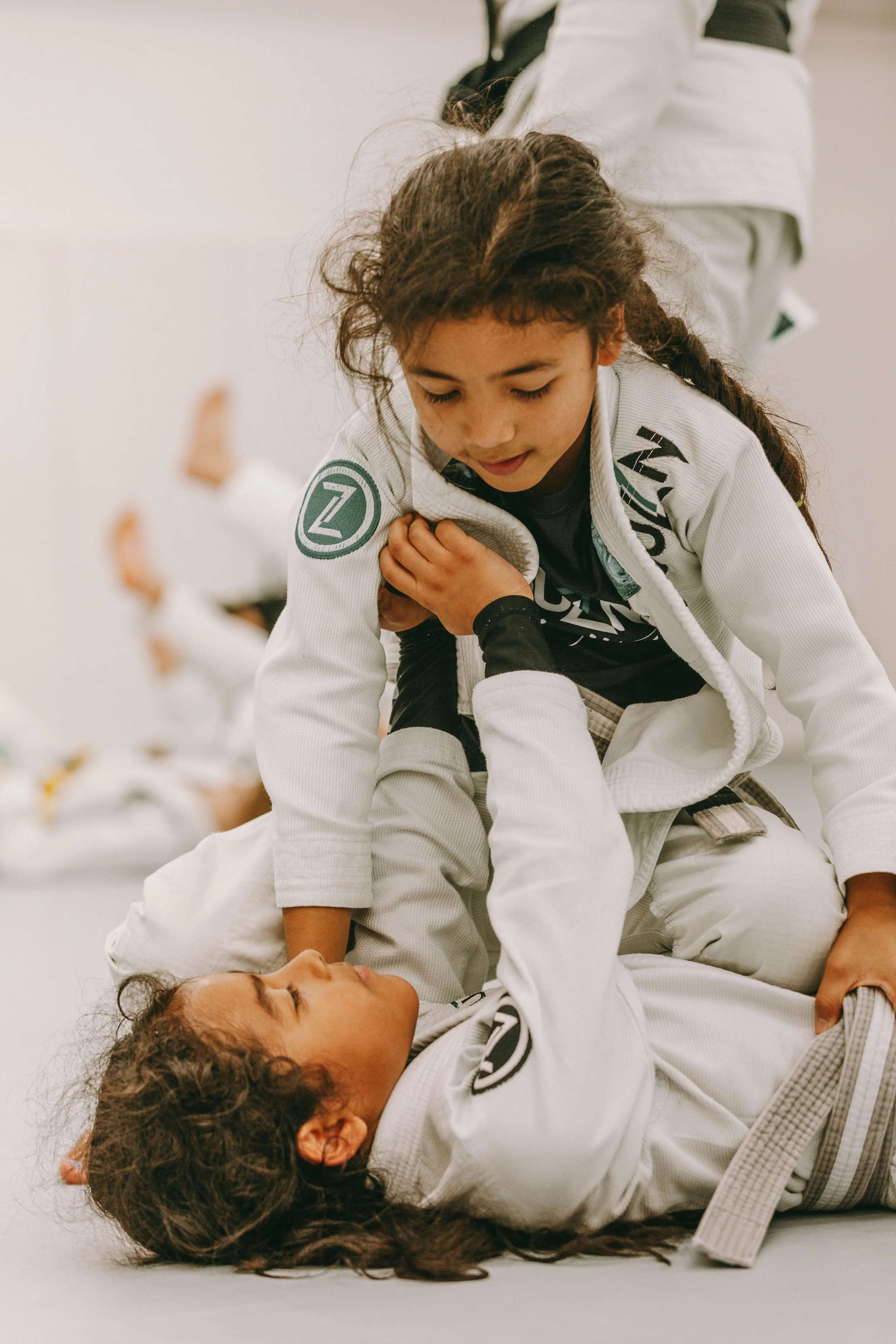
In a good Kids Program, leadership isn’t assigned through popularity. It’s built through habits. That’s why we don’t obsess over “who’s the toughest” or “who wins rounds.” We care about who is growing. A child who learns to lead on the mat is learning something deeper than technique. They’re learning how to be in a group without losing themselves and without trying to control everyone else.
As coaches, we also pay attention to the quieter forms of leadership, because a lot of great leaders don’t look like leaders at first. Some kids are naturally outgoing and confident. They’ll volunteer, answer questions, and speak up. That’s fine, as long as it’s paired with humility. Other kids lead by example. They line up quickly. They pay attention. They drill with focus. They tap early. They don’t get distracted. They make the room calmer. If you’re a parent, those quiet behaviors are worth noticing and reinforcing, because they’re the roots of real confidence.
A big part of our job is helping kids understand the difference between dominance and leadership. Dominance is about control. Leadership is about responsibility. Dominance needs an audience. Leadership shows up even when nobody is clapping. That distinction matters, because kids are constantly being taught to perform. Jiu Jitsu, when taught ethically, is a place where they can develop substance.
Parents can reinforce all of this at home without turning Jiu Jitsu into another pressure point. The simplest way is to praise the teammates' behaviors, not just the outcomes. If your child comes home excited because they “won,” you can still celebrate their effort, but bring it back to character. Ask how they trained. Ask if they were a safe partner. Ask if they helped anyone. Ask how they handled getting stuck. Those questions shape what your child values.
The language you use matters more than most people realize. When you say, “I noticed you helped someone,” you’re telling them that leadership is service. When you say, “I noticed you stayed respectful when you were frustrated,” you’re telling them that emotional control is strength. When you say, “I noticed you controlled your intensity,” you’re telling them that safety is part of mastery. Over time, that becomes their identity.
If your child is struggling with leadership behaviors, that’s normal too. Some kids get overwhelmed and act out. Some kids get competitive and start pushing too hard. Some kids get embarrassed and stop trying. Our approach isn’t to label the child as “bad” or “not a leader.” Our approach is to give them a clear standard, coach them toward it, and hold them accountable with care. Discipline is the road to achievement, but discipline without relationship doesn’t work with kids. They need to know we’re in their corner while we’re also holding the line.
One thing that helps is giving kids a specific leadership focus for a short period of time. Leadership gets easier when it’s concrete. “Be a better leader” is vague. “Be the kid who welcomes someone new this week” is clear. “Be the kid who taps early and resets without complaining” is clear. “Be the kid who listens the first time” is clear. When kids know what to aim at, they can actually practice it.
That’s why we like to work with parents on simple monthly goals. We can tell you what we’re seeing in class and where your child is strong. We can also tell you what to focus on next, based on their personality and training age. Some kids need more confidence. Some need more control. Some need to learn to speak up. Others need to learn to be patient and not rush. There isn’t one leadership path. There’s the right next step for your child.
If you’d like a clear, specific leadership goal for your child’s next month of training, grab your kids coach after class or ask for a conference. We’ll keep it simple, measurable, and age-appropriate, and we’ll make sure it supports the bigger mission: raising kids who are honest, responsible, and capable—on and off the mat.
Kids Jiu Jitsu Progress: Why Consistency Matters More Than Talent
Progress in Kids Jiu Jitsu is rarely linear. The children who improve the most long-term are usually the ones who show up consistently, learn from mistakes, and keep going through slow seasons. This post from Houzn Jiu Jitsu Academy in Mount Pleasant, SC (serving Charleston families) explains why consistency beats talent, what parents should expect at different stages, and how stripes and promotions should reflect habits and skill application—not just time.
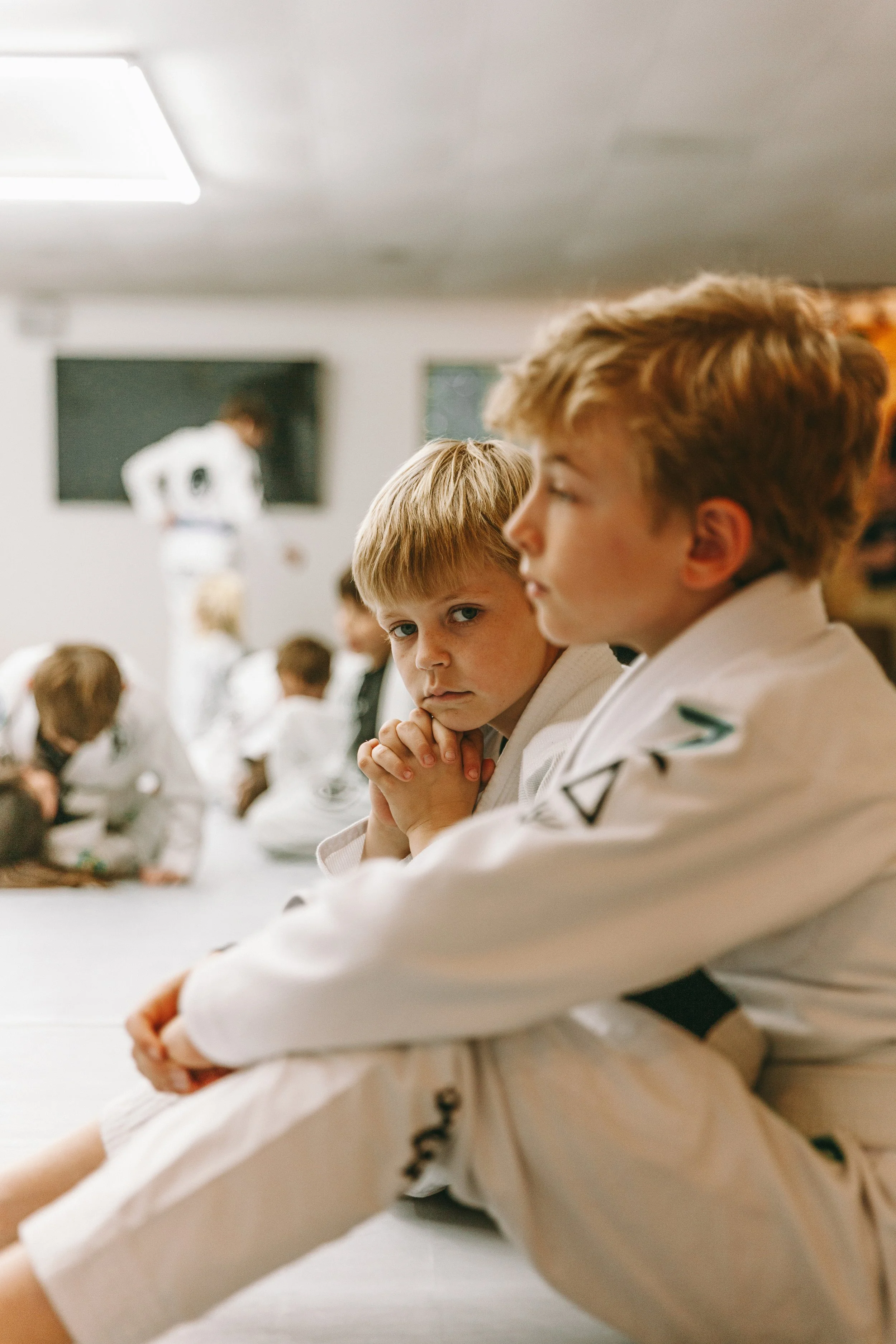
If you hang around a Kids Jiu Jitsu class long enough, you start to see the same story play out again and again.
The kid who looks like a natural in the first few weeks isn’t always the one still leading a year from now. And the child who struggles early, who feels “behind,” often ends up being the one who suddenly takes off later.
Most of the time, it isn’t because one kid is tougher or more athletic. It’s because one kid stayed consistent long enough for the work to turn into skill.
At Houzn Jiu Jitsu Academy, we see this across every age group. The kids who make real progress aren’t usually the most “motivated” kids. They’re the kids who simply keep showing up, even when their energy is low, even when they had a rough day at school, even when they’re in a phase where they’d rather be doing something else.
Consistency is not exciting, but it’s powerful. And for kids, it’s one of the healthiest lessons they can learn.
Consistency doesn’t mean training every day. It means having a simple routine that your child can follow for long enough that their body and brain can actually absorb what they’re learning.
Jiu Jitsu is not like memorizing spelling words. Your child isn’t just collecting information. They’re building a physical language. That language takes time, and it takes repetition.
Every time your child drills a movement, they’re not just “doing it again.” They’re building timing. They’re building balance. They’re learning where their weight goes. They’re learning how to breathe when someone is pressing into them. They’re learning how to stay calm when something feels uncomfortable.
That’s why consistent training works. It gives them enough reps for the movement to become natural, and it gives them enough different looks that they can adapt instead of freezing.
In Kids Jiu Jitsu, real skill is built through repetition, but also through variety. Your child needs exposure to different partners, different sizes, different energy levels. One day they’re working with a gentle partner and they can focus on the details. Another day they’re with someone stronger and they have to solve a different problem. Both are useful. That range of experiences is what turns a technique into a skill they can actually use.
Coaching feedback matters too, but feedback only sticks when a child comes back often enough to apply it. If a kid hears “keep your elbows in” once every two weeks, it’s hard for that to become a habit. If they hear it twice a week and they get corrected in the moment, that habit forms much faster.
There’s also a coordination piece that a lot of people underestimate. Kids are still learning how to control their own bodies. Some children have that coordination early. Some get it later. Neither one tells you much about where they’ll be in a year. Consistent training gives the body time to organize itself. It’s like watching handwriting improve over a school year. At first it’s messy. Then one day you realize it’s readable. Jiu Jitsu is similar. You’re not just learning moves, you’re learning control.
Confidence works the same way. Confidence under pressure isn’t something you can talk a child into. It’s something they earn through experience. They learn, slowly, that they can handle a bad position, that they can stay safe, that they can keep thinking while their heart rate goes up. That kind of confidence is quiet and real. It comes from training consistently enough that pressure stops feeling like panic.
This is why we tell parents not to judge progress week to week. Week to week, Jiu Jitsu looks messy. Month to month, it starts to make sense. And over six months or a year, you often see a completely different child on the mat.
When parents say, “My child is progressing slowly,” what they usually mean is, “I expected it to look smoother by now.”
But slow progress is often exactly what healthy progress looks like.
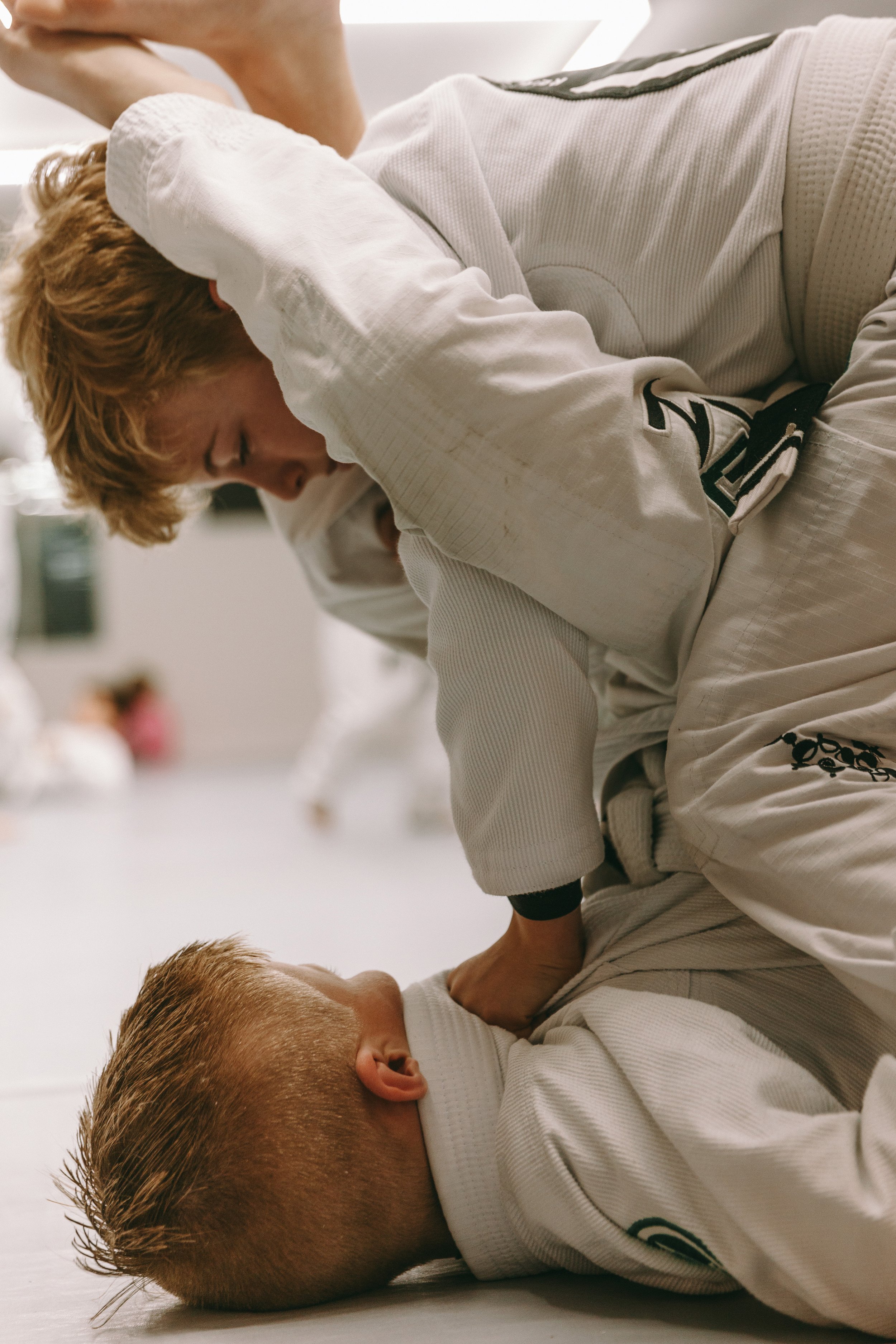
Sometimes “slow” means your child is learning foundational movement. They’re learning how to shrimp, how to bridge, how to base out, how to fall safely, how to get back up. Those fundamentals don’t look flashy, but they’re the root system. If the root system is weak, everything else breaks later.
Sometimes “slow” means they’re building balance and timing. Timing is not something you can force. It’s learned through thousands of little exchanges. Your child has to feel what happens when they move too early, too late, too hard, too soft. They have to learn the rhythm of another person. That takes time.
Sometimes “slow” means they’re transitioning from copying to understanding. In the beginning, most kids can mimic what the coach does. They can “perform” a technique in the air or with a compliant partner. The next stage is harder: they have to understand why the move works and when to use it. That stage often looks like a plateau because the child is thinking more. They’re not just moving. They’re processing.
That’s not failure. That’s development.
It also helps to understand that progress in Kids' Jiu Jitsu is not always linear. A child can look amazing for a few weeks and then look like they forgot everything. That doesn’t mean they lost skill. It usually means they’re being challenged in a new way. Maybe the partners changed. Maybe they moved up an age group. Maybe the coach started holding them to a higher standard. Maybe they’re growing fast and their coordination is temporarily off. Growth spurts can make kids look clumsy for a while. Then the body catches up.
The important thing is to keep the routine steady through those phases. That’s where parents make the biggest difference.
Parents don’t need to push. They need to support the routine.
In our experience, the best thing you can do is keep class days consistent. Same days each week. Predictable schedule. Kids do well with structure, and it reduces the daily negotiation. When training is “just what we do on Tuesdays and Thursdays,” it becomes normal, like brushing teeth.
Packing gear the night before sounds small, but it’s a big deal. A rushed, stressful exit can turn a child against class before they even get to the academy. When the bag is ready, the car ride is calmer, and the child arrives more open.
The way you talk about training matters too. Kids pick up quickly on what adults reward. If the only praise they get is for winning rounds or tapping someone, they start to chase outcomes. That creates anxiety and can make them want to quit when things get hard.
If you celebrate effort and consistency, you teach something more durable. You teach them that showing up counts, that trying counts, that being coachable counts. Those are the kids who stay in the sport long enough to become skilled.
One simple shift that helps is to ask better questions after class. Instead of “Did you win?” try “What did you work on today?” or “What was one hard thing you handled?” This keeps their attention on learning, not on comparison.
Another helpful piece is to let the coaches coach. If your child hears one set of instructions from the mat and another from the sidelines, they get confused. It’s also hard for a child to relax and learn if they feel like they’re being evaluated every second. Jiu Jitsu is a long game. The best growth happens when kids feel safe to make mistakes.
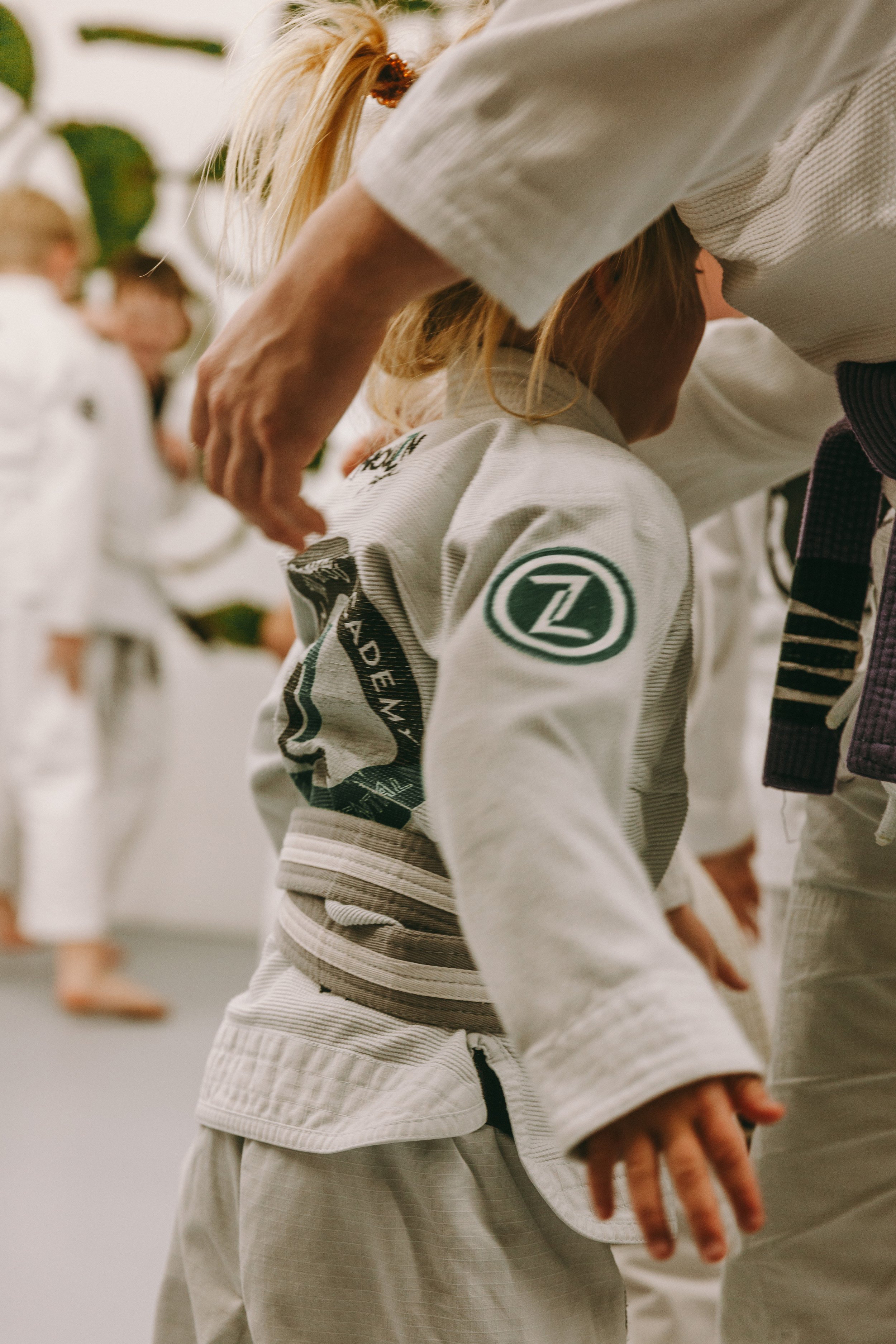
And yes, sometimes kids go through a dip in motivation. That’s normal. Adults do too. The goal isn’t to have a child who feels excited for every single class. The goal is to build the habit of following through even when they don’t feel like it. That’s a life skill, and Jiu Jitsu is one of the best places to learn it in a healthy way.
That said, there’s a difference between “not in the mood” and “something is wrong.” If your child is consistently anxious, dreading class, or talking about specific fears, that’s worth a conversation with the coach. Often it’s something simple that can be adjusted: pairing, intensity, expectations, or even just a confidence-building plan for a few weeks.
Training frequency is another place where parents sometimes feel unsure. More is not always better, especially for younger kids. The right schedule depends on age, temperament, school load, and your family’s bandwidth. A consistent two days a week can beat a random five days one week and none the next. Consistency wins.
If you’re unsure what a realistic training frequency is for your child’s age and goals, grab your kids coach after class or ask for a conference with the coach. We’ll recommend a simple plan you can actually stick to, and we’ll adjust it as your child grows.
If you want a practical next step as a parent, pick two class days you can realistically hold for the next eight weeks, set them on the calendar, and treat them like a standing appointment. Then after class this week, ask your child what they’re most proud of from today’s training, even if it’s something small. That small routine, repeated, is how momentum starts.
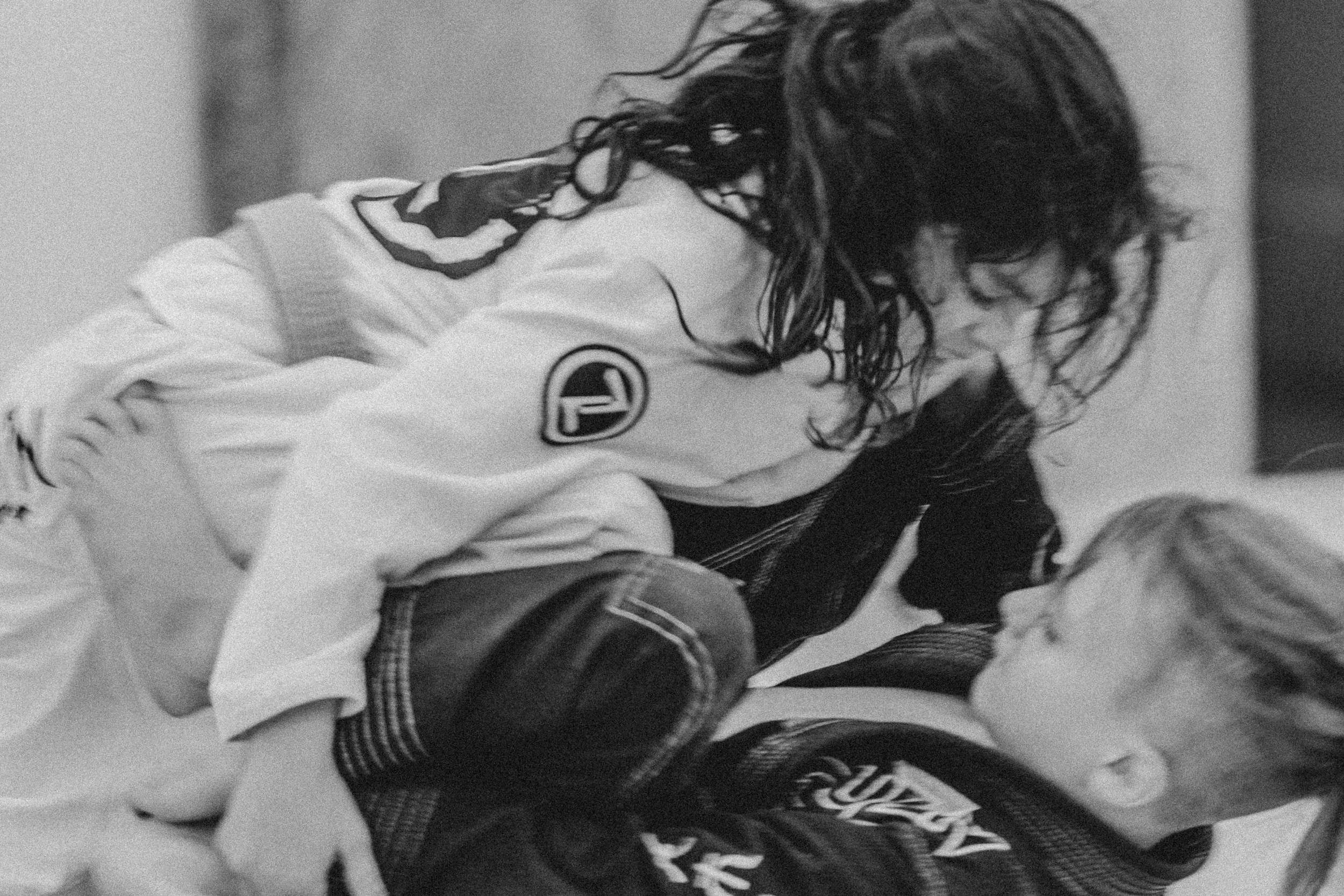
Kids Jiu Jitsu and Bullying: What Parents Need to Know
Parents want their child to be safe and confident around bullying—but they don’t want to create aggression. Kids Jiu Jitsu can help by building calm confidence, clear boundaries, and basic safety skills. This post from Houzn Jiu Jitsu Academy in Mount Pleasant, SC (serving Charleston families) explains what Brazilian Jiu Jitsu for kids does (and does not) teach about bullying, why “voice and exit” comes first, and how to talk to your child about conflict in a way that supports safety and responsibility.
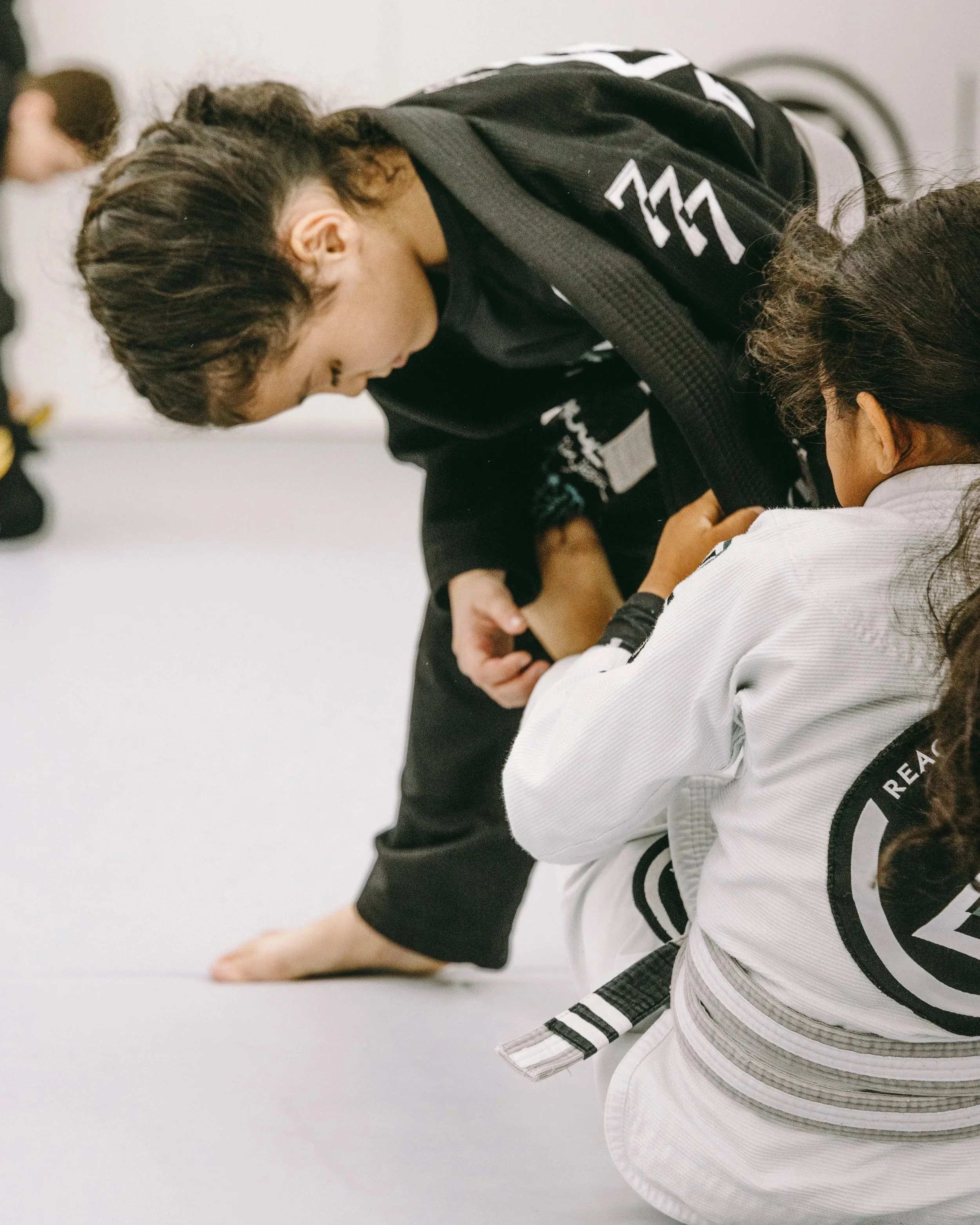
Bullying is emotional, social, and sometimes physical, and parents are right to take it seriously. Most of the time, what families want isn’t a tougher kid. They want a child who feels safe walking into school and knows what to do when someone starts testing them. They want their kid to stop dreading lunch, recess, the bus line, or that one stretch of hallway where things keep happening.
We’ve also learned that when parents start searching for “kids self-defense” or “kids jiu jitsu near me,” they’re usually not chasing a trend. They’re looking for a plan. And they’re looking for adults who will take the problem seriously without turning their child into someone they don’t recognize.
The phrase “self-defense” can get messy, especially when people treat it like a simple message: “hit back.” That’s not what we teach, and it’s also not realistic for how school situations actually unfold. Kids live in a world of rules, teachers, cameras, zero-tolerance policies, and social dynamics that can flip the story fast. What they need is a response that protects them, keeps them as safe as possible, and helps them make decisions they can live with afterward.
At Houzn Jiu Jitsu Academy in Mount Pleasant, we focus on bully-resistance. That means building the skills and habits that reduce the chance of being targeted, and improving your child’s response if something does happen. It’s not about turning kids into aggressors. It’s about helping them carry themselves with calm confidence and make good decisions under stress. We want them to have a backbone and a conscience at the same time.
The rule in our kids program is simple: you don’t start it. You try your voice, you create space, you get to an adult. But if someone touches you or won’t let you leave, you have a God-given right to defend yourself. We teach Jiu Jitsu so they can protect themselves, get free, and get to safety without losing control.
That last part matters. “Defend yourself” doesn’t mean “lose your mind.” It doesn’t mean payback. It doesn’t mean chasing someone down after the fact. It means protecting your body and getting away. When kids have that definition in their head, they’re far less likely to freeze, and they’re also far less likely to overreact.
A lot of bullying starts well before anyone throws a punch. Most of it is probing. It’s a kid seeing who they can move, embarrass, control, or isolate. That’s why we start with posture and presence. Kids who look unsure, who fold their shoulders, who avoid eye contact, or who seem isolated are often easier to target. We help kids stand taller, move with purpose, and feel comfortable taking up their space. Not to look “tough,” but to look confident and aware. When a child looks like they belong, many problems fade before they begin.
Presence isn’t an act. It’s a trained skill. When a child can keep their balance, step back without tripping, and move away safely without panicking, they come across as capable. That doesn’t guarantee no one will bother them, but it often discourages the kid who’s looking for an easy target.
The next piece is voice. We practice using clear, direct words that a child can actually remember when they’re nervous. “Stop.” “Back up.” “Don’t touch me.” “Leave me alone.” The goal is not to trade insults or prove who’s tougher. The goal is to set a boundary in a way that’s easy for adults nearby to understand. A steady voice also helps your child stay out of the emotional spiral that bullies often try to create.
Most kids don’t struggle because they don’t know what they should say. They struggle because their body floods with adrenaline and their brain goes blank. That’s why we practice. The same way we drill a technical stand-up until it’s automatic, we want the first few seconds of a bullying situation to be automatic too. Clear voice. Strong posture. Move to safety.
Awareness is part of bully-resistance as well. Kids don’t need to be paranoid, but they do need to be smart about position and environment. We encourage them to stay near groups, avoid being isolated, and move toward safe spaces when something feels off. If a child is being bothered, the best time to make a safer choice is early, before things escalate.
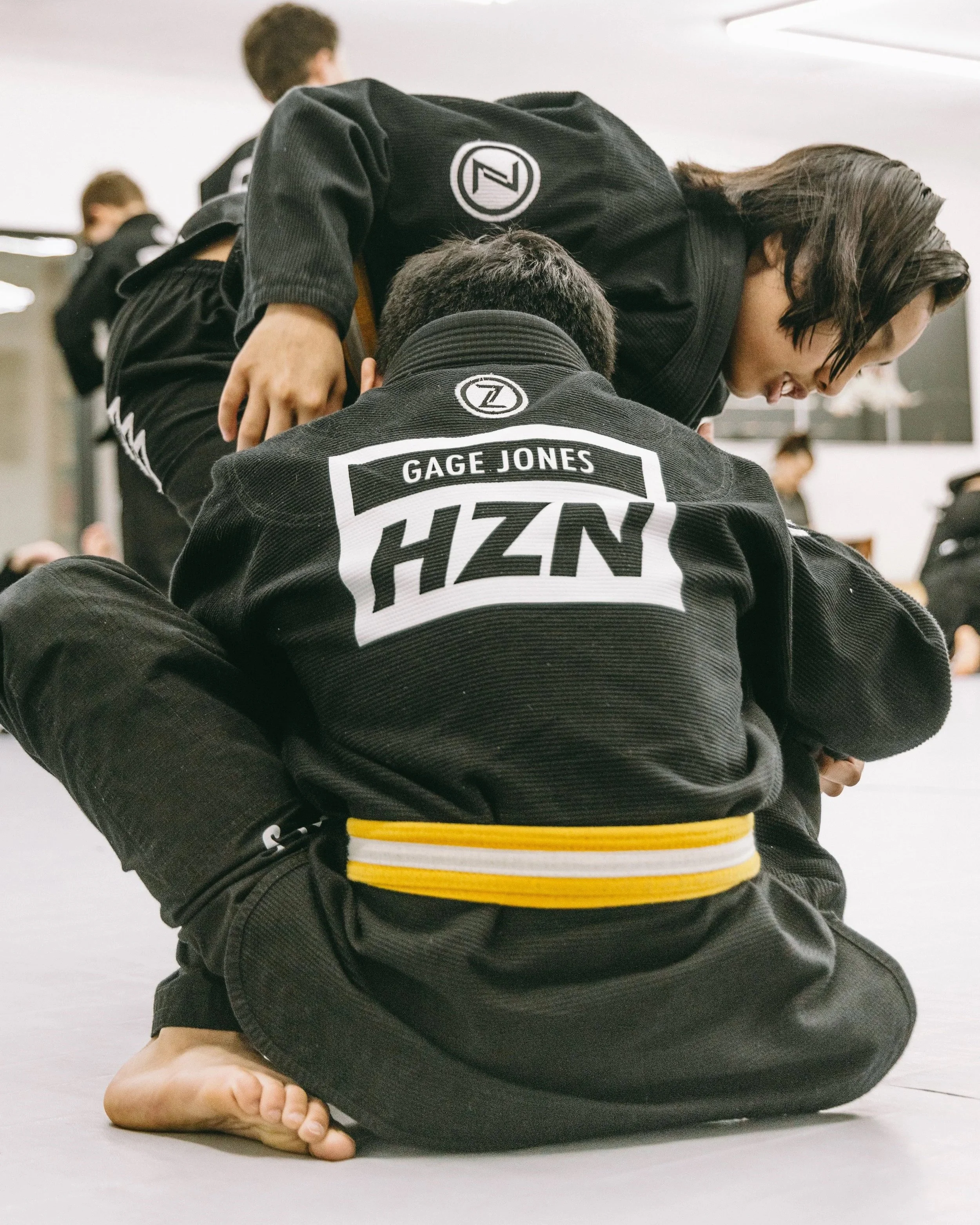
This is one of the biggest differences between movies and real life. In real life, the “fight” often begins with positioning. Who is near you? Where are the exits? Are you getting steered toward a corner? Is someone blocking your path? In Jiu Jitsu, we call this understanding space and pressure. When kids learn that on the mats, they start noticing it off the mats too.
Boundaries are where verbal skills meet physical reality. Sometimes bullying looks like “joking,” but it includes grabbing a backpack, pulling a hoodie, poking, blocking someone from walking away, or putting a hand on a shoulder to steer them. We teach kids that unwanted contact is a real line. They should use their voice, create distance, and get help. If someone keeps touching them or stops them from leaving, that’s when self-defense becomes relevant.
This is also where parents appreciate a straightforward philosophy. You don’t need your child to be confused about whether they’re allowed to protect themselves. At the same time, you don’t want them using force for social problems that require adult intervention. The line we teach is simple: words first, distance second, adults early, and physical defense only when someone is putting hands on you or trapping you.
Jiu Jitsu is uniquely helpful here because it teaches control, balance, and escapes. Instead of relying on anger or wild swings, kids learn how to break grips, regain their base, and create space. The goal isn’t to “win a fight.” The goal is to get free, get away, and get to an adult. That mindset keeps kids safer physically and legally, and it fits the reality of most school environments.
In a typical kids class, we might work on how to deal with a wrist grab, how to pull your arm back without yanking against the strongest part of the grip, how to turn your body so you’re not being dragged, and how to get your feet under you. We teach them to protect their head if they fall and to stand back up without giving someone an easy chance to jump on them. Those are boring-sounding skills until you’ve seen a child use them to avoid being controlled.
People sometimes ask why we don’t just teach striking for bullying. The answer is simple: striking is harder to control under stress, and it escalates quickly. Grappling gives kids more options to create space, break contact, and get out. It’s also easier to teach the difference between necessary force and excessive force. Jiu Jitsu has built-in brakes if it’s taught the right way.
That brings us to restraint, which is a core part of our culture. Tapping culture teaches kids to stop the moment a partner signals. Partner training teaches respect. Coached rounds teach kids how to stay calm under pressure and solve problems without panicking. Over time, kids learn they can handle a tough moment without needing to be mean.
When kids train, they learn something that’s hard to teach with words: power is a responsibility. If you can control someone, you don’t need to hurt them to prove a point. That idea alone prevents a lot of bad decisions. We want kids who are confident, not reckless. Capable, not cruel.
Jiu Jitsu also helps with the emotional side of bullying, because bullying isn’t just about bruises. It’s about nervous systems. It’s about kids who live on edge waiting for the next comment, the next shove, the next group laugh. Training gives them a place where pressure is normal and manageable. They get used to being uncomfortable and staying calm. That’s a life skill, not just a martial arts skill.
It’s also why we care so much about the room culture. A kids program can’t be chaos. It has to be structured and supervised. It has to teach respect in a way kids can feel, not just repeat. Our mission is bigger than technique. We’re building a community based on morality, truth, and personal responsibility. That shows up in how we correct behavior, how we pair kids up, and how we talk about what Jiu Jitsu is for.
Now, a practical note for parents: not every hard moment at school is “bullying.” Kids argue. Friendships shift. Someone says something rude. Those moments still matter, but they often require social coaching, not self-defense. Bullying is usually repeated behavior, a power imbalance, and a pattern that makes your child feel trapped. If you’re unsure which one you’re dealing with, start by listening for patterns. Is it the same kid? Same group? Same setting? Same time of day? Is your child changing their behavior to avoid it?
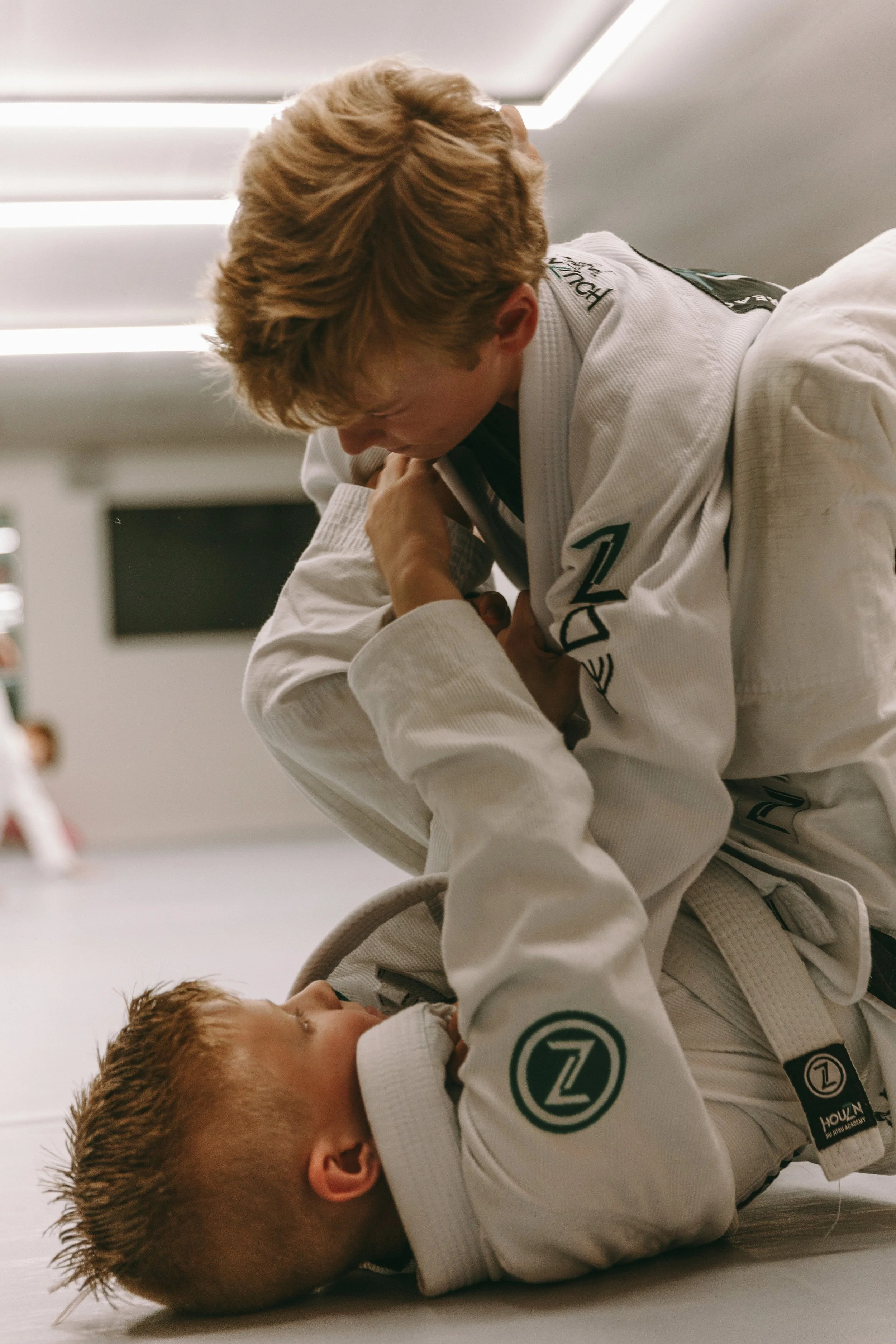
When you talk to your child, keep it simple and repeatable. Ask questions that help them think in order, not in emotion. “What did you say?” “Did you try to leave?” “Where was the teacher?” “Did they touch you?” “Did they block you?” Those details matter. They also help you communicate clearly with the school.
A good basic plan is: use your voice, leave and get to safety, tell a trusted adult. And if someone grabs you or won’t let you leave, get free and get away. The order matters. We want your child’s default setting to be prevention and exit, not escalation. But we also want them to know, deep down, that if someone puts hands on them, they’re allowed to protect themselves.
If your child is shy or freezes, practice is everything. Practice saying “Stop” out loud at home. Practice turning and walking toward an adult. Practice not explaining or debating. Bullies often want a conversation because a conversation gives them control. Your child doesn’t owe them that. They owe themselves safety.
If your child is reactive, the practice looks a little different. You’re working on a pause. A breath. A first step that isn’t a swing. That’s where Jiu Jitsu helps because it gives them a place to feel intensity and still choose control. We coach that explicitly. We praise restraint. We correct ego. We reward discipline.
Some parents also worry about school consequences. That’s real. Every school handles things differently, and no blog post can promise a perfect outcome. What we can do is teach your child responses that are easier to justify: clear verbal warnings, visible attempts to leave, and defensive actions that create space rather than cause damage. We can also help you build the language your child can use with a teacher afterward: “I told him to stop. I tried to leave. He grabbed me. I got free and went to you.” Simple. Honest. Clean.
If you’re local to Mount Pleasant and you’re reading this because bullying is on your mind, you’re not alone. We’ve had families come in with quiet concerns and families come in after serious incidents. In both cases, the path forward looks similar: train the body, train the mind, and train the decision-making.
If you want a clear script that fits your child’s age and personality, grab your kids coach after class or ask for a conference. We’ll keep it practical, responsible, and aligned with what you want for your child: confidence, safety, and self-control. We’ll also tell you the truth about what we’re seeing on the mats, because that matters too. Sometimes a child needs more assertiveness. Sometimes they need more restraint. Sometimes they need better friends and more adult support. We’ll help you sort it out.
Jiu Jitsu won’t fix every social problem. But it can change how your child walks through the world. It can make them harder to intimidate, calmer under pressure, and more capable of protecting themselves if someone crosses the line. That’s bully-resistance, and it’s one of the most valuable things we teach.
Kids Jiu Jitsu and Emotional Regulation: Calm Under Pressure
Calm isn’t just temperament—it’s a trained skill. In Kids Jiu Jitsu, children learn to regulate their emotions and body under pressure by breathing, staying safe, and solving problems one step at a time. This post from Houzn Jiu Jitsu Academy in Mount Pleasant, SC (serving Charleston families) explains how Brazilian Jiu Jitsu for kids builds self-control, why “panic” is a normal first reaction, and how parents can support the same calm-down habits at home.
A calm child isn’t a child who never feels upset. A calm child is a child who can feel upset and still make a good decision.
That’s self-regulation, and it can be trained.
A lot of parents come to us after class with the same concern, even if they say it in different ways. “My kid gets overwhelmed.” “He shuts down the second it gets hard.” “She melts down when she makes a mistake.” “Transitions are a battle.” Sometimes there’s anxiety in the mix. Sometimes it’s big emotions and a strong personality. Sometimes it’s just a nervous system that runs hot.
The good news is that self-regulation isn’t a personality trait you either have or you don’t. It’s a skill. And Brazilian Jiu Jitsu is one of the most natural places to practice that skill, because it trains the mind and the body at the same time.
In kids class, we’re not trying to create emotionless little robots. We’re helping kids build a steady center. We’re teaching them how to notice what they’re feeling, stay safe, and still move forward one good decision at a time.
Jiu Jitsu teaches regulation naturally because it gives kids a healthy dose of pressure in a controlled environment. In real life, stress doesn’t ask permission. It just shows up. A kid gets corrected by a teacher. A friend says something mean. They lose a game. They spill a drink. Their little brother touches their stuff. The nervous system spikes, and if they don’t have tools, the reaction takes over.
On the mats, we can simulate that same spike in a way that’s supervised, age-appropriate, and repeatable. A child gets held down for a second. They lose their balance. They get stuck. They make a mistake in front of others. They feel the frustration of not being able to force the outcome. That’s stress. But it’s “manageable stress.” It’s not trauma. It’s not chaos. It’s a training dose.
And here’s what kids learn very quickly when you repeat that experience with good coaching: panic wastes energy.
When a child panics, they hold their breath, their shoulders rise, their arms push with no plan, their eyes widen, and they burn through their gas tank. When a child stays calm, they breathe, they find posture, and they look for a simple next action. The outcome changes, not because they suddenly got stronger, but because they stayed present.
That’s self-regulation in plain language.
One of the most important things Jiu Jitsu teaches is that you can be uncomfortable and still be safe. You can be upset and still be respectful. You can be losing and still be thinking. You can feel pressure and still make a choice.
That’s a big deal for kids, especially the ones who feel everything intensely.
Now, I want to be clear about something. Regulation doesn’t mean your child will never cry, never get angry, or never have a tough day. Kids are kids. Their brains are still developing. What changes over time is the recovery. The bounce-back. The ability to come back to baseline sooner and make a better decision on the next moment.
That’s what we’re after.
This is also why we coach kids through structure and clear cues. When a child is stressed, their brain doesn’t want a lecture. In a high emotional state, the thinking part of the brain gets quieter and the survival part gets louder. That’s true for adults too. So we don’t try to overwhelm them with ten options. We give them one step.
In Jiu Jitsu, the “one step” mindset shows up constantly. “Make frames.” “Get to your side.” “Find space.” “Reset your base.” Those cues sound technical, but they’re also emotional anchors. They narrow focus. They stop the spiral.
If a kid is stuck under someone and their brain starts telling them, “I can’t breathe,” “I’m losing,” “Everyone is watching,” “This is embarrassing,” they can go down fast. But when a coach calmly says, “Frames first,” that child has a job. A single job. The brain goes from panic mode to problem-solving mode.
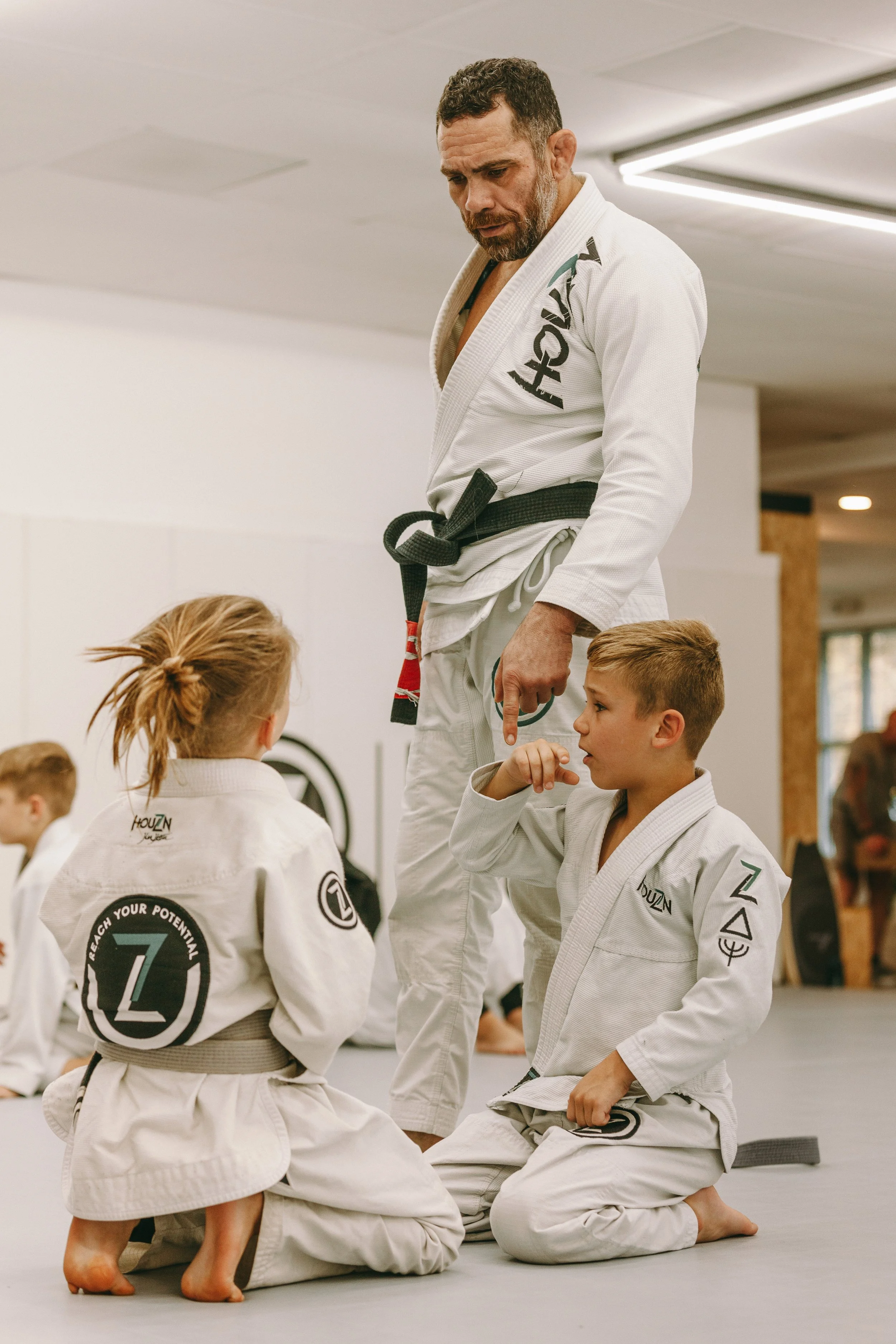
Even better, Jiu Jitsu rewards small wins. A kid might not escape right away, but they can get to their side. They can make space. They can recover guard. They can stand back up. Each step is progress, and their nervous system learns, “I can handle this in pieces.”
That’s how resilience is built. Not with speeches, but with reps.
Another thing Jiu Jitsu does well is teach kids to use their body to regulate their mind. Adults talk about breathing, posture, and “grounding.” Kids don’t always have language for that, but they can feel it. When we teach a child to exhale, relax their shoulders, and build a strong base, we’re giving them a physical switch that calms the system down. Over time, they learn what calm feels like in their own body, not just what it sounds like in someone else’s advice.
This is also why the culture matters. In a good Kids Program, the room is not run by intimidation. It’s run by standards and safety. Kids don’t learn regulation by being yelled into compliance. They learn regulation by being coached with consistency, boundaries, and respect.
At Houzn, we want kids to feel safe enough to try, fail, and try again. That’s not “soft.” That’s how real growth happens. A child who is terrified of being embarrassed will choose avoidance. A child who knows they can mess up and still be supported will choose effort.
And effort is where confidence comes from.
Parents usually start noticing changes at home in small, practical ways before they see anything dramatic. You might see fewer meltdowns, or meltdowns that don’t last as long. You might see smoother transitions, like getting out the door or moving from play time to homework. You might notice your child recovers faster after being corrected. Instead of “I hate you” or “I’m never doing this again,” you may hear a sigh, a pause, and then they keep going.
Some parents tell me their child is more willing to attempt homework or chores after a mistake. That matters, because a lot of “behavior issues” are really frustration tolerance issues. When a child believes mistakes are dangerous, they avoid the task. When a child learns mistakes are information, they stay in it longer.
You might also notice more emotional vocabulary. Not because we’re doing therapy on the mats, but because Jiu Jitsu gives kids real experiences to name. “I felt nervous.” “I got frustrated.” “I wanted to quit, but I didn’t.” That’s powerful. When a child can name the feeling, the feeling has less control.
Another shift you may see is better sibling conflict. Not perfect, but better. Jiu Jitsu teaches children that physical impulse has consequences, and it also teaches them options. They don’t have to go from zero to one hundred. They can pause. They can step back. They can ask for help. They can choose the next right move. Again, not every time. But more often.
So how can you support this at home without turning your living room into a dojo?
The simplest way is to borrow the same concept we use on the mats: one step.
When your child is overwhelmed, it’s tempting to give them the whole solution. “Calm down, it’s not a big deal, just do your homework, you’re fine.” Most kids can’t use that in the moment. It’s too broad. It can feel dismissive even when you mean well.
Instead, bring them back to the body and give them one doable action. You can say, “Take one step.” You can say, “Reset your posture.” You can say, “Let’s breathe once and try again.” You’re not negotiating the standard. You’re coaching the nervous system.
You can also mirror the way we correct in class. In Kids Jiu Jitsu, we try to correct without shame. We separate who the child is from what the child did. At home, that can sound like, “That choice wasn’t okay. Let’s reset and choose again.” The message is firm, but it leaves a door open. Kids who struggle with big reactions often carry a lot of internal shame already. They don’t need more labels. They need tools and consistency.
It helps to praise the process, not just the outcome. If your child was upset but they took a breath before responding, that’s a win worth naming. “I saw you pause. That was strong.” If they wanted to quit but stayed with the task for two more minutes, that’s a win. Regulation is built in inches.
And if you want one practical thing to watch for, watch the recovery time. That’s the scoreboard. A child who can return to baseline faster is building the skill, even if they still have big feelings.
There’s also a pacing piece that matters. Not every child needs the same training intensity. Some kids need to be challenged more so they don’t check out. Some need a slower ramp so they don’t panic and avoid. A good coach will see that and adjust, because the goal is not to “toughen them up” at all costs. The goal is to build them up so they become capable and steady over time.
That’s why I always invite parents to talk to us, especially if your child struggles with anxiety, overwhelm, or big reactions. The best plan is usually simple. We might choose one focus for a few weeks, like breathing under pressure, learning how to safely say “tap,” or practicing a basic escape sequence with extra reassurance. We might pair them with the right training partners. We might slow down the rounds. We might add structure. Those small decisions make a huge difference.
If your child struggles with anxiety, overwhelm, or big reactions, grab your kids coach after class or ask for a conference with the coach. We can help choose a simple focus and the right training pace. We’re not here to push kids through fear. We’re here to guide them through growth, with safety, respect, and standards that make them stronger for life.
Brazilian Jiu Jitsu for Kids: Handling Failure and Frustration the Right Way
Resilience isn’t built by always winning—it’s built by learning how to lose well and try again. In Kids Jiu Jitsu, children practice “tap, reset, and learn,” which teaches emotional control, safety, and persistence. This post from Houzn Jiu Jitsu Academy in Mount Pleasant, SC (serving Charleston families) explains why failure is part of training, how coaches help kids handle frustration, and what parents can watch for at home as their child learns calm recovery after setbacks.
Most kids don’t need more success. They need a healthier relationship with struggle.
As a parent, it’s hard to watch your child get frustrated. You want them to feel confident. You want them to enjoy what they’re doing. You want them to “win” often enough that they stay motivated.
But confidence that only shows up when things go well is fragile. Real confidence is what stays when your child is tired, confused, or behind. That’s the kind that transfers to school, friendships, and stressful moments at home. And that’s why Brazilian Jiu Jitsu can be such a powerful tool for kids.
Kids Jiu Jitsu creates controlled, coached “micro-failures” every class. That sounds negative, but it’s one of the best parts of training. In a good kids program, your child meets a challenge that’s just hard enough to stretch them, but safe enough to learn from. They make a mistake. They get stuck. They tap. They reset. Then they try again with a little more awareness than they had thirty seconds ago.
That cycle is the work. That cycle is the win.
It’s also the opposite of what a lot of kids experience today. Many environments are built to protect kids from discomfort, and I understand why. The world can be loud and fast and judgmental. But if a child never practices staying steady in discomfort, they don’t build the skill of recovery. Then a tough teacher, a hard test, a social conflict, or a bad sports game can feel like a personal crisis.
In Jiu Jitsu, struggle is normal. We don’t treat it like an emergency. We treat it like a training partner.
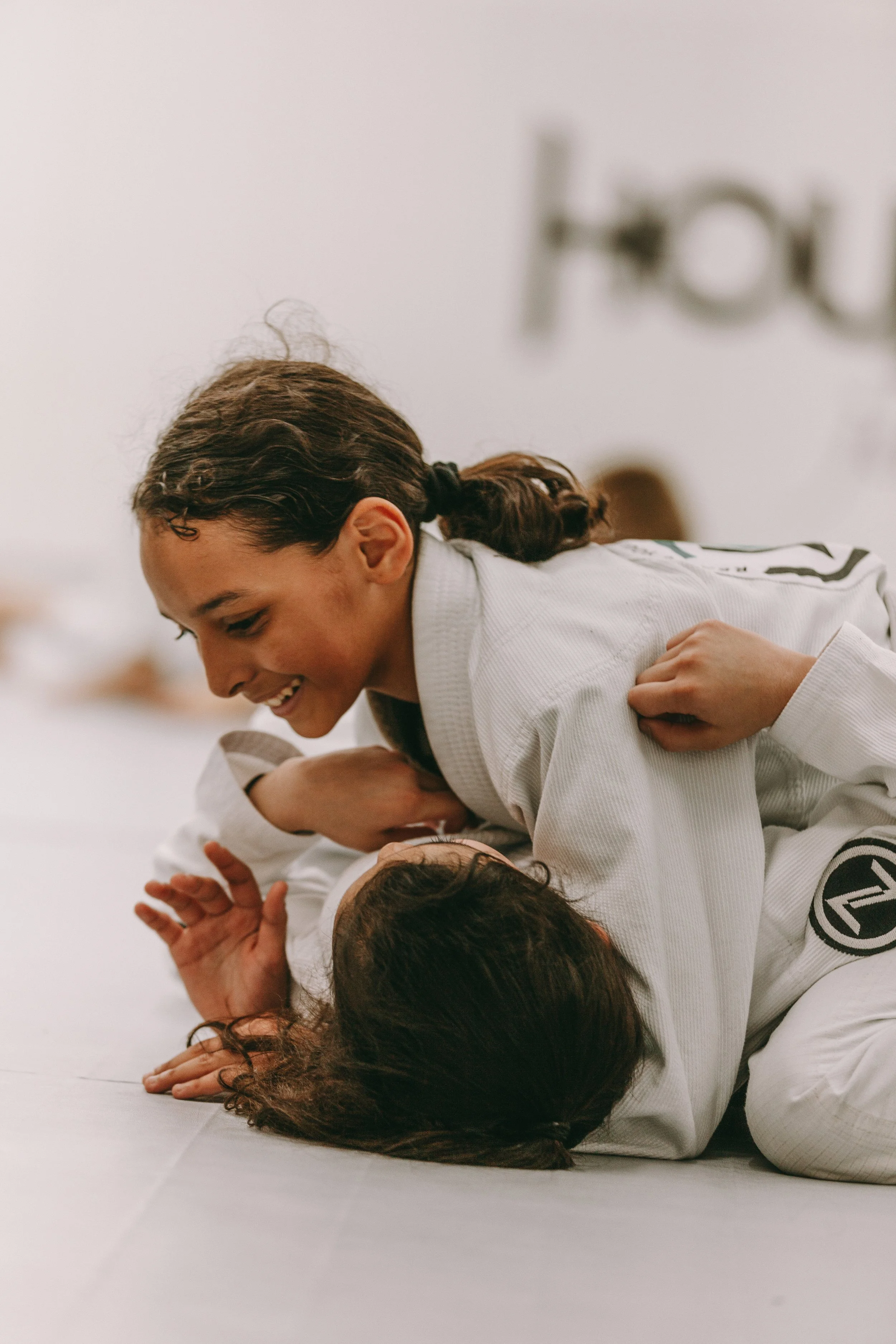
Why kids struggle with losing
Losing can hit kids in a few different places, and it often comes out fast. One moment they’re fine, and the next moment they’re overwhelmed.
Embarrassment shows up when a child thinks everyone saw them mess up, or when they compare themselves to a teammate who seems to “get it” faster. Fear shows up when they decide, in their own mind, that the struggle means they’re not good at this. Anger shows up when they feel a situation is unfair, or when they’re tired and their body is doing something it can’t quite control yet. Avoidance shows up when their brain starts connecting the activity with discomfort, and the simplest solution becomes quitting.
Those reactions are normal. They’re not character flaws. They’re nervous system reactions, and kids don’t always have the words to explain what’s happening inside them. What they do have is behavior, and behavior is communication.
The goal isn’t to eliminate emotion. The goal is to teach recovery.
Recovery means your child can feel something real, and still move forward. It means they can take feedback without collapsing into shame. It means they can have a hard moment and not turn it into a hard identity.
In our kids' classes, we don’t treat losing as a personal label. We treat it as information. If something doesn't work, we get curious. We adjust one piece. Then we try again.
The Jiu Jitsu “reset” is a life skill
Jiu Jitsu has a built-in mechanism that most sports don’t have: the tap.
In Jiu Jitsu, tapping is not a failure. It’s a safety signal and a learning moment. It’s your child saying, “I’m done with this position,” and the other kid immediately stops. That is a big deal. It teaches boundaries in a physical, practical way. It teaches that communication works. It teaches that safety matters more than pride.
And here’s the part parents don’t always realize at first: tapping also gives kids permission to try hard without panic. They don’t need to “survive” a bad spot forever. They just need to stay calm long enough to learn what’s happening, then reset.
When kids tap, they learn, “I can be in a bad spot and stay calm.” They learn, “I can stop safely and restart.” They learn, “I can learn without blaming.” They learn, “I can improve through repetition.”
That’s resilience in action.
Over time, that resilience starts to look like emotional control. A child who used to melt down after getting pinned learns to breathe and listen. A child who used to get angry learns to pause and problem-solve. A child who used to avoid challenges learns that discomfort passes, and that they can handle it.
I’ve seen kids who were nervous to even step on the mat become the kid who helps a new student feel welcome. That doesn’t happen because we hype them up. It happens because they practiced recovery so many times that their confidence became earned.
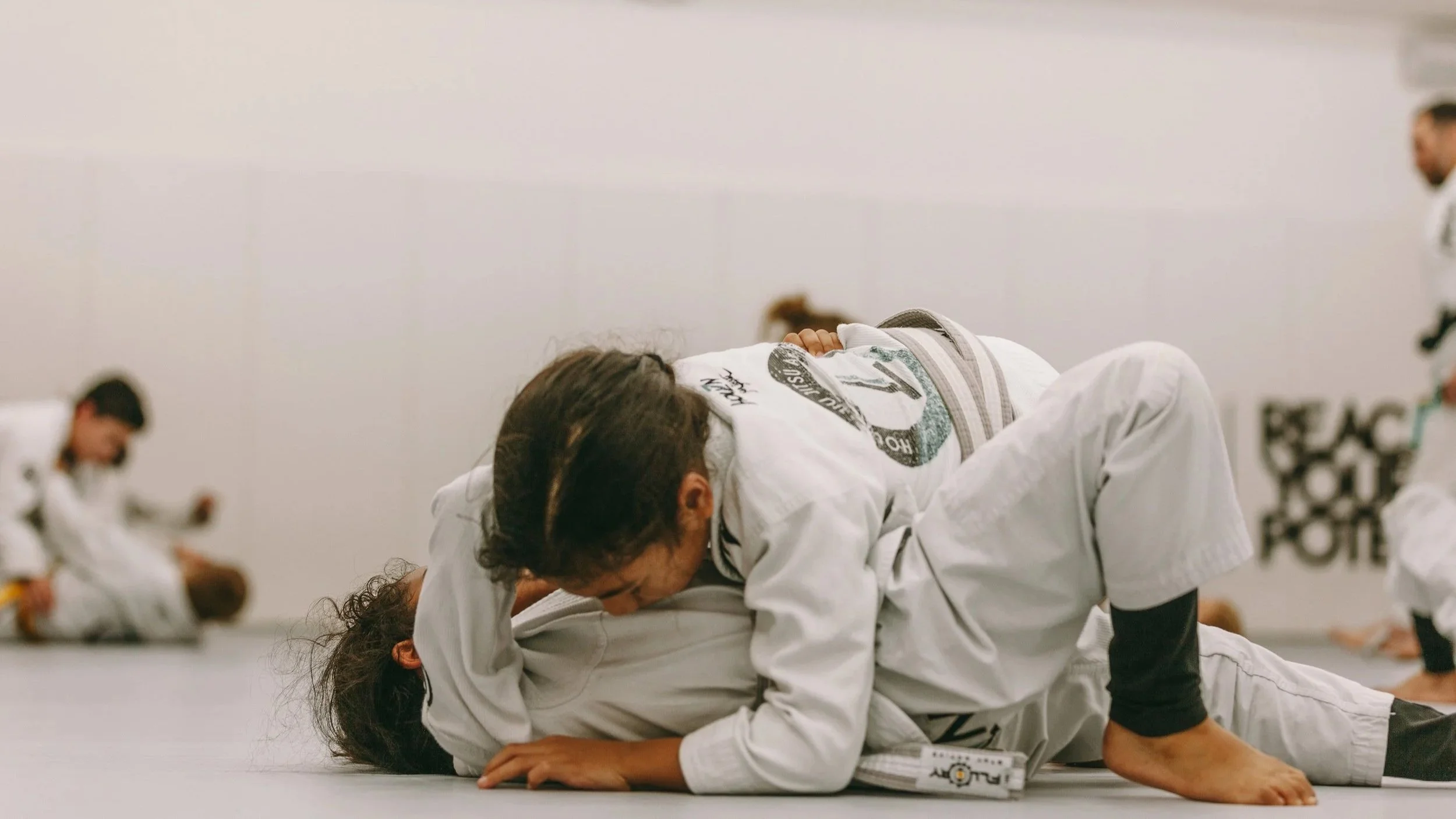
What “micro-failure” looks like in a kids class
Sometimes parents hear “micro-failure” and imagine we’re putting kids in harsh situations. That’s not what we mean. We’re not breaking kids down. We’re building them up with the right dose of challenge.
A micro-failure might be as simple as not being able to finish a movement yet. Maybe they can’t shrimp smoothly, or they forget which way to turn, or they lose balance during a technical stand-up. They try. It doesn’t work. We coach one correction. They try again. That’s a rep of patience.
It might be getting caught in a position during sparring. They feel pressure. They want to push away with straight arms and it doesn’t work. We teach them to frame, breathe, and turn. That’s a rep of composure.
It might be losing a grip fight, getting swept, or tapping to a simple submission that they didn’t recognize yet. That’s a rep of humility and learning.
The point is not the loss. The point is the reset. Jiu Jitsu gives kids a clear routine for what to do after things go wrong: pause, breathe, listen, adjust, and go again.
That routine is gold for kids, especially kids who struggle with frustration tolerance, anxiety, perfectionism, or impulse control.
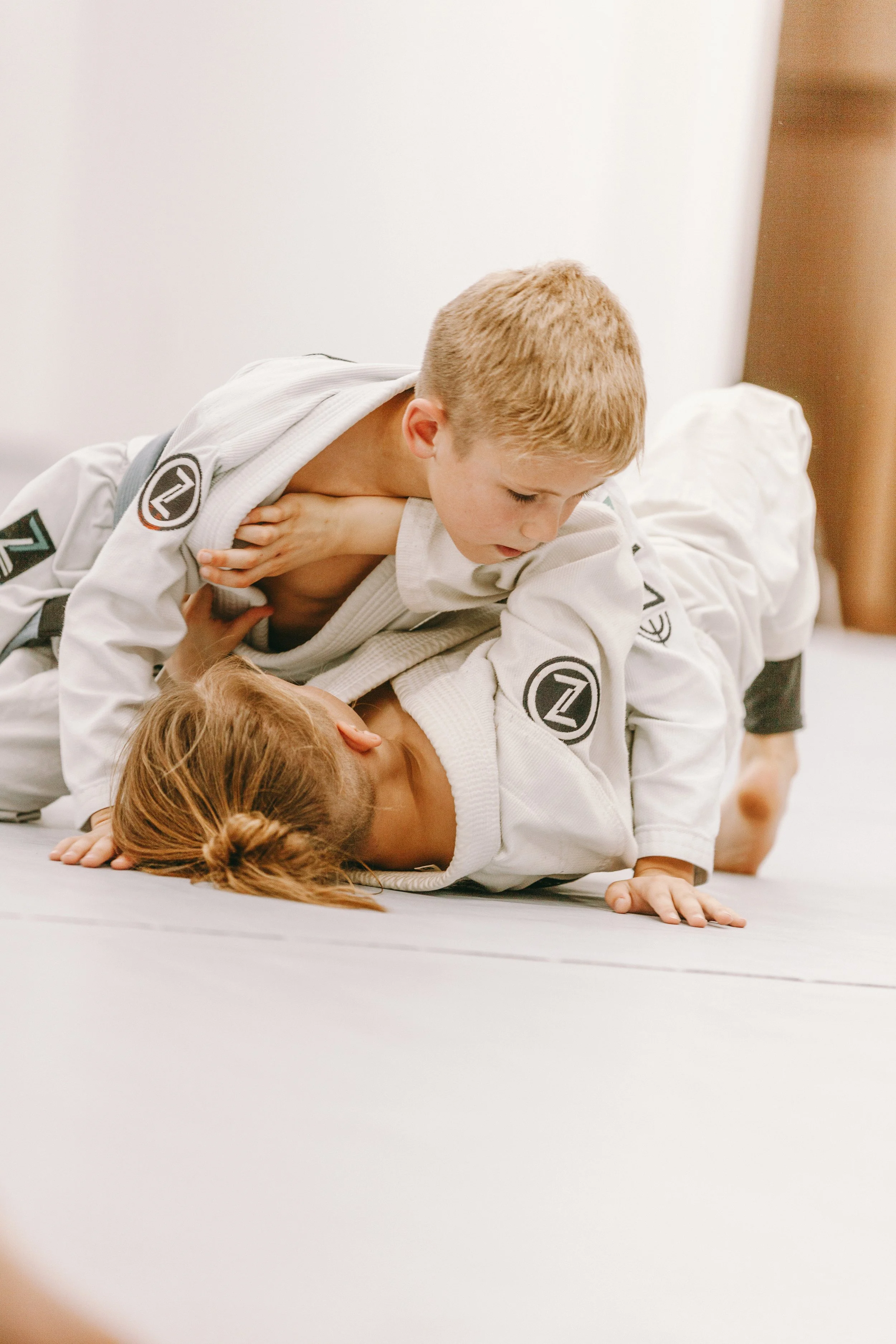
How coaches help kids build resilience
Coaching matters. A lot.
Kids don’t just learn techniques. They learn what struggle means by watching how adults respond to their struggle. If a coach treats mistakes like a problem, kids learn to fear mistakes. If a coach treats mistakes like part of training, kids learn to stay present.
In our Academy, we set expectations early that everyone struggles. That includes the tough kids, the athletic kids, the shy kids, the kids with big feelings, and the kids who seem “naturally good.” Everyone meets a wall at some point. That’s normal.
We also pay attention to what we praise. If we only praise winning, we teach kids to chase outcomes. If we praise effort, focus, and composure, we teach them to build character. I’d rather have a kid lose a round with calm breathing and a good attitude than win a round while panicking or acting disrespectfully. The first kid is learning something that will last.
We normalize mistakes by correcting them without drama. We keep instruction clear and age-appropriate. We match kids with partners who help them learn instead of overwhelming them. We adjust intensity based on maturity and experience, not ego.
And we teach simple tools that kids can actually use: breathe, relax your shoulders, look for one step, not ten. When a child is overwhelmed, their brain can’t hold a long checklist. But they can hold one next step.
That’s how you build resilience without turning the room into a pressure cooker.
What parents can do at home
Parents have more influence here than you might think, and it doesn’t require a long speech. The best thing you can do is reinforce the same language and the same emotional tone you want your child to develop.
When your child has a tough class, try not to rush in with a solution or a rescue. Start by helping them name what happened. “That was hard today.” Then anchor them to process. “Reset. Try again. What did you learn? What’s your next step?”
Those phrases work because they don’t argue with emotion. They guide it. They give your child a path forward.
If your child says, “I’m bad at Jiu Jitsu,” you can gently shift it to, “You’re new at Jiu Jitsu,” or “That position is hard right now.” If they say, “I always lose,” you can say, “You’re learning how to recover. That’s what training is.”
Also, be careful with the well-meaning pressure we sometimes put on kids. Asking, “Did you win?” after every class can turn training into a scoreboard, even if that’s not your intention. A better question is, “What did you work on today?” or “What’s one thing you did better than last week?”
And if your child is having a tough season emotionally, don’t wait until it becomes a bigger thing. Kids go through phases. Sometimes it’s school stress. Sometimes it’s sleep. Sometimes it’s friendship stuff. Sometimes it’s just a developmental leap and their emotions are loud for a while.
That’s normal. We can work with normal.
If your child is having a tough season emotionally, grab your kids coach after class or ask for a conference. We can recommend a clear focus and the right level of challenge for the next stage. Sometimes the answer is more structure. Sometimes it’s a different training partner. Sometimes it’s one specific goal for the next four weeks so your child can feel progress again.
We’re not just teaching kids how to grapple. We’re teaching them how to handle hard moments with respect, discipline, and personal responsibility. That’s bigger than a stripe. And it’s worth training.
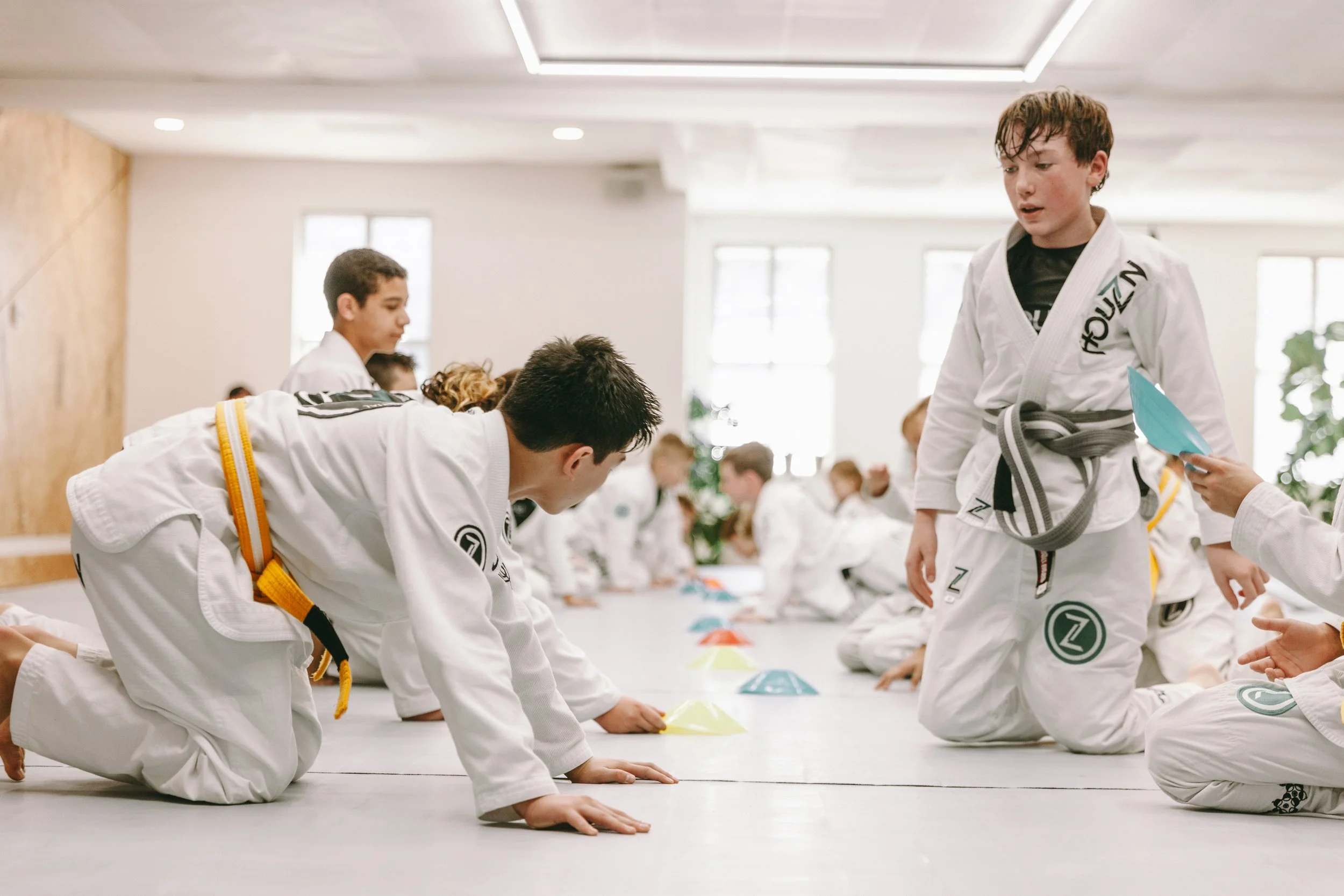
Kids Jiu Jitsu Builds Listening Skills: Following Directions Under Pressure
Listening isn’t just a behavior—it’s a skill, especially for kids. In Brazilian Jiu Jitsu for kids, children practice following directions while they’re excited, tired, or frustrated. That’s why good Kids Jiu Jitsu classes repeat fundamentals: repetition turns “thinking” into calm, automatic skill. This post from Houzn Jiu Jitsu Academy in Mount Pleasant, SC (serving Charleston families) explains how Jiu Jitsu builds attention and coachability, what parents can look for at home, and how to support growth without turning training into pressure.
Parents sometimes tell us, “My child knows what to do. They just don’t do it.”
We hear that a lot, and we get why it’s frustrating. You’ve explained it. The teacher has explained it. They can repeat the rule back to you. And then, in the moment, it’s like it never existed.
The first thing I want you to know is this: for most kids, that gap between knowing and doing isn’t a character flaw. It’s a skill gap. Knowing is a thinking skill. Doing is a nervous system skill. Doing requires timing, attention, self-control, and the ability to stay steady when emotions spike. Those are trainable.
That’s one of the reasons Kids Jiu Jitsu works so well for listening and follow-through. Not because it’s “tough” or because we lecture kids about discipline. It works because the environment quietly trains the exact sequence your child struggles with: hear a cue, hold it in their mind, control their body, and apply it under a little bit of pressure.
If you’re in Mount Pleasant or nearby and you’re searching for Kids Jiu Jitsu that helps with behavior, focus, and listening, this is the heart of it. Jiu Jitsu doesn’t just tell kids what to do. It gives them thousands of reps at doing it.
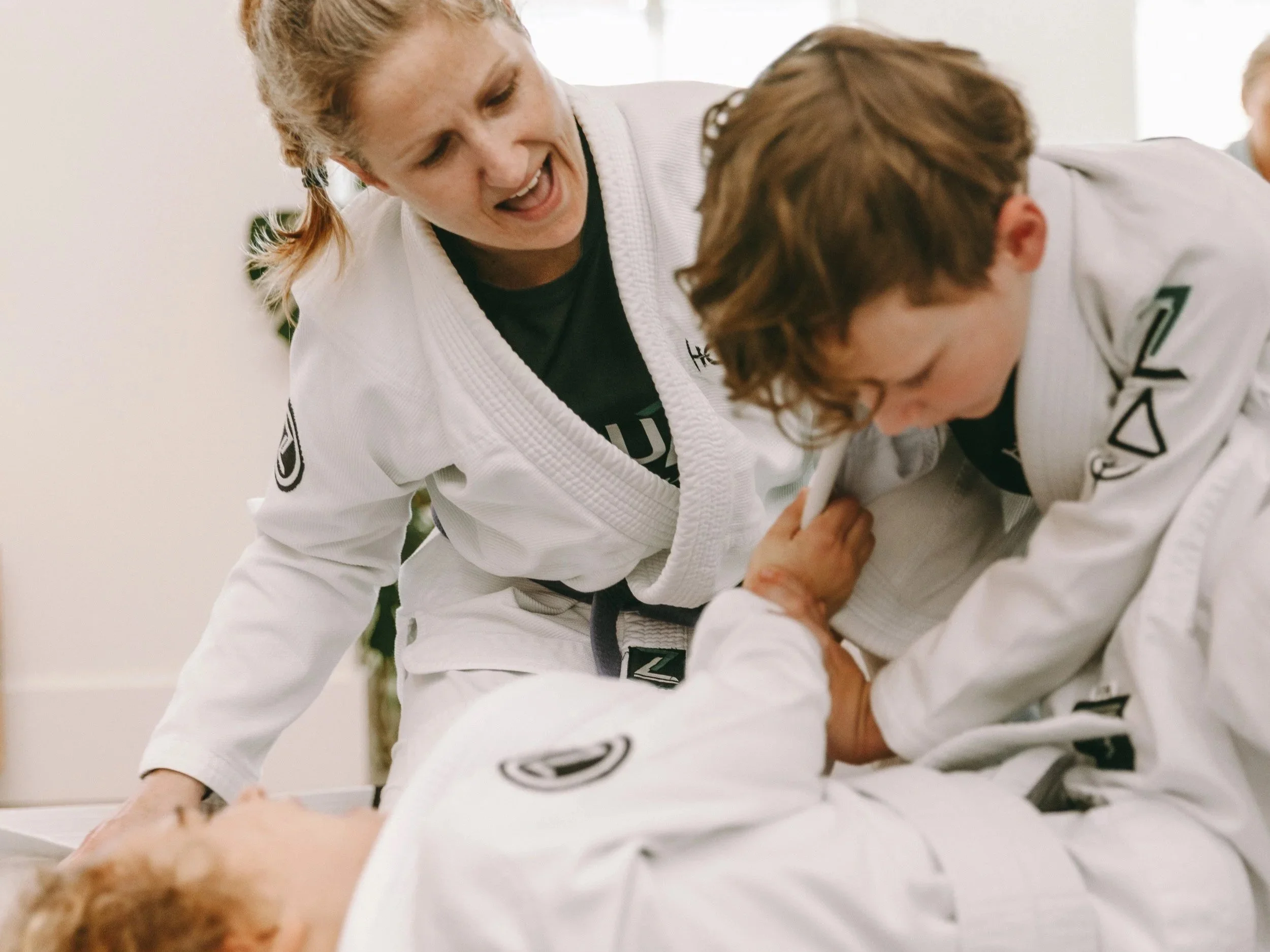
Listening is harder than it looks
Most parents aren’t actually asking for perfect obedience. What you’re really asking for is something like this: “When it matters, I want my child to slow down, take in what I’m saying, and follow through.”
That is a high-level skill for a developing brain.
Kids struggle to listen when they’re excited, embarrassed, frustrated, tired, hungry, overstimulated, or trying to impress friends. Sometimes they struggle because they’re anxious and their mind is already racing ahead. Sometimes they struggle because they’ve had a full day of holding it together at school and they’re out of bandwidth by the time you pick them up. Sometimes they struggle because they’re still learning how to switch gears from play mode to instruction mode.
None of that means your child is “bad.” It means their attention and self-regulation haven’t been trained enough for the situations you’re putting them in. And that’s normal.
In kids classes, we see the whole range. We see kids who want to be the first to move, the first to answer, the first to show a friend what they know. We also see kids who freeze up when they’re unsure and then act silly to cover it. We see kids who do great one day and then struggle the next because they’re tired or their routine changed.
That’s not a reason to quit. That’s the training.
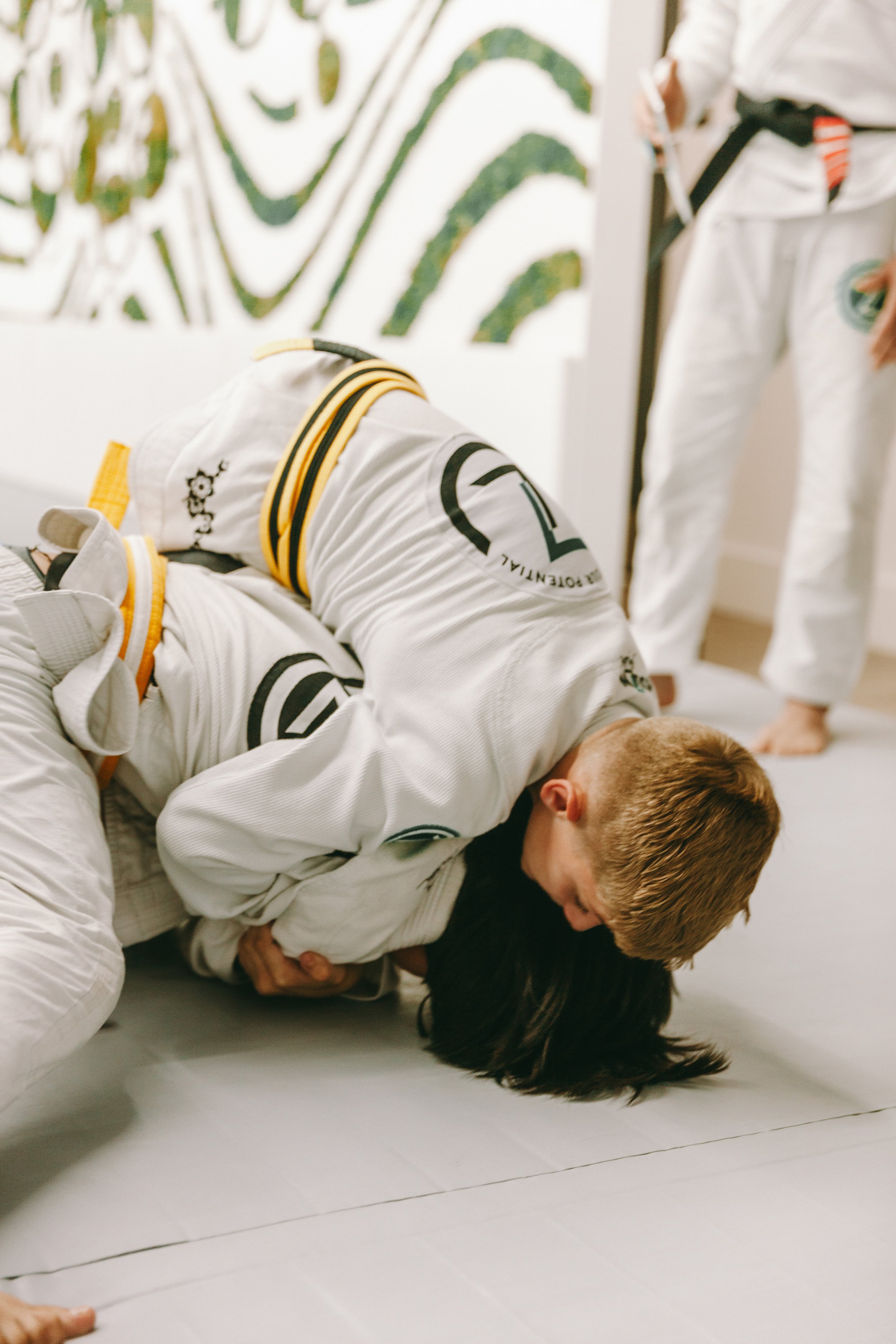
How Jiu Jitsu trains listening in a realistic way
At Houzn Jiu Jitsu, we don’t train “listening” as an abstract idea. We train it as a behavior that has consequences and rewards you can feel immediately.
In a typical kids class, your child hears a safety rule. They hear a technical detail. They hear a timing cue. They hear an instruction about their partner. Then they have to apply it with their body, right away, in real time.
If they don’t listen, it shows up instantly. Not as punishment, not as shame, and not as a lecture. It shows up as the technique not working. Or the position falling apart. Or the partner escaping. That’s the feedback loop most kids need.
A lot of the world gives kids delayed feedback. “Stop doing that or you’ll get in trouble later.” “Do your homework because it matters for the future.” Those are true, but they’re too far away for many kids to feel in their body.
Jiu Jitsu gives immediate, clean feedback. If your hands go here, you can hold the position. If your hands go there, you can’t. If you keep your base, you don’t fall. If you reach too far, you get swept. If you breathe and slow down, you last longer. If you panic, you gas out.
That’s not just martial arts. That’s cause and effect training for the nervous system.
It also matters that Jiu Jitsu requires “dual attention.” Your child has to pay attention to the coach and to their own body at the same time. They have to notice where their knees are, where their hands are, where their partner’s weight is shifting. That kind of attention is different from sitting still and listening. It’s active listening. It’s embodied listening. And kids who struggle with passive listening often do surprisingly well with this, because it gives their brain something to do.
There’s another piece parents don’t always see at first: listening in Jiu Jitsu includes listening to the room. Kids learn that certain moments are for movement and certain moments are for stillness. They learn how to look at the coach when instruction starts. They learn how to wait their turn. They learn how to stop when told to stop, even if they’re in the middle of something fun.
That last part is big. Stopping on cue is one of the clearest signs of self-control. We practice it constantly, and we practice it without making it dramatic. It’s just part of the culture.
Why repetition matters (and why we don’t rush)
Parents sometimes worry we’re doing “the same stuff.” We understand that worry, especially if you’re used to sports where each week looks totally different.
Here’s what we know after years on the mat: basics are not “beginner stuff.” Basics are the stuff you can still do when you’re tired, nervous, or under pressure.
When a child is calm, they can do a lot. When they’re stressed, they can do what they’ve repeated.
That’s not a motivational quote. That’s how habits work. Under pressure, the brain doesn’t get more creative. It gets more efficient. It defaults to the pattern it knows best.
So when we repeat shrimping, base, posture, frames, and simple escapes, we’re not stalling. We’re building reliability. For kids who struggle with listening and follow-through, reliability is the goal.
Repetition also teaches something deeper: patience. Kids learn that improvement isn’t magic and it isn’t instant. They learn that showing up matters. They learn that you can be frustrated and still keep going. They learn you don’t need a new trick every week to grow. You need consistent practice and good coaching.
And repetition makes the coach’s cues more meaningful. The first time a child hears “elbows tight,” it’s just words. The fiftieth time, it becomes a physical feeling they can recognize and correct. That’s when listening becomes doing.
How we keep it disciplined without being harsh
A lot of parents are looking for structure, but they don’t want a harsh environment. We agree with that. There’s a difference between high standards and heavy-handed coaching.
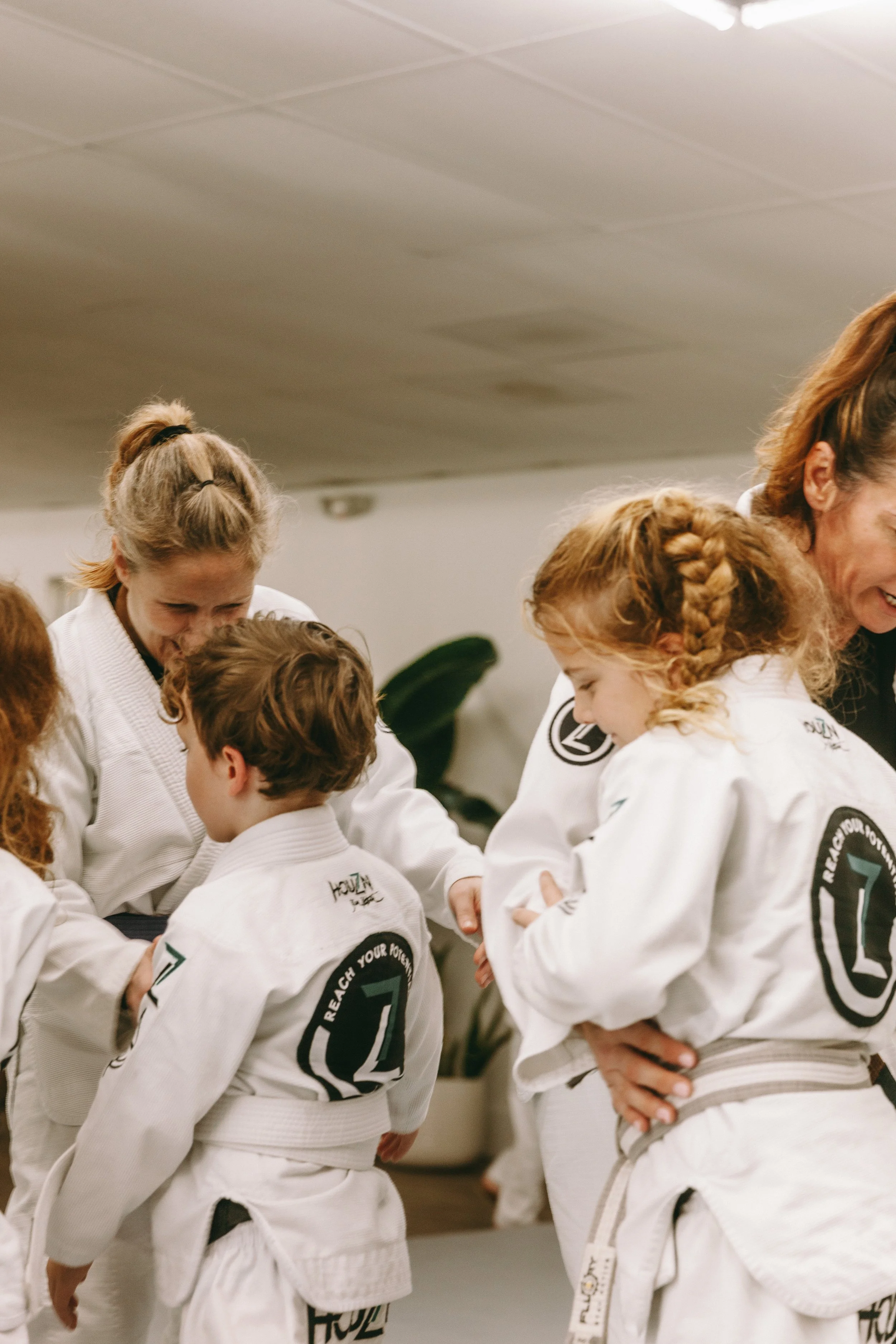
In our Kids Program, we keep the tone warm and clear. We correct behavior quickly, but we don’t label kids. We don’t call a child “lazy” or “bad.” We coach the action. We redirect. We reset. Then we let them succeed.
Kids need to feel safe to try. A child who is afraid of embarrassment will often stop listening because their brain is busy protecting them. When the room is respectful, kids take more responsibility. They settle faster. They recover from mistakes faster.
That’s also why we’re careful about partner pairings and intensity. When kids feel physically safe, their nervous system is more available for learning. If they’re worried they’ll get crushed or laughed at, they won’t absorb instruction. They’ll either shut down or act out.
Listening improves when the environment is both structured and safe.
What “better listening” looks like over time
Listening doesn’t usually improve in a straight line. It improves in moments. A child who used to ignore a cue starts catching it one out of five times. Then two out of five. Then they start self-correcting without being told. Then they start helping a newer kid remember the rule.
You might notice your child starts making eye contact more quickly when you give instructions. You might notice shorter recovery time after frustration. You might notice they can stop an impulsive action and reset. You might notice they can wait their turn without melting down. You might notice they can handle losing a round without spiraling.
Those are big wins, even if their room is still messy at home and they still argue about brushing teeth. Jiu Jitsu doesn’t turn kids into robots. It builds capacity. It gives them more “pause” between impulse and action.
And that pause is where listening lives.
What parents can do at home (that actually helps)
The best thing you can do at home is keep it simple and keep it positive. After class, instead of quizzing your child with a bunch of questions, ask them to teach you one cue.
Not a whole technique. One cue.
It could be “posture up.” It could be “elbows in.” It could be “base wide.” It could be “hips away.” Let them show you on the living room floor for 30 seconds. When kids teach, they have to organize the idea, find the words, and demonstrate with their body. That strengthens the same “knowing-to-doing” pathway we’re building on the mats.
If they don’t want to teach that day, don’t force it. Just try again another time. The goal is to make Jiu Jitsu feel like a place where they’re growing, not another place where they’re being tested.
Also, if listening is a major challenge, don’t carry it alone. A good kids coach wants to help. We can give you age-appropriate cues, simple goals, and a plan that matches your child’s temperament. Sometimes it’s as small as giving a child one focus point per class instead of five. Sometimes it’s adjusting where they stand in line so they’re less distracted. Sometimes it’s pairing them with a steadier partner. Those small changes can make a big difference.
If you want help with this, grab your kids coach after class or ask for a conference. Tell us what “not listening” looks like at home and at school. We’ll help you choose specific cues and goals for your child’s age group, and we’ll work together from there.
Because the point isn’t just that your child knows what to do.
The point is that, little by little, they become the kind of kid who can do it when it counts.
Brazilian Jiu Jitsu for Kids: A Safe Outlet That Builds Focus
Kids Jiu Jitsu is more than exercise. It’s a structured way for children to release energy and learn self-control at the same time. In this post from Houzn Jiu Jitsu Academy in Mount Pleasant, SC (serving Charleston families), we explain how Brazilian Jiu Jitsu for kids helps with nervous system regulation, focus, and healthy fatigue—especially for high-energy kids or kids who struggle with transitions. You’ll learn what coaches are really teaching when we say “control,” and what parents can watch for at home.
Many parents come to us saying some version of: “My child has a lot of energy.”
Sometimes that’s said with a smile. Sometimes it’s said with exhaustion. And sometimes it’s said with a little worry behind it, because you’re not just trying to “wear them out.” You’re trying to help them feel settled in their own body, get through the day without constant battles, and build the kind of confidence that isn’t loud or reactive.
At Houzn Jiu Jitsu Academy, we see high-energy kids all the time. We also see the parents who are doing their best to guide that energy without crushing their spirit. That’s the real job. The good news is: movement helps, structure helps, and the right kind of training can do both at the same time.
Jiu Jitsu gives kids a place to move hard and learn boundaries in the same hour. It’s not “run until you drop.” It’s not “sit still and behave.” It’s controlled intensity, coached closely, with clear rules and a culture that rewards listening, respect, and self-control.
Exercise is good. Regulated exercise is better.
Any physical activity can tire a kid out. Most sports will burn energy. The difference with Jiu Jitsu is that it teaches kids to switch gears on purpose.
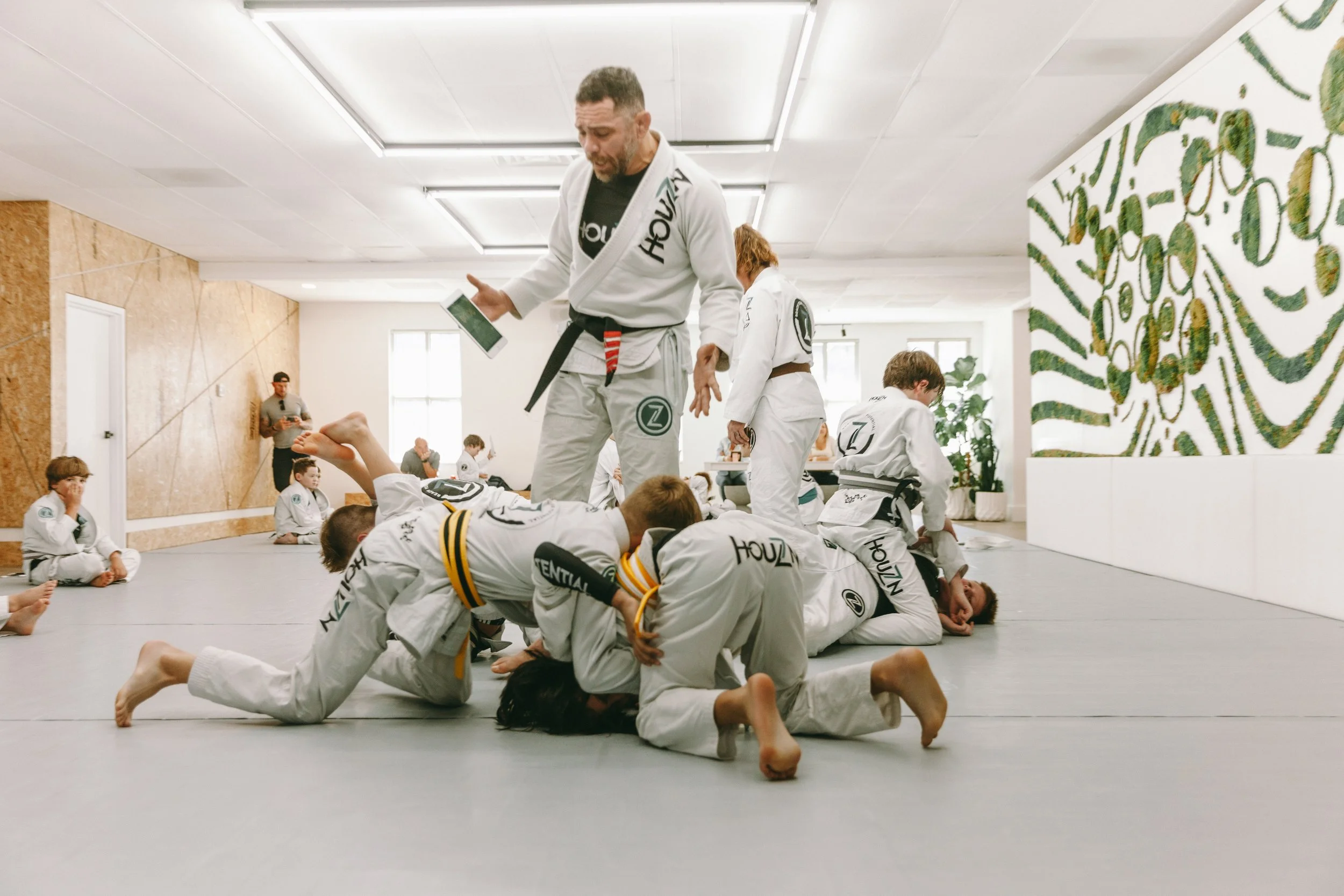
In one class, a child may go from playing a warm-up game, to standing in line and listening, to drilling a movement slowly, to doing a short round with a partner, then back to stillness while the coach explains what comes next. That constant change is not a flaw. It’s one of the benefits.
A lot of high-energy kids don’t struggle because they “have too much energy.” They struggle because they don’t yet know how to regulate it. They go from zero to one hundred and have a hard time finding the middle. Jiu Jitsu gives them practice living in that middle. They learn how to turn it on, and then turn it back down, without being shamed for being intense.
They learn to explode briefly, then slow down. They learn to listen even when their heart rate is up. They learn to control their hands and feet around another human being, which is a big deal. They learn to breathe under pressure, because if you hold your breath in Jiu Jitsu you get tired fast and you panic faster. These aren’t just “skills for the mat.” They’re nervous system skills. That’s why the effects can show up at home, at school, and in social settings.
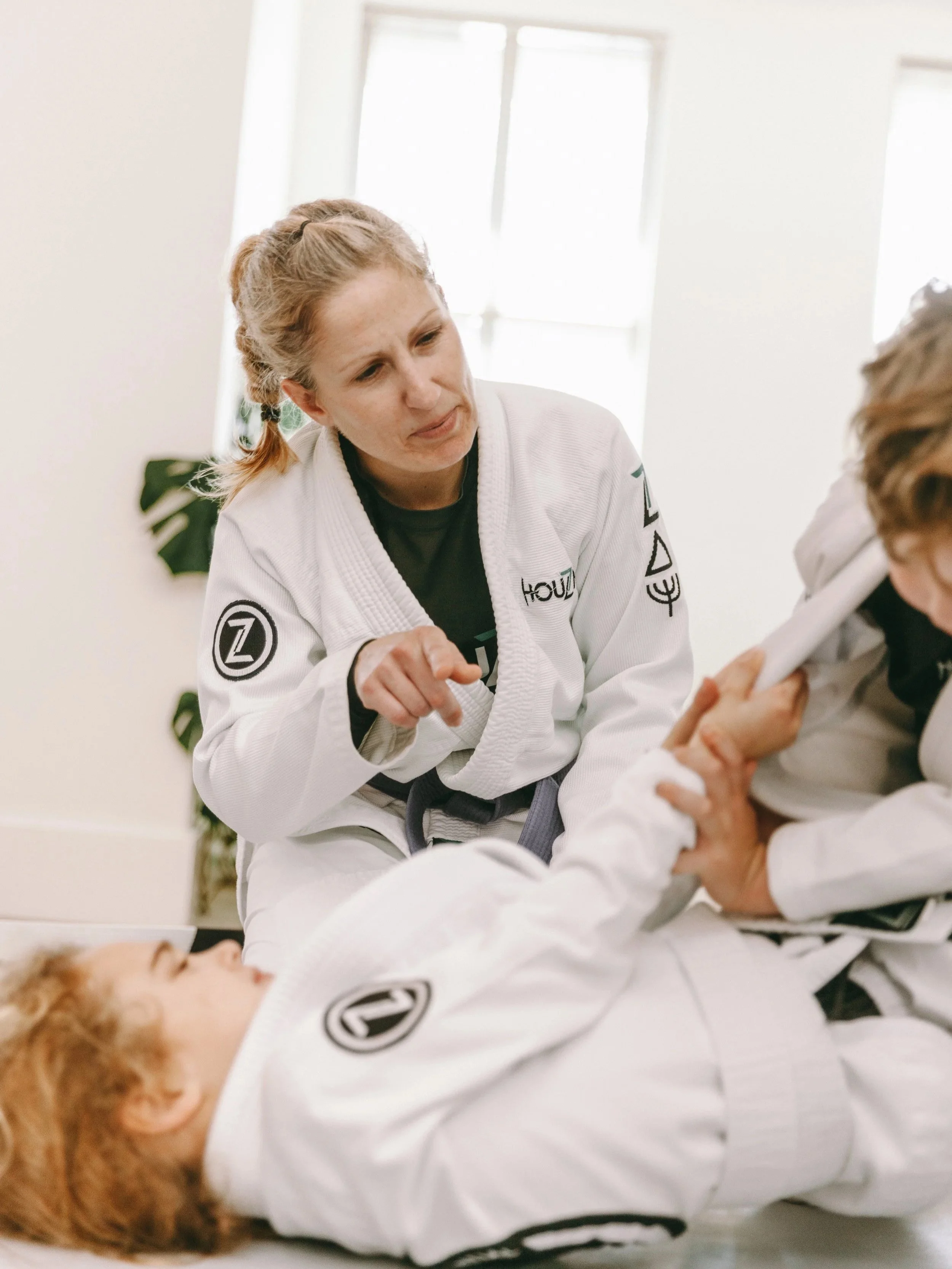
Why Jiu Jitsu helps with transitions
Many kids struggle with transitions. Leaving the house can be a meltdown. Turning off screens can feel like you’re starting a fight. Shifting from play to homework can turn into stalling, arguing, or tears. Bedtime can drag on because their body is tired but their system is still “on.”
Transitions are a regulation skill. And in Jiu Jitsu, transitions are constant.
From the kid’s point of view, class is a sequence of “now we do this, now we stop, now we reset, now we listen, now we go again.” The coach gives simple instructions. The room has clear expectations. The child gets immediate feedback. If they jump ahead, they’re guided back. If they freeze, they’re coached forward. If they get frustrated, they’re taught how to pause and re-engage.
Over time, kids start to carry that rhythm into their day. They don’t become perfect, and we don’t expect them to. But many parents tell us they start seeing fewer “hard stops” and more “okay, what’s next?” That’s the shift we’re after.
There’s also something important here: in a good Kids Jiu Jitsu class, transitions aren’t punitive. A child isn’t being corrected because they’re “bad.” They’re being coached because they’re learning. That keeps the emotional tone healthy. It’s firm, but it’s not harsh. Kids can feel that difference. So can parents.
Why the close-contact part matters (and why we handle it carefully)
Some parents worry about the fact that Jiu Jitsu is close contact. That’s reasonable. It’s also one of the reasons it works so well when it’s coached the right way.
In Jiu Jitsu, a child has to become aware of their body in relation to someone else’s body. They have to learn personal space, pressure, balance, and control. They also have to learn consent and boundaries in practical terms. We match partners thoughtfully. We correct roughness immediately. We teach kids how to train safely and respectfully, not just how to “win.”
For high-energy kids, this is powerful because it channels intensity into control. They learn that strength without control doesn’t help. They learn that speed without awareness leads to mistakes. They learn that being “wild” makes things harder, not easier. And they learn it in a way that makes sense to them because it’s physical and immediate.
When kids start to understand that calm beats chaos, you’ll often see a different kind of confidence develop. It’s not the confidence of acting tough. It’s the confidence of knowing what to do.
The role of discipline (and what we mean by it)
Discipline gets misunderstood. Some people think discipline means punishment. Others think it means pushing a kid until they break. That’s not what we’re doing.
The kind of discipline we care about at Houzn is personal responsibility. It’s learning to show up, follow instructions, and keep trying. It’s learning to be coachable. It’s learning to be a good partner. For a high-energy kid, discipline is not about shrinking them down. It’s about giving their energy a direction.
A good kids program also teaches moral basics without preaching. Treat others the way you’d like to be treated. Take ownership for your actions. Be honest about what happened. Apologize when needed. Get back in line and try again. That’s real character training, and it happens through normal moments, not speeches.
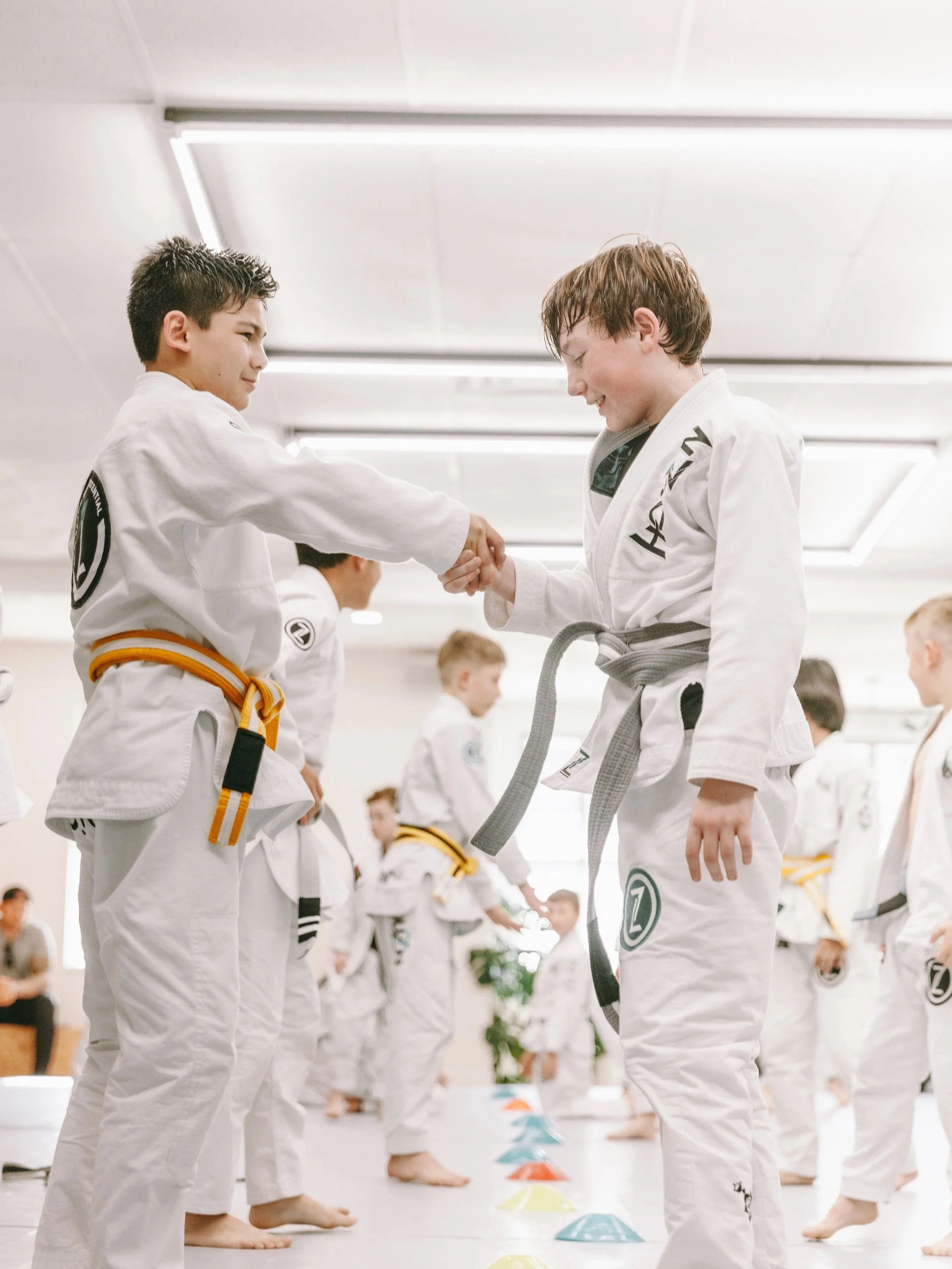
What parents might notice at home
If your child’s energy feels hard to manage right now, it helps to know what change can look like. A lot of parents report improved sleep, especially on training days. Some notice an easier evening routine because their child’s body finally feels like it had a productive outlet. Some notice less “wired” behavior, where the kid is tired but still bouncing, still impulsive, still restless.
Appetite often improves when training becomes consistent, because the child is actually using their body in a meaningful way. Mood can improve too, not because Jiu Jitsu is magic, but because movement, belonging, and progress are good for a kid’s brain. The child starts to feel capable. They start to feel like part of something. They start to see that effort creates results.
This isn’t always immediate. Some kids need a few weeks just to get comfortable. Some kids have a “honeymoon phase” where they’re calm for a day, then they go right back to normal. That’s okay. We’re not chasing a quick fix. We’re building a long-term skill: regulation.
It’s also normal for kids to be a little more emotional after class early on. Training can bring up frustration. They’re learning new movements, being corrected, and dealing with small failures. For a child who isn’t used to structured struggle, that can spill out later. If that happens, it doesn’t mean Jiu Jitsu is harming them. It often means they’re finally practicing resilience in a real way. With consistent coaching and supportive parenting, those emotions usually settle into confidence.
What frequency works best for “high energy” kids
Parents ask us all the time how many days a week a child should train. The honest answer is: it depends on the child, the family schedule, and what you’re trying to improve first.
Some kids do great with one or two classes a week as a steady rhythm. Others need three classes a week because the consistency helps them regulate better. More is not always better, especially if the child is already overwhelmed. The right dose is the one that your family can sustain without constant stress.
When parents tell me they want “better behavior,” I usually steer them toward consistency over intensity. A predictable schedule and a clear routine around class helps more than trying to cram in a bunch of sessions and burning out. Jiu Jitsu works when it becomes part of the lifestyle, not a punishment or a panic move.
How we keep it safe and respectful
If you’re considering kids Jiu Jitsu in Mount Pleasant, or you’re already training with us and you’re trying to decide if it’s the right fit long-term, safety is not an afterthought. It’s the foundation.
Kids need structure, and they need to know the room is controlled. That means we enforce rules, we coach the details, we stop unsafe behavior quickly, and we teach kids how to be good training partners. It also means we don’t confuse aggression with confidence. A confident child is not the one who dominates everyone. A confident child is the one who can stay calm, listen, and keep learning.
That culture matters as much as the techniques. You can get “tired” anywhere. What you’re looking for is a place where your child learns to handle pressure and responsibility in a way that makes them better outside the Academy, too.
If your child’s energy feels hard to manage, grab your kids coach after class to ask questions. We can help you choose the right class frequency and focus, and we’ll tell you honestly what we think will work best for your child and your family.
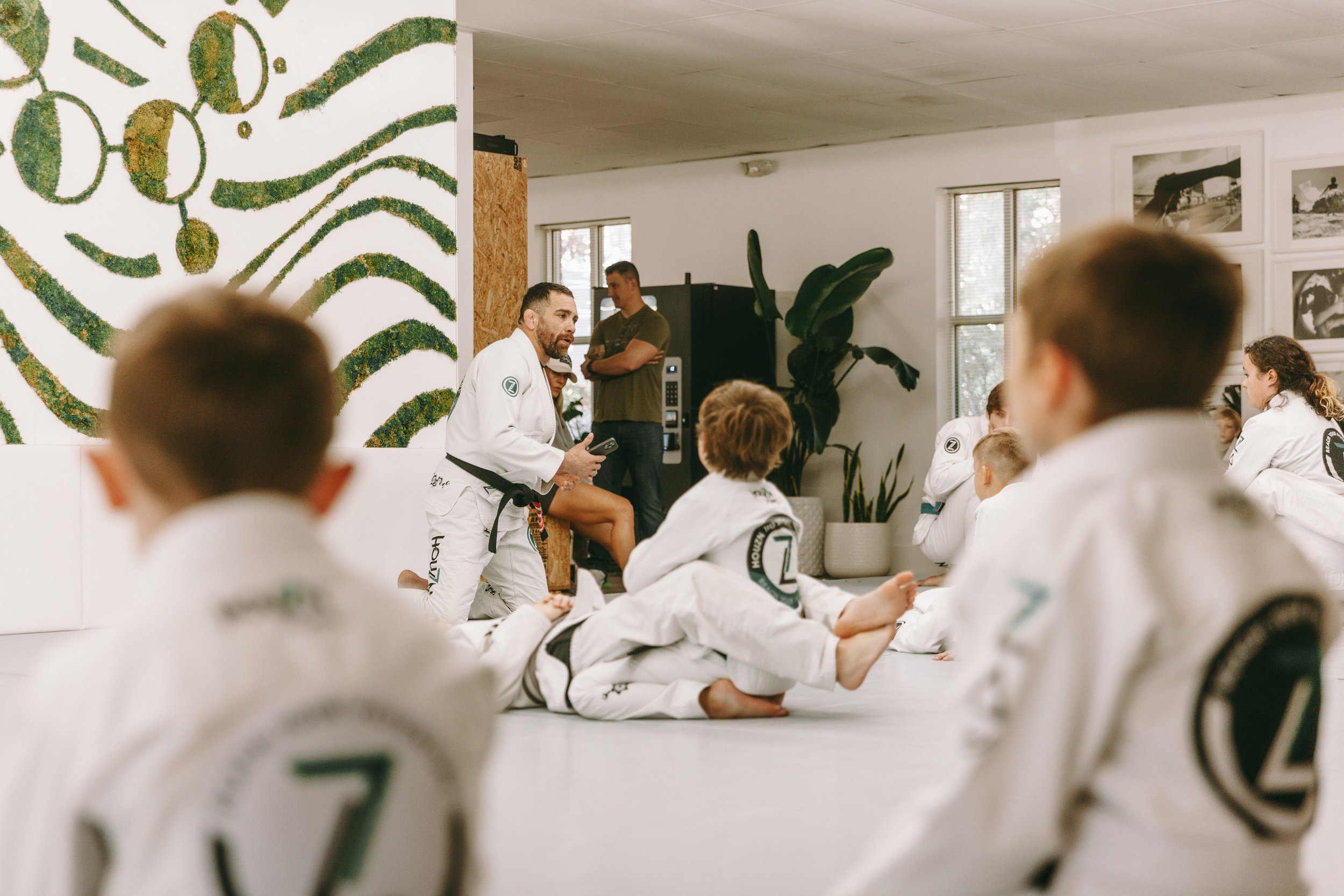
Kids Jiu Jitsu for Shy or Unathletic Kids
Not every child feels at home in traditional sports. The good news is that kids jiu jitsu often works especially well for shy, uncoordinated, or “not sporty” kids—because progress comes from listening, problem-solving, and steady repetition, not just raw athleticism. In this post from Houzn Jiu Jitsu Academy in Mount Pleasant, SC (serving Charleston families), we explain why late bloomers thrive in Brazilian Jiu Jitsu for kids, what progress looks like early on, and how parents can support the long learning curve without comparing their child to others.
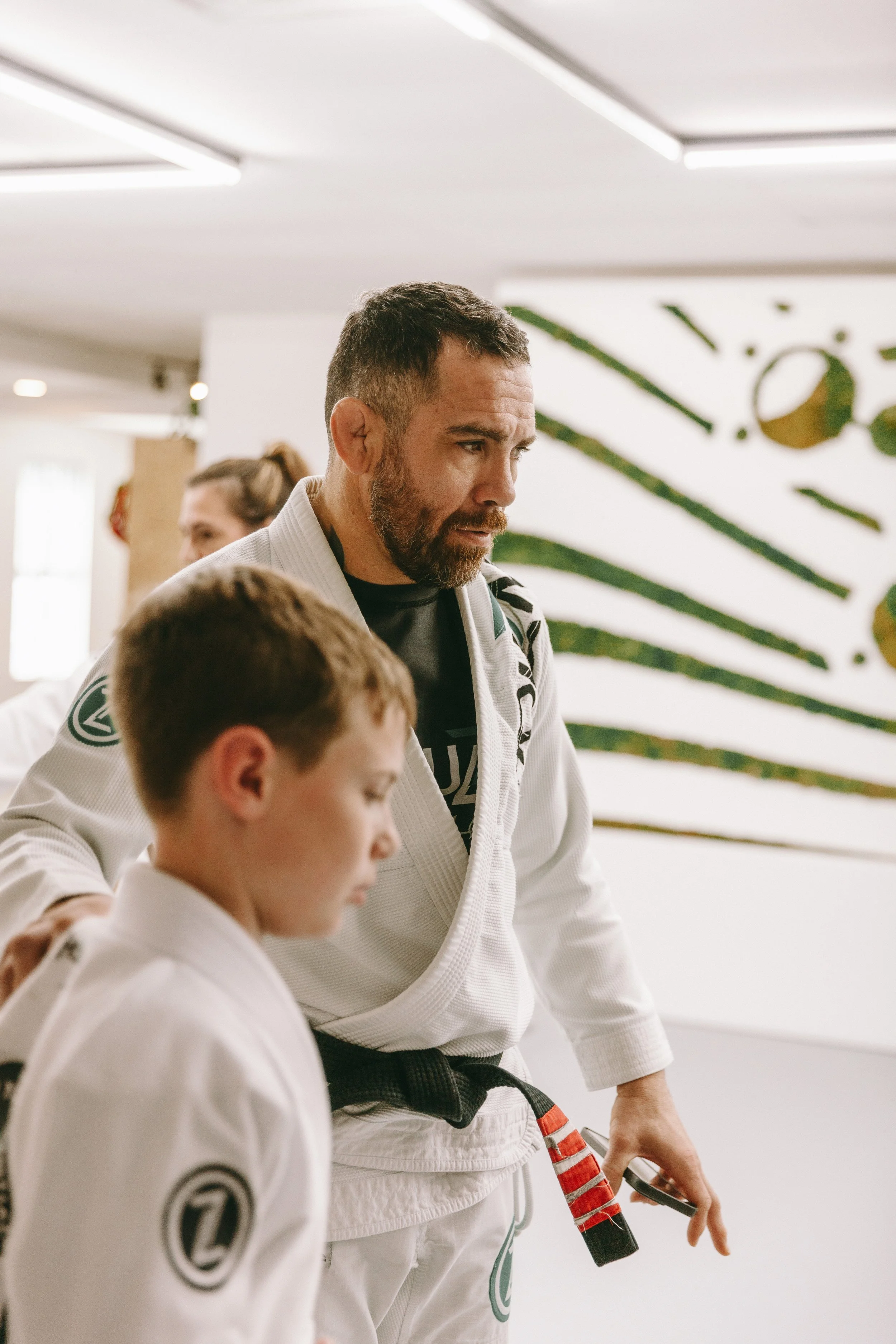
If your child is shy, uncoordinated, or just not naturally athletic, starting any new activity can feel like walking into the deep end. As a parent, you’re trying to do the right thing. You want them to move their body, make friends, and build confidence. But you also don’t want them to feel embarrassed, left behind, or singled out as “the kid who can’t keep up.”
We’ve coached enough kids to tell you this clearly: in kids Jiu Jitsu, the “not athletic” label often stops making sense after a few weeks. Not because we magically change a child’s personality, and not because we lower the standard. It changes because Jiu Jitsu is built differently than most youth sports. It rewards learnable habits over natural speed, and it gives kids a clear path forward even if they start out unsure.
A lot of parents come in with a picture in their head of what “good” looks like. They imagine the kids who run fast, catch well, or already look coordinated. Those kids can do well in Jiu Jitsu too. But they aren’t the only ones who succeed, and they’re not even always the ones who stick with it. Jiu Jitsu has a way of leveling things out over time, because the skills that matter most are not the ones kids are born with. They’re the ones they practice.
Jiu Jitsu rewards timing, balance, attention, patience, and composure. Those aren’t personality traits you either have or don’t have. They’re trainable. Timing is something we build by repeating the same movements in a consistent way until the body starts to recognize patterns. Balance improves when a child learns how to place their weight and how to move without rushing. Attention gets better when the environment is structured, the expectations are clear, and the coach helps them return to the task without shame. Patience is a skill. Composure is a skill. And honestly, those are the skills most kids need more than a bigger vertical jump.
This is why many kids who don’t shine in fast-paced ball sports end up doing well in Jiu Jitsu. Ball sports can be chaotic for some kids. Things are moving quickly, the rules change based on the situation, and a child might only touch the ball a few times in an entire game. If they miss, everyone sees it. In Jiu Jitsu class, we can slow things down. We can repeat. We can isolate one movement. We can give a child a “job” to do that makes sense, and then build from there. That structure matters, especially for kids who feel overwhelmed easily.
You might also notice that in Jiu Jitsu, success doesn’t depend on being the fastest kid in the room. It depends on using your body in a smart way. A smaller or less athletic child can learn to create strong frames, manage distance, and stay safe under pressure. They learn how to survive first, then how to escape, then how to control, and only after that do we spend more time on submissions. That order is intentional. It protects the child physically, and it protects them emotionally too. When a kid knows how to get out from underneath, they stop feeling trapped. When they stop feeling trapped, they stop panicking. When they stop panicking, they can actually learn.
Something else happens for “late bloomers” that many parents don’t expect. A child who struggles early often ends up building a stronger foundation than the child who wins early without understanding why. When things don’t come easily, the child has to learn real fundamentals. They have to learn how to move their body safely. They have to learn how to breathe when they’re uncomfortable. They have to learn how to listen and apply coaching, not just rely on natural coordination. They learn how to problem-solve instead of freeze.
Over time, that becomes an advantage.
We’ve watched plenty of kids start out awkward and unsure, and six months later they’re the ones with the cleanest movement and the best control. Not because they turned into a different person, but because they built their game on basics. Basics hold up under pressure. Basics don’t disappear when you get nervous. Basics are what make a child feel steady.
If your child is shy, Jiu Jitsu can be a good fit for another reason: it gives them a safe way to interact without having to be loud or extroverted. They don’t have to “perform.” They don’t have to be the funniest or most talkative kid to belong. In a good kids program, the routine stays familiar. They line up, they warm up, they drill, they spar in a controlled way, they line up again. That predictability helps shy kids settle in. And as they get comfortable, the social part tends to grow naturally. They start to recognize teammates. They share small moments of success. They start to feel like they have a place in the room.
A question we hear a lot is, “What if my kid gets discouraged because other kids are ahead?” That’s a real concern, and it’s why we pay close attention to the culture we build.
Comparison is the enemy of long-term training. Kids will compare no matter what, but the way a school structures progress can either fuel that comparison or calm it down. At Houzn, we use stripes to mark progress in a way that fits the child’s consistency, skill application, and behavior. It’s not a rigid calendar where everyone moves up just because time passed. It’s also not a mystery where kids feel like they’re invisible. We want kids to see that their actions matter. Showing up matters. Trying matters. Listening matters. Using the technique the right way matters. Being a good teammate matters.
That approach helps kids stay motivated without feeling like they’re in a race. It also helps parents, because you can see progress without turning every class into a test. A stripe is not “you’re the best.” It’s “you’re growing.” And for a shy or unathletic child, that message is important. They need to feel improvement without needing to dominate anyone.
It also helps to understand what “progress” looks like in kids Jiu Jitsu, because it’s not always obvious from the outside. Sometimes the biggest improvement is that a child who used to quit when they were frustrated now takes a breath and tries again. Sometimes it’s that they used to fall over during drills and now they can keep their base. Sometimes it’s that they used to avoid partner work and now they can pair up without melting down. Those wins matter. They’re not as flashy as winning a match, but they’re the wins that shape who your child becomes.
As a parent, you can support that process in a few simple ways.
Consistency is the big one. Most kids don’t feel comfortable in the first class. Many don’t feel comfortable in the first month. If your child is shy or unsure, the early stage is mainly about becoming familiar with the room, the coach, and the structure. The more consistent the routine is, the faster that comfort builds. If classes are random and spaced out, it can feel like starting over every time.
Praise effort more than outcomes. If you only celebrate “winning,” a child who isn’t naturally athletic will feel like they’re failing even when they’re improving. Instead, look for controllable things: they showed up, they tried the drill, they listened, they stayed calm, they asked for help, they kept going after making a mistake. Those are the exact habits that create confident students over time.
Avoid labels, even when you think you’re being honest. “You’re not athletic” lands heavy on a child. Even “it’s okay, you’re not a sports kid” can become a story they carry into every challenge. A better approach is to describe what you see in a way that leaves room for growth. You can say, “You’re learning how to move your body,” or “You’re getting more comfortable,” or “You kept trying even when it was hard.” Those phrases build identity around improvement.
And ask better questions after class. Instead of “Did you win?” try “What did you learn today?” or “What was hard today?” or “What are you working on right now?” That tells your child that learning matters more than ranking, and it gives them a chance to reflect. Reflection is part of how kids turn practice into skill.
One more thing I’ll say, because it’s important: a good kids Jiu Jitsu program should feel challenging but not chaotic. Your child should be safe physically, and they should be handled with care emotionally. They can be pushed, but they shouldn’t be shamed. They can be corrected, but they shouldn’t be embarrassed. If a child is shy or uncoordinated, the coach’s job is to guide them with clarity and patience, not to pressure them into being someone else.
If you want a coach’s view of how your child is progressing, grab your kids coach after class or ask for a conference with the coach. We’ll give you a simple, specific answer about what they’re doing well, what they’re working on, and how you can support them at home without turning it into homework.
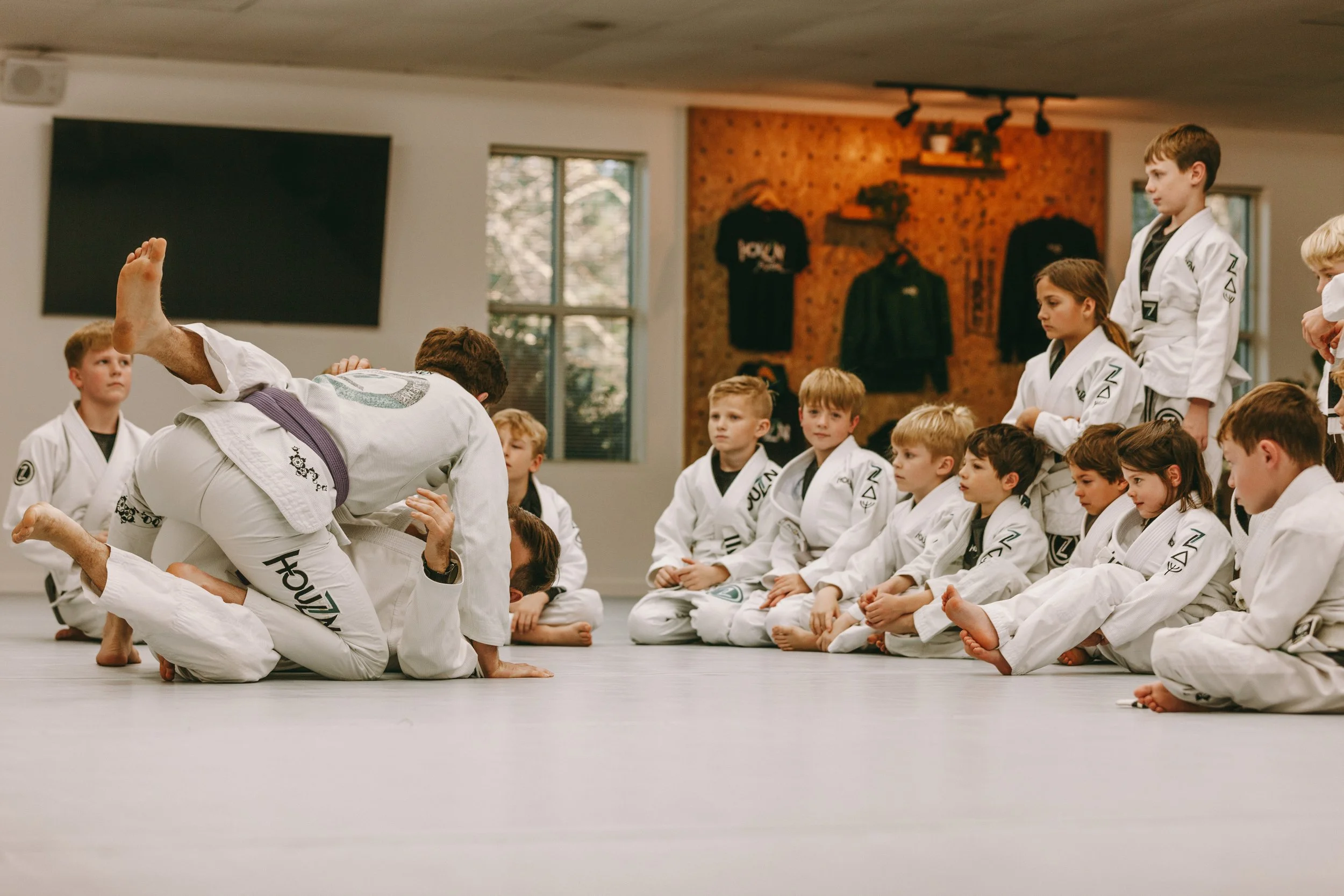
Respect in Kids Jiu Jitsu: What It Really Means
Respect in Kids Jiu Jitsu is more than manners. It’s being a safe partner, listening to coaching, and controlling your body even when you’re excited or frustrated. This post from Houzn Jiu Jitsu Academy in Mount Pleasant, SC (serving Charleston families) explains how Brazilian Jiu Jitsu for kids builds real respect through partner work, boundaries, and coached intensity. You’ll learn what coaches look for, how stripes and promotions connect to behavior, and how parents can spot respect showing up at home with siblings, classmates, and adults.
Respect is one of those words that sounds simple until you try to teach it.
Most parents aren’t really asking for “politeness.” They’re asking for something deeper: a child who can manage themselves around other people. A child who can handle being corrected without snapping. A child who can be excited without being out of control. A child who can feel frustrated without taking it out on whoever is closest.
That’s exactly what Kids Jiu Jitsu trains, when it’s taught the right way.
At Houzn Jiu Jitsu Academy, we work with kids across a wide range of ages and personalities. Some are naturally gentle. Some are intense. Some are shy and cautious. Some come in like a firecracker. Respect matters for all of them, but the “why” can look different from child to child.
In Jiu Jitsu, respect isn’t a speech. It’s not a poster on the wall. It’s a daily practice. It’s built into the structure of class, the way we pair partners, the way we correct behavior, and the way kids learn to share space with other bodies moving at full speed.
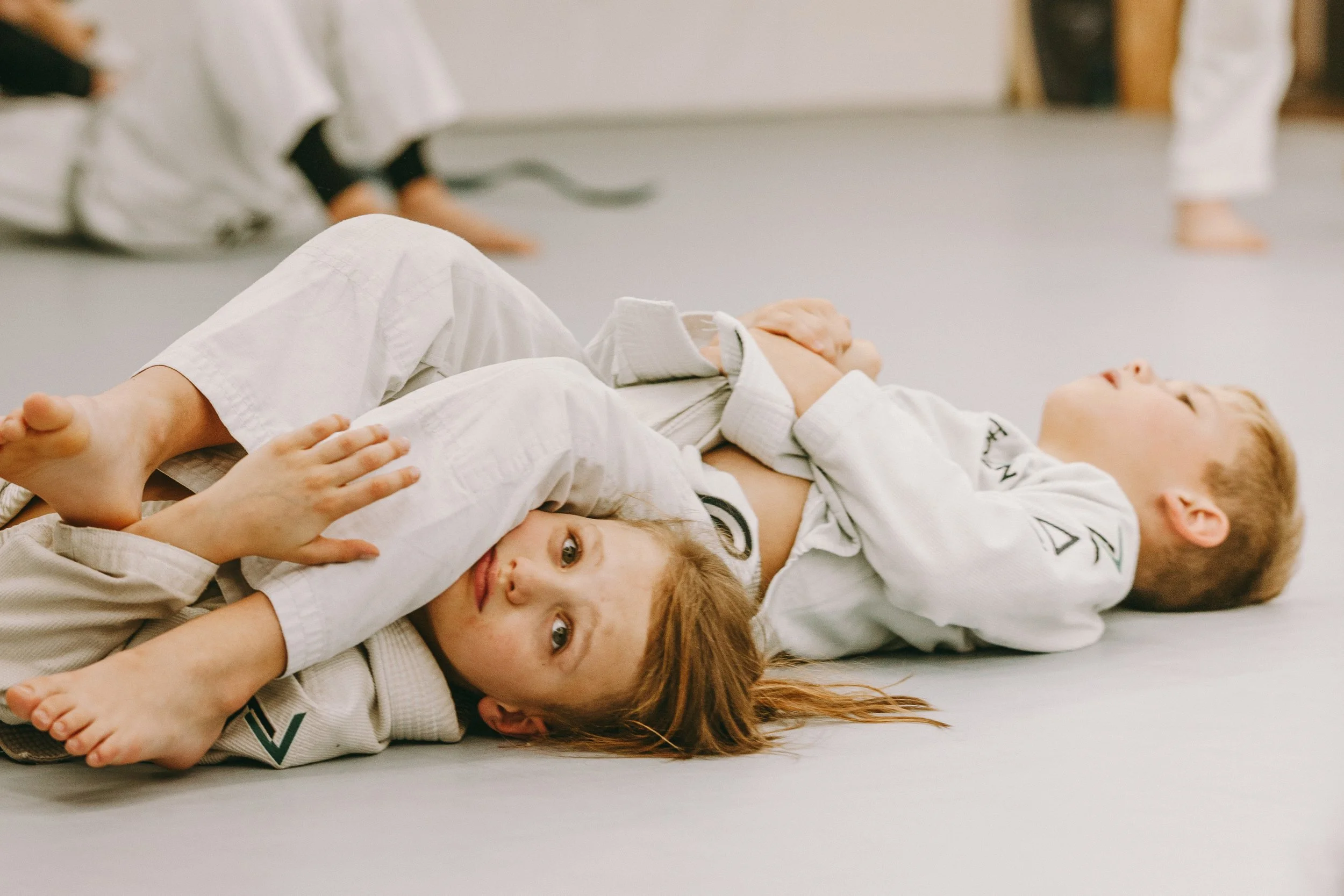
The reason Jiu Jitsu can shape respect so well is that it makes respect practical. It makes it real. If a child is careless, somebody gets hurt. If a child refuses to listen, they can’t train safely. If a child can’t control themselves when they’re frustrated, they lose the trust of the room.
So the mat becomes a safe, guided place to learn the social skill underneath the word “respect”: self-control in relationship with other people.
When parents ask us about respect, we usually start with one simple idea. Respect starts with safety.
Because Jiu Jitsu involves physical contact, the first form of respect is learning how to keep your partner safe while still training hard. A child can’t be “respectful” in the Jiu Jitsu sense if they are rough, careless, or unpredictable. It doesn’t matter if they say “yes sir” with perfect manners. On the mat, respect shows up in their hands, their pressure, their pace, and their ability to stop immediately.
That’s why in a good kids program, the first lessons aren’t flashy submissions. The first lessons are things like controlling your body, understanding space, and learning what “too much” feels like.
Kids don’t naturally know where that line is. Some kids are naturally cautious and need permission to apply appropriate pressure. Other kids come in with lots of intensity and need to learn how to dial it back without feeling like they’re being punished for having energy. We coach both.
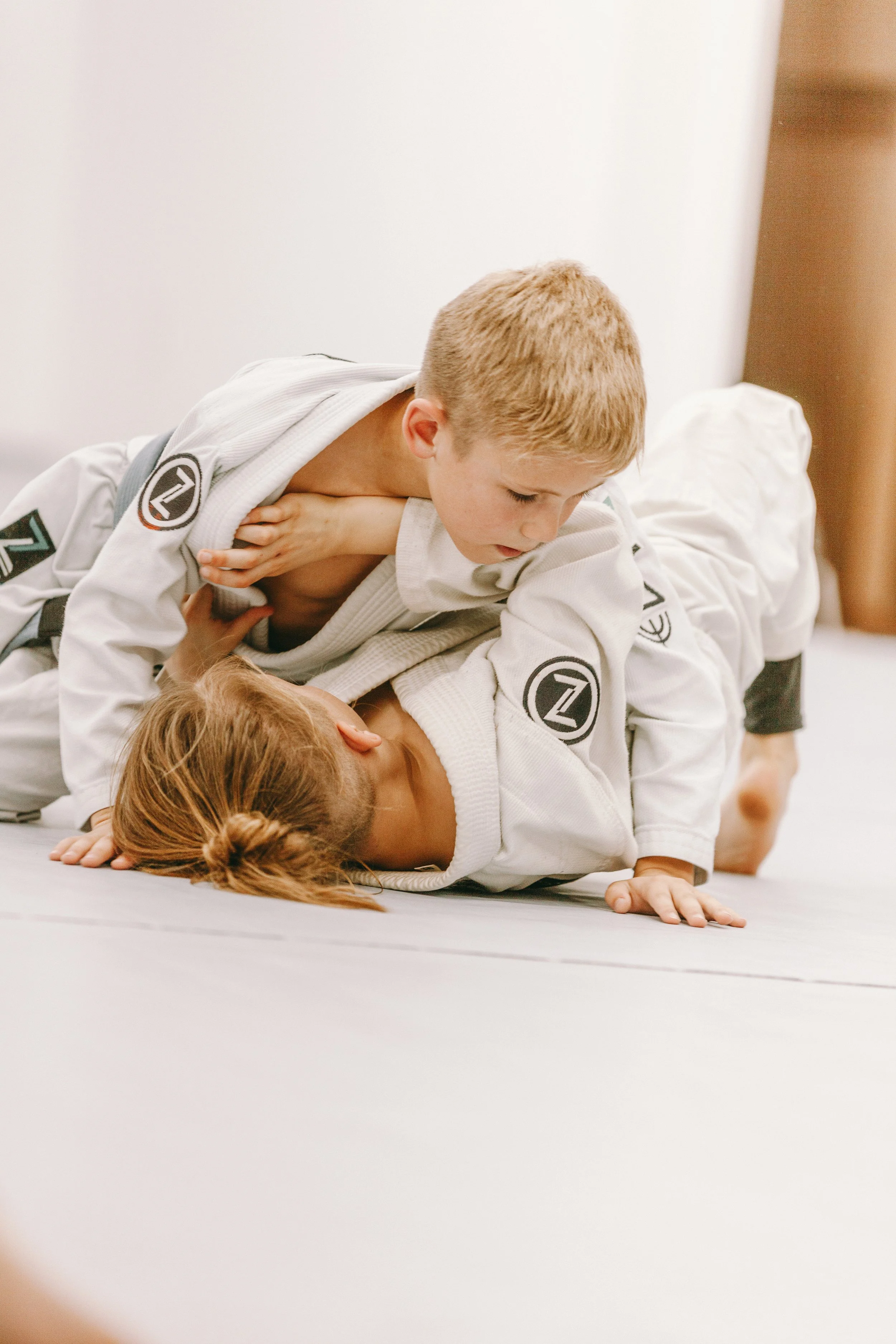
A respectful child doesn’t crank or yank. They don’t treat their partner like a training dummy. They learn to use steady pressure instead of sudden force. They learn that speed without control is not impressive. They learn to stop when told, right away, even if they think they were “about to win.” They learn to match intensity appropriately, which is a fancy way of saying they learn to play the same game their partner is playing.
Most importantly, they learn to treat every partner like a teammate.
That idea changes kids. In most areas of life, kids get taught “don’t hit” or “be nice,” but they don’t get many structured reps of what it means to be safe while still being physical. Jiu Jitsu gives them those reps every class. They learn that being a good partner is part of being good at Jiu Jitsu.
This is also why behavior matters for stripes at Houzn. We follow the IBJJF kids belt system, and stripes are not just about technique. We’re looking at a few things over time: hours of practice, whether a child can apply what we’re teaching with a real partner, and whether their behavior supports a safe training room. Four stripes are needed before a belt change, and we’re honest about what that means. Skill without control isn’t the goal. In Kids Jiu Jitsu, control is the foundation.
If you’re a parent, that should be reassuring. It means we’re not rewarding a child for being “good at fighting.” We’re rewarding them for being a safe, respectful student who is actually learning.
Respect is also coachability.
Coachability is one of those words that can sound abstract until you see it on the mat. Coachability is listening when the coach explains. It’s looking up instead of fooling around. It’s accepting corrections without taking it personally. It’s trying the move the way it’s taught, even if you think you already have a better idea.
That last part is important for kids. A lot of kids are used to environments where they can negotiate, debate, or avoid. They’re smart, and they test boundaries. That’s normal. But when it comes to learning a physical skill safely, the ability to follow direction matters. If a coach says, “Keep your elbow tight,” and a child ignores it, they might get their arm extended in a way that hurts. If a coach says, “Slow down,” and a child speeds up, they might collide with another pair.
So on the mat, listening isn’t about obedience for its own sake. It’s about safety and progress.
Over time, kids who become coachable on the mat tend to become more coachable at home and at school. Not perfect, but improved. Parents tell us they notice quicker responses when they ask their child to stop. They notice less arguing about every small direction. They notice a child who can take feedback without spiraling. That’s not because Jiu Jitsu magically fixes personality. It’s because coachability is trained as a skill.
A coachable kid has practiced doing something that’s hard: letting an adult guide them while their ego is involved. Jiu jitsu naturally brings ego up, because there’s winning and losing, and kids compare themselves. We use that moment to teach humility and learning. The message becomes, “Correction isn’t criticism. It’s information.”
That lesson transfers.
Respect during frustration is where most parents really want help, even if they don’t say it that way.
It’s easy to be respectful when you’re winning, comfortable, and in control. The hard kind of respect is respectful behavior during disappointment.
In Jiu Jitsu, kids get put in uncomfortable positions and they don’t always like it. They get pinned. They get stuck. They get their favorite move shut down. They lose to a smaller kid who has more time on the mat. They get corrected when they were sure they were doing it right. Those moments bring up real emotion.
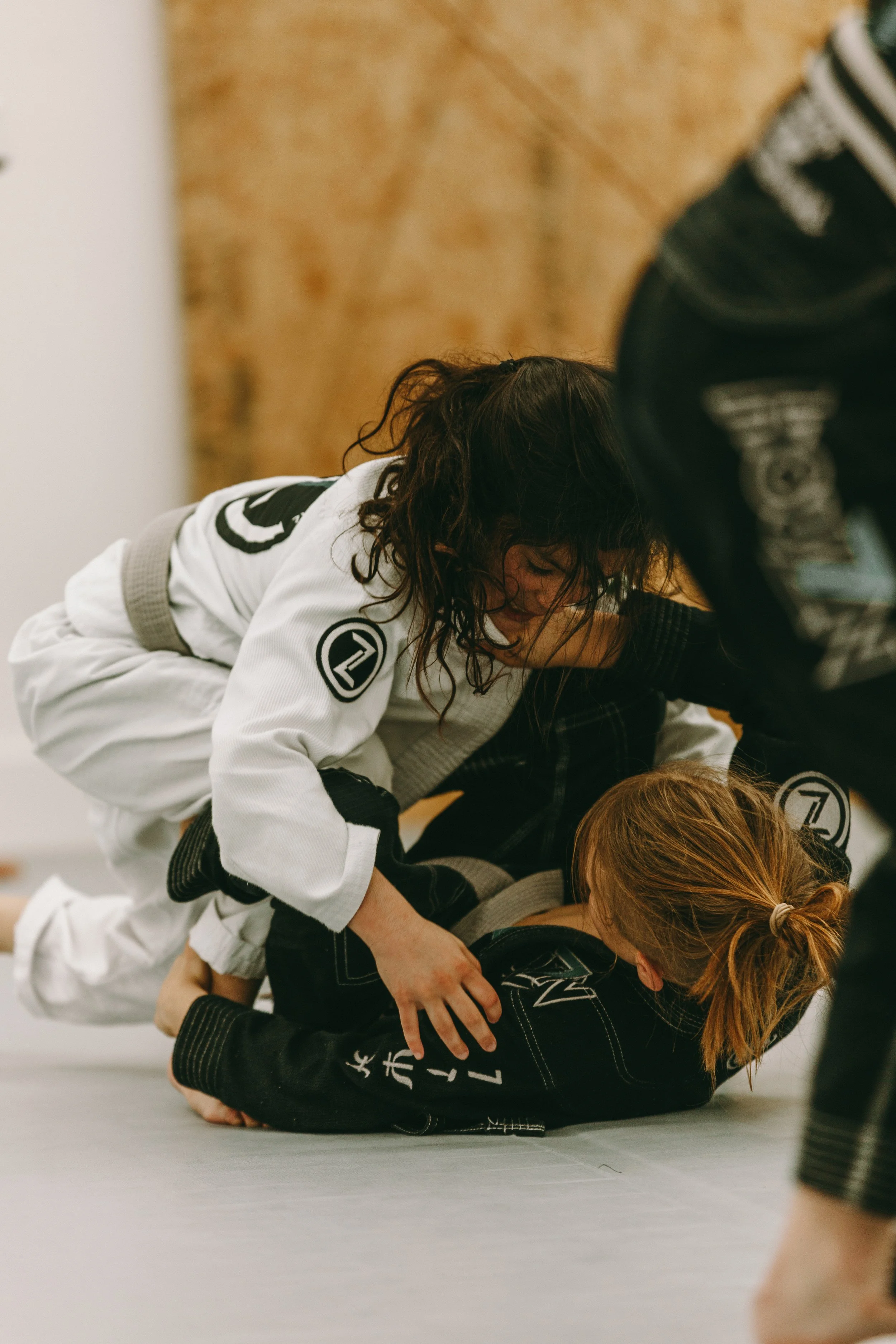
If a child’s default is to react physically when they’re upset, Jiu Jitsu gives us a clear and safe place to address it. We teach them to keep their hands safe anyway. We teach them to pause, breathe, and reset. We teach them that they can feel a big emotion and still be in control of their body.
That is respect in its most useful form: self-control under stress.
Parents sometimes ask, “Are they going to get more aggressive doing Jiu Jitsu?” In a room with poor coaching and loose standards, that can happen. In a room with strong standards and good culture, the opposite tends to happen. Kids learn that intensity is not the same thing as aggression. They learn that you can train hard and still be safe. They learn that losing is not an emergency. They learn to separate frustration from behavior.
That’s why we’re picky about how kids roll, who they roll with, and what we allow in live training. Live rounds are valuable, but only when kids can do them with control. We want the room to be challenging, but we also want it to be predictable and safe.
It’s also worth saying out loud that Jiu Jitsu is one of the few places where kids regularly practice consent and boundaries in a physical setting. Kids learn to ask, “Are you okay?” They learn to respect the tap. They learn that when someone says stop, we stop. They learn that we don’t keep going just because we want to finish. Those are simple lessons, but they’re powerful.
A child who truly understands “stop means stop” in a physical sport tends to understand it better everywhere else.
When respect is trained this way, parents usually notice it at home in a few familiar areas.
One is siblings. You might still see conflict, because siblings are siblings, but you often see fewer aggressive reactions. You see a child who can de-escalate faster, or who can walk away sooner, or who can play rough without crossing the line into unsafe. You may hear them say things like, “I’m not doing that,” or “Stop,” with a clearer voice. That’s boundaries.
Another area is the ability to stop when asked. In Jiu Jitsu, kids hear “pause” and “stop” often, and they practice responding immediately. That becomes a trained reflex. So when you say, “Hey, I need you to stop,” it’s not a brand-new idea. Their nervous system has reps with that cue.
Parents also mention improved tone when corrected. Correction is hard for kids because it can feel like rejection. On the mat, correction is normal and constant. Kids learn that being corrected doesn’t mean they’re bad; it means they’re learning. So they begin to handle feedback with less defensiveness.
And finally, you often see a stronger sense of boundaries. Kids learn what respectful touch is. They learn that partners are not toys. They learn that play has rules. That boundary awareness is one of the best “real life” benefits of Kids Jiu Jitsu, especially as kids get older and social situations get more complex.
Now, a quick note for parents who want to support this without turning it into a constant lecture.
The most effective support is usually simple, specific praise when you see the behavior you want. If you notice your child stopping quickly when asked, tell them. If you notice them handling corrections better, point it out calmly. If you notice them being a good teammate, acknowledge it. Kids repeat what gets reinforced.
It also helps to use the same language we use on the mat. When a child is escalated, long explanations usually don’t land. Short cues do. “Hands safe.” “Breathe.” “Reset.” Those are useful at home too, because they’re neutral and action-oriented.
Respect doesn’t mean your child becomes quiet and compliant. Respect means they learn how to live around other people without making the environment unsafe or unpleasant. It means they can be strong without being reckless. It means they can be upset without being disrespectful. It means they can take direction and still keep their personality.
That’s a worthwhile goal, and it’s very trainable.
If you’re curious how your child is doing in the “good teammate” category, grab your kids coach after class to ask. We’ll give you a clear, honest read on what we’re seeing, and one simple focus to work on over the next few weeks.
Looking for kids jiu jitsu in Mount Pleasant, SC that teaches real respect? Learn how Houzn Jiu Jitsu trains safety, coachability, and self-control under frustration so kids become better teammates at the Academy and at home.
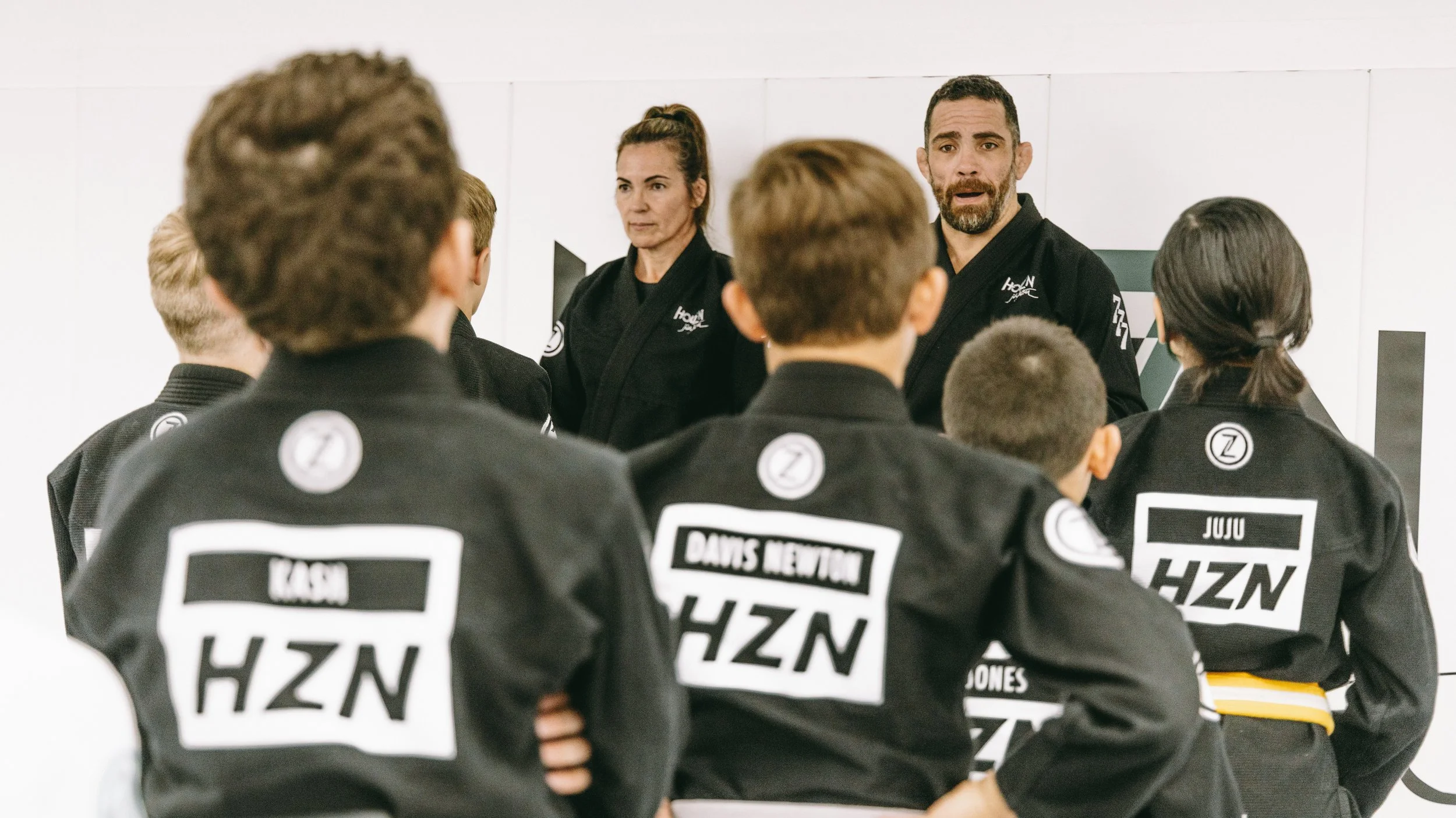
Brazilian Jiu Jitsu for Kids: How Structure Builds Listening and Self-Control
Discipline in kids Jiu Jitsu isn’t about harshness. It’s about structure, repetition, and clear expectations—practiced in a way that still feels fun. This post from Houzn Jiu Jitsu Academy in Mount Pleasant, SC (serving Charleston families) explains how Brazilian jiu jitsu for kids builds listening, self-control, and respect through simple routines: lining up, partnering safely, following directions, and resetting after mistakes. You’ll also learn what parents can watch for at home and how to reinforce discipline without turning training into pressure.
When parents ask me about discipline, they’re usually asking about something very specific. They’re not asking for a tougher kid, or a perfectly obedient kid, or a kid who never has a hard day. They’re asking, “How do I help my child listen, follow directions, and control themselves—without our whole house turning into a negotiation?”
That’s a real question. If you’ve been stuck in the loop of repeating yourself, raising your voice, taking things away, feeling guilty, and then doing it all again tomorrow, you’re not alone. Parenting is already demanding. Add school stress, screens, irregular sleep, big emotions, and a growing body that wants to move, and it can feel like you’re constantly managing behavior instead of building character.
This is one of the reasons kids jiu jitsu can be such a good fit, especially when the program is coached the right way. At Houzn Jiu Jitsu Academy, we care about discipline, but we don’t chase “perfect behavior.” We train something more durable: self-control. The kind that shows up when nobody is watching. The kind your child can carry into school, sports, friendships, and eventually adulthood.
Discipline starts to click when we separate it from compliance.
A child can be compliant in one environment and chaotic in another. Plenty of kids “hold it together” at school and melt down at home. Some kids behave around one teacher but push every boundary with another. That doesn’t mean they’re manipulative or broken. It means compliance is often situational. It depends on the external pressure in the room.
Compliance usually comes from fear of consequences, or from wanting to please someone, or from the child sensing they’ll get a reward. Those things can work short-term, but they don’t build a steady inner compass. When the pressure is gone, the behavior disappears.
Discipline is different. Discipline is internal. It’s the ability to do what needs to be done even when your mood doesn’t match, even when you’re excited, even when you’re frustrated, even when you’d rather do literally anything else. It’s not stiff or robotic. It’s freedom through structure. A disciplined kid isn’t a kid who never moves. It’s a kid who can move and still stay in control.
Brazilian jiu jitsu is a powerful place to train that, because it gives kids real-time feedback. Not in a harsh way. In an honest way.
On the mat, if you don’t listen, you miss the detail and you struggle. If you don’t respect space, you bump into someone and the coach resets you. If you go too hard, your partner doesn’t want to train with you and the coach steps in. If you freeze and panic, you learn to breathe and problem-solve. Jiu Jitsu is a conversation, and the body doesn’t lie. Over time, kids start learning that their choices have consequences, and that they can choose better.
That’s the heart of personal responsibility. Not blame. Ownership.
A well-run kids jiu jitsu class also has something many families are missing in daily life: consistent structure. And I don’t mean “strict for the sake of strict.” I mean predictable rhythms that create safety.
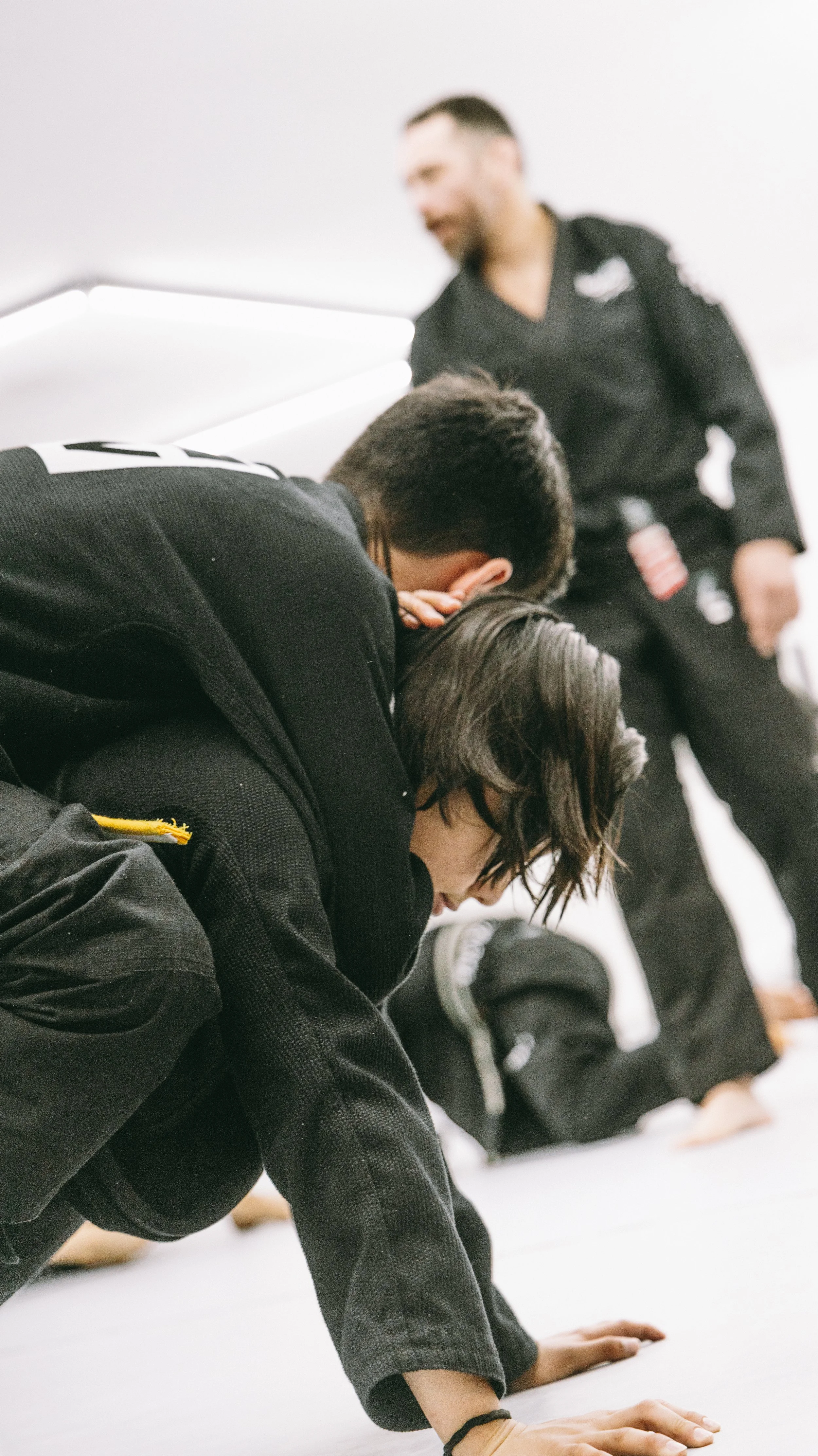
A good kids class is basically a blueprint for self-control. The class begins the same way most days. Kids learn to line up when asked, not because we want little soldiers, but because it’s the fastest way to get order in a room full of energy. They learn to keep their hands to themselves while the coach is talking, because attention is a skill. They learn to follow multi-step directions, because life is full of sequences: shoes on, backpack, lunchbox, out the door. They learn to practice safe intensity, because they’re going to feel excitement and competitiveness in life, and they need to learn how to steer that intensity instead of being steered by it.
And they learn to stop immediately on the coach’s cue.
That last one matters more than most parents realize. “Stop when told” is a safety skill, and it’s a life skill. It’s the difference between a kid who can play rough safely and a kid who escalates. It’s the difference between a child who can handle conflict and a child who gets stuck in a reaction. On the mat, stopping on command keeps partners safe. Off the mat, it shows up as impulse control.
Parents sometimes ask me, “Will jiu jitsu help my child stop hitting, stop roughhousing, stop acting out?” The honest answer is that jiu jitsu doesn’t magically erase big emotions or high energy. What it does, when coached well, is give those emotions and that energy a clear channel.
High-energy kids often aren’t “bad.” They’re under-trained in impulse control and over-loaded with energy. They can be bright, kind kids who simply have a nervous system that runs hot. And modern life doesn’t always give them what they need. Recess gets shorter. Outside time gets replaced by indoor time. Physical risk gets removed, and then we’re surprised when energy turns into chaos at dinner.
Jiu Jitsu lets kids move. It gives them permission to wrestle, to use their bodies, to feel pressure and resistance in a safe environment. But it also draws a line around that movement. There are rules. There are partners. There is respect. There are consequences that are immediate but not shaming. We correct the behavior, not the child’s identity.
Over time their nervous system learns something important: I can be intense and still be in control.
That’s why Jiu Jitsu can be especially helpful for kids who struggle with focus, who are impulsive, who get overwhelmed, or who have a hard time transitioning. We can’t promise a diagnosis changes, and we don’t pretend the mat is therapy. But we do see the same pattern again and again. Kids who have trouble sitting still in a chair often do very well with learning that happens through movement. They learn by doing. They learn with their hands. They learn with immediate feedback.
Discipline in kids Jiu Jitsu isn’t one giant “aha moment.” It’s trained in small, repeatable moments.
It’s the moment your child wants to keep talking, but they choose to look at the coach.
It’s the moment they want to rush ahead, but they wait until they’re told.
It’s the moment they get tagged or swept and they feel embarrassment, but they take a breath and try again instead of quitting.
It’s the moment they’re told, “Reset,” and they reset without a fight.
These moments look small. But small moments stacked over months are how a child becomes steady.
If you’re a parent reading this, one of the best things you can do is adjust what you measure. A lot of parents look for a dramatic change fast. They want to know, “Will this fix the problem?” What I recommend instead is watching for small, realistic changes that tell you the skill is growing.
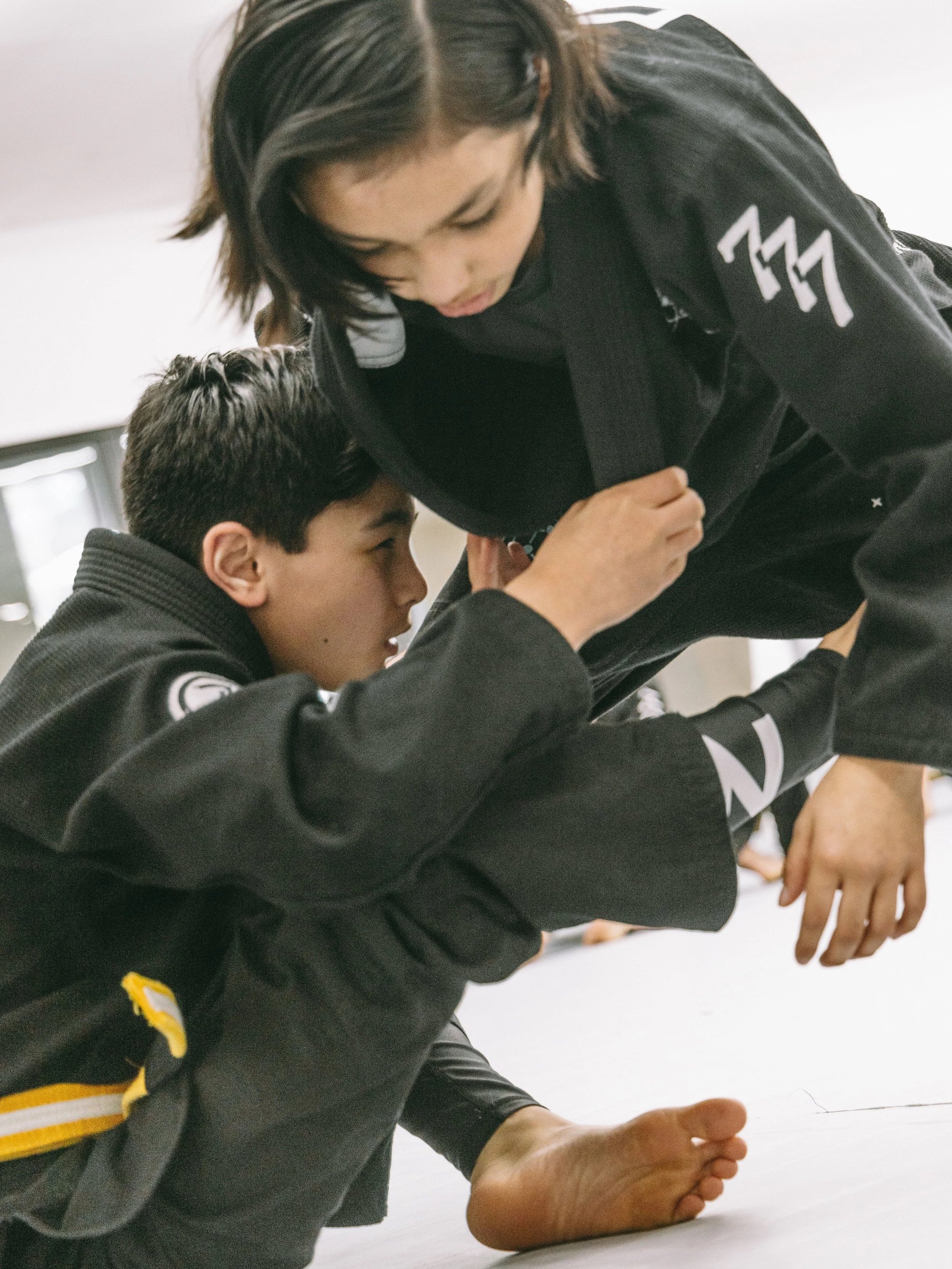
At home, you might notice they transition faster when asked to do something. It might not be instant, but the delay gets shorter. You might notice they can wait a little longer without melting down. You might see them accept corrections with less argument, or recover from “no” a little quicker. You might catch them taking a breath before reacting, even if they still get upset afterward. Those are meaningful wins. That’s discipline showing up.
And one of the most overlooked wins is how a child handles being uncomfortable.
Jiu Jitsu gives kids controlled discomfort in a safe setting. They get pinned. They get pressure. They get tired. They have to deal with frustration. They have to deal with losing tiny battles in training. When they learn to stay calm in those moments, it carries over. The kid who learns, “I can be uncomfortable and still make good decisions,” becomes a kid who can handle a hard test, a tough conversation, a bad day, or a disappointment without falling apart.
That’s confidence through competence. Not confidence as a pep talk.
Now, there’s a part of this conversation that matters for parents: how you support discipline at home without becoming the coach.
Most kids do not want their parent coaching technique in the kitchen. And honestly, it’s not your job. Your job is to be the parent, and to keep the home relationship clean. The best way to reinforce what we do on the mat is to reinforce principles, not moves.
Simple phrases work because kids can remember them. “We listen to the coach.” “We keep our hands to ourselves.” “We reset and try again.” Those are transferable. They apply to school, to the playground, to siblings, to sports teams, and to dinner.
You can also support discipline by helping your child show up consistently. Consistency is where the real results come from. If you can build a routine where Jiu Jitsu is “just what we do,” you take willpower out of the equation. And if your child is having a hard week, that’s often the week they need structure the most.
One more thing I’ll say as a coach: discipline grows best in an environment that is both warm and firm.
Warm without firm turns into chaos. Firm without warmth turns into fear. Kids need to know the adult in charge cares about them and also means what they say. That balance is what we aim for at Houzn. We hold standards. We correct. We also encourage, guide, and keep kids safe. We’re not trying to “break” a child. We’re trying to build a child who can handle themselves.
If you’re in the Mount Pleasant area and you’re looking into Brazilian Jiu Jitsu for kids, it’s smart to ask specific questions when you visit a school. Ask how they handle safety. Ask what happens when a child can’t stop messing around. Ask how they pair kids up. Ask how they teach a new child who’s nervous. A kids program isn’t just about technique. It’s culture. And culture shows up in the details.
If you want a simple strategy for your child’s age group, whether they’re in Little Warriors, Young Warriors, Warriors, or Juvenile, grab your kids coach after class or ask for a conference with the coach. We’ll help you connect mat routines to home routines in a way that fits your child’s personality. Discipline isn’t a fight you have to win every night. It’s a skill your child can build, one rep at a time.
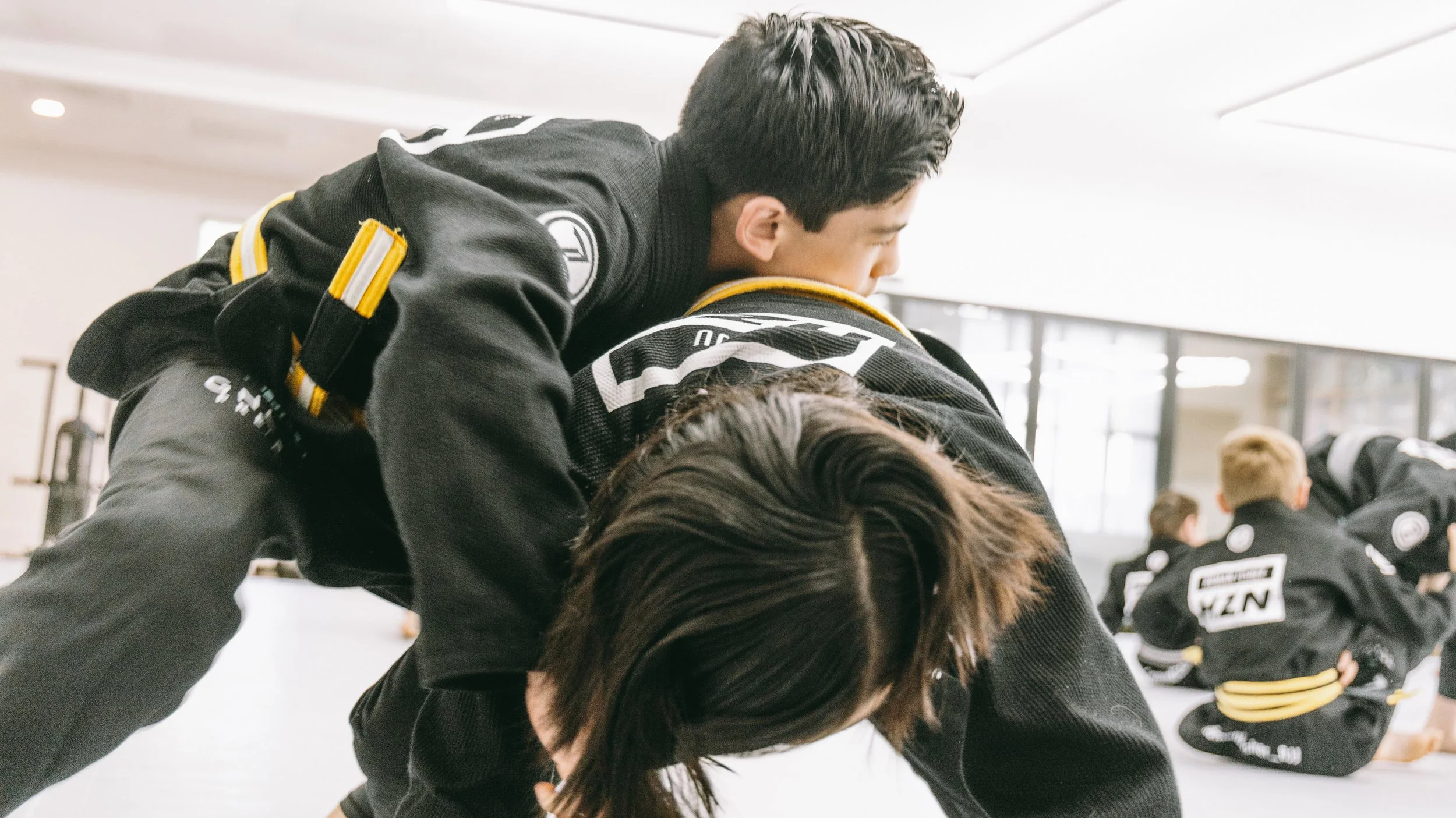
Kids Jiu Jitsu Confidence: How It Really Builds Over Time
Confidence from kids jiu jitsu isn’t about becoming loud or aggressive. It’s about staying calm, trying again, and believing “I can handle this.” In this post from Houzn Jiu Jitsu Academy in Mount Pleasant, SC (serving Charleston families), you’ll learn what real confidence looks like in Brazilian jiu jitsu for kids, why shy and unathletic kids often thrive, and how parents can spot progress at home. If your child is hesitant, sensitive, or hard on themselves, this will help you support them through the long learning curve.
Parents often tell me they want their child to be more confident. It’s one of the most common reasons families try kids jiu jitsu in the first place.
I get it. Confidence affects everything. It shows up in how your child walks into a new classroom, how they handle a mistake on homework, how they respond to a teammate who’s upset, and how they deal with a friend who pushes boundaries. When kids don’t feel confident, they tend to shrink, avoid, or lash out. When they do feel confident, they’re more willing to try, learn, and recover.
But confidence gets misunderstood. Some people picture a “tough kid” who talks big, never feels nervous, and isn’t afraid of anything. That’s not what we’re building at Houzn Jiu Jitsu Academy.
We’re building the kind of confidence you can trust. The kind that doesn’t disappear the second something gets hard. The kind that comes from competence, self-control, and real experience dealing with pressure.
In Brazilian Jiu Jitsu for kids, confidence is not a personality trait. It’s a skill. And like any skill, it’s trained.
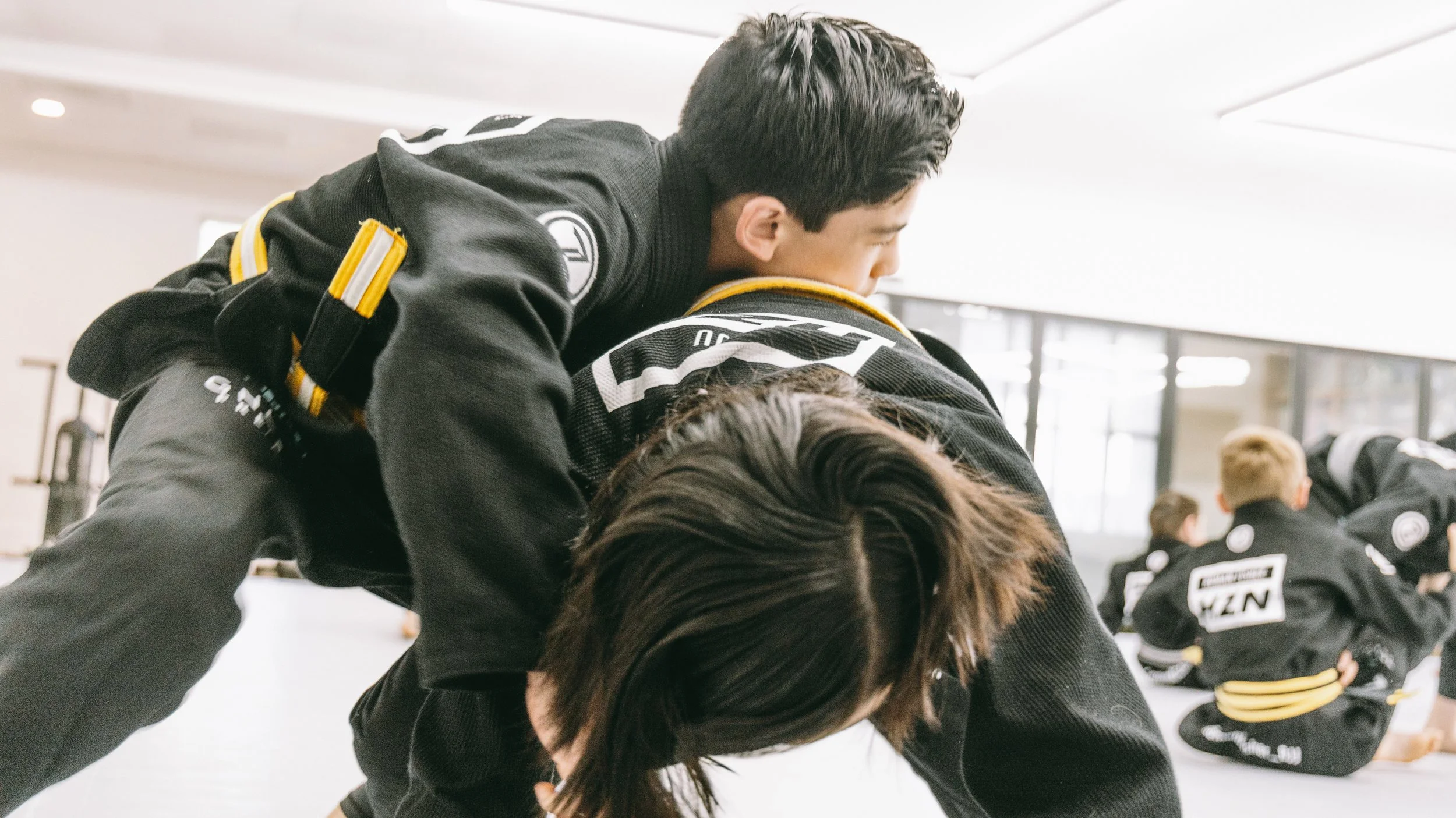
On the mat, confidence looks like the ability to stay engaged when things feel uncertain.
That might sound simple, but it’s a big deal for a child. Most kids are fine when they feel in control. The challenge is what happens when they don’t. When a technique doesn’t work the first time. When a training partner is stronger. When the coach gives a correction. When they lose a position. When they feel behind. When their heart rate goes up and their brain wants to panic.
A confident child is not the child who never struggles. A confident child is the child who struggles and keeps going.
In a kids jiu jitsu class, you can see it in small moments. A child tries the move even though they’re not sure they’ll get it. They listen when a coach corrects them, even if it stings a little. They lose a position and keep working instead of freezing. They tap and reset without embarrassment because they understand tapping is how we train safely. They treat partners with respect, even when they’re frustrated, because they’re learning that self-control is part of the art.
That’s confidence built on something real.
It’s also why we don’t confuse confidence with being loud. Some confident kids are quiet. Some confident kids are high-energy. Some confident kids are intense. Some confident kids are sensitive. What they share is steadiness. They can feel a feeling without it driving the car.
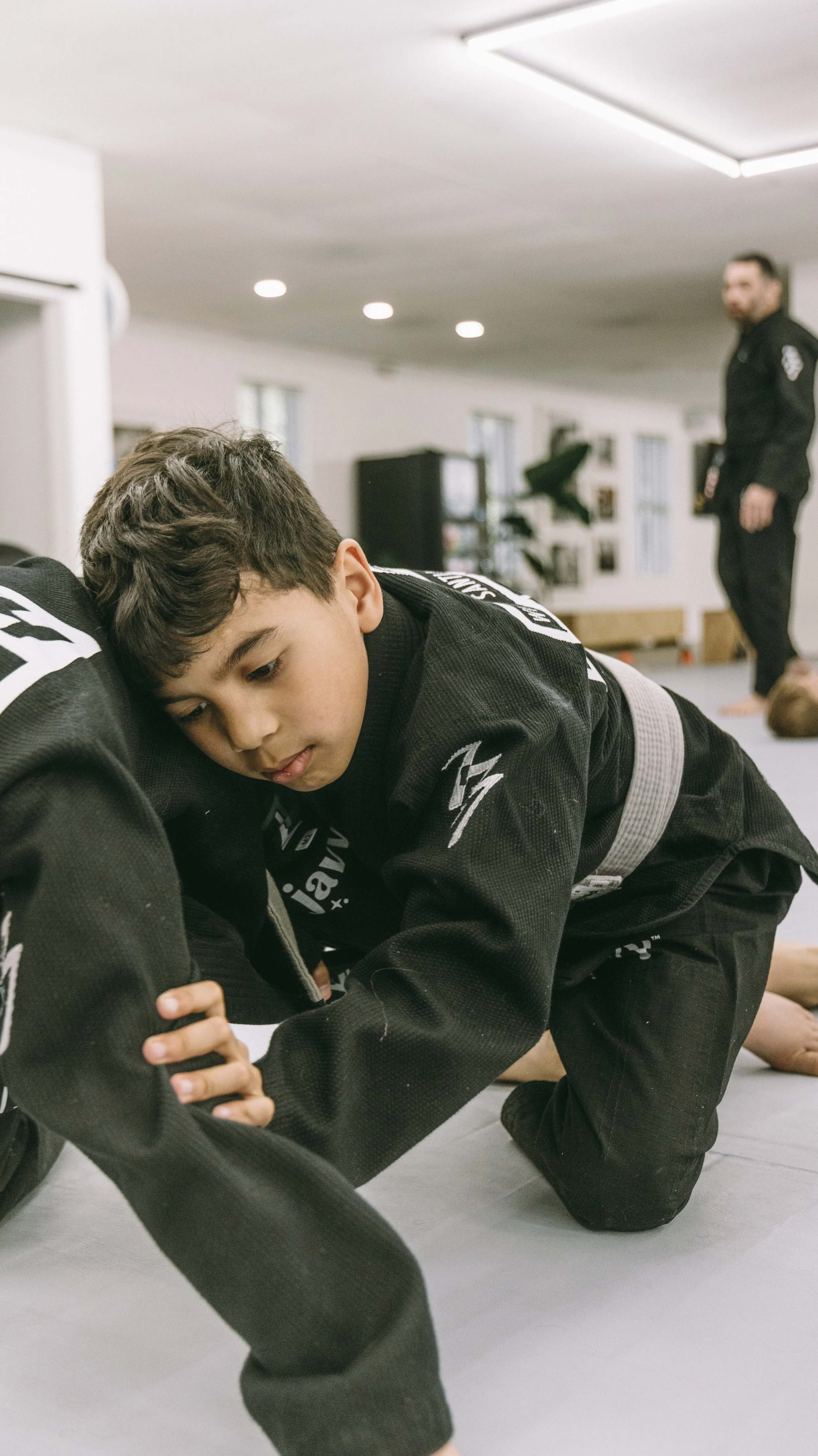
A lot of parents come in hoping jiu jitsu will “bring their kid out of their shell.” Sometimes that happens. More often, what happens is better. Their child becomes comfortable being themselves. They don’t need to perform. They don’t need to prove. They can just do the work.
That matters, because kids are smart. They can tell when confidence is fake. They can tell when a kid is acting tough to cover fear. Real confidence is quieter. It’s an internal posture. It’s, “I can handle this,” even if their voice shakes a little.
One of the reasons jiu jitsu is so effective for building that kind of confidence is that it gives immediate feedback. If you do the movement correctly, things start to work. If you forget the detail, things fall apart. That feedback loop is honest, and it makes progress visible. Kids start to trust the process because they can feel the difference in their body.
And in a good program, that honesty is paired with safety and structure. We don’t throw kids into chaos and call it growth. We give them a clear plan, we match partners carefully, and we teach them how to train with control. Confidence grows best when challenge is real but manageable.
This is also why jiu jitsu can be a great fit for kids who haven’t thrived in traditional sports.
A lot of sports reward early athleticism. If a child is fast, coordinated, or naturally aggressive, they get results quickly. If they’re not, they can feel behind from the start. They might spend an entire season chasing the game and never touching the ball, and the message they internalize is, “I’m not good at this,” or worse, “I’m not a sports kid.”
Kids jiu jitsu is different. Everyone is learning a new language at the same time. Balance, base, grips, positioning, timing, pressure, breathing. Even the “sporty” kids have to slow down and learn. Even the strong kids have to learn that strength without technique doesn’t last. The starting line is more even.
Shy kids often do well because they listen closely. They watch details. They tend to be respectful partners, and that helps them get good training reps. Uncoordinated kids often do well because jiu jitsu is built on repetition and specific movement patterns. We don’t just say, “Go play.” We teach a movement, then we practice it again and again, and the child’s coordination improves as a result.
Sensitive kids often do well too, even though parents sometimes worry they won’t. Sensitive kids notice things. They pick up on tone, pace, and pressure. With the right coaching, sensitivity turns into awareness instead of anxiety. They learn how to stay present when their body feels stress. They learn that discomfort is information, not danger.
One of the biggest mistakes parents make is looking for a personality change.
Your child doesn’t need a new personality. They need more capacity.
A shy child doesn’t need to become loud. They need to become steady. They need to know they can speak when it counts, hold eye contact when it matters, and make a decision under pressure.
A high-energy child doesn’t need to become calm all the time. They need to become controllable. They need to learn how to turn the volume knob down without being told ten times. They need to learn how to be intense without being unsafe.
A strong-willed child doesn’t need to become “easy.” They need to become coachable. They need to learn the difference between stubbornness and perseverance. They need to practice taking feedback without taking it personally.
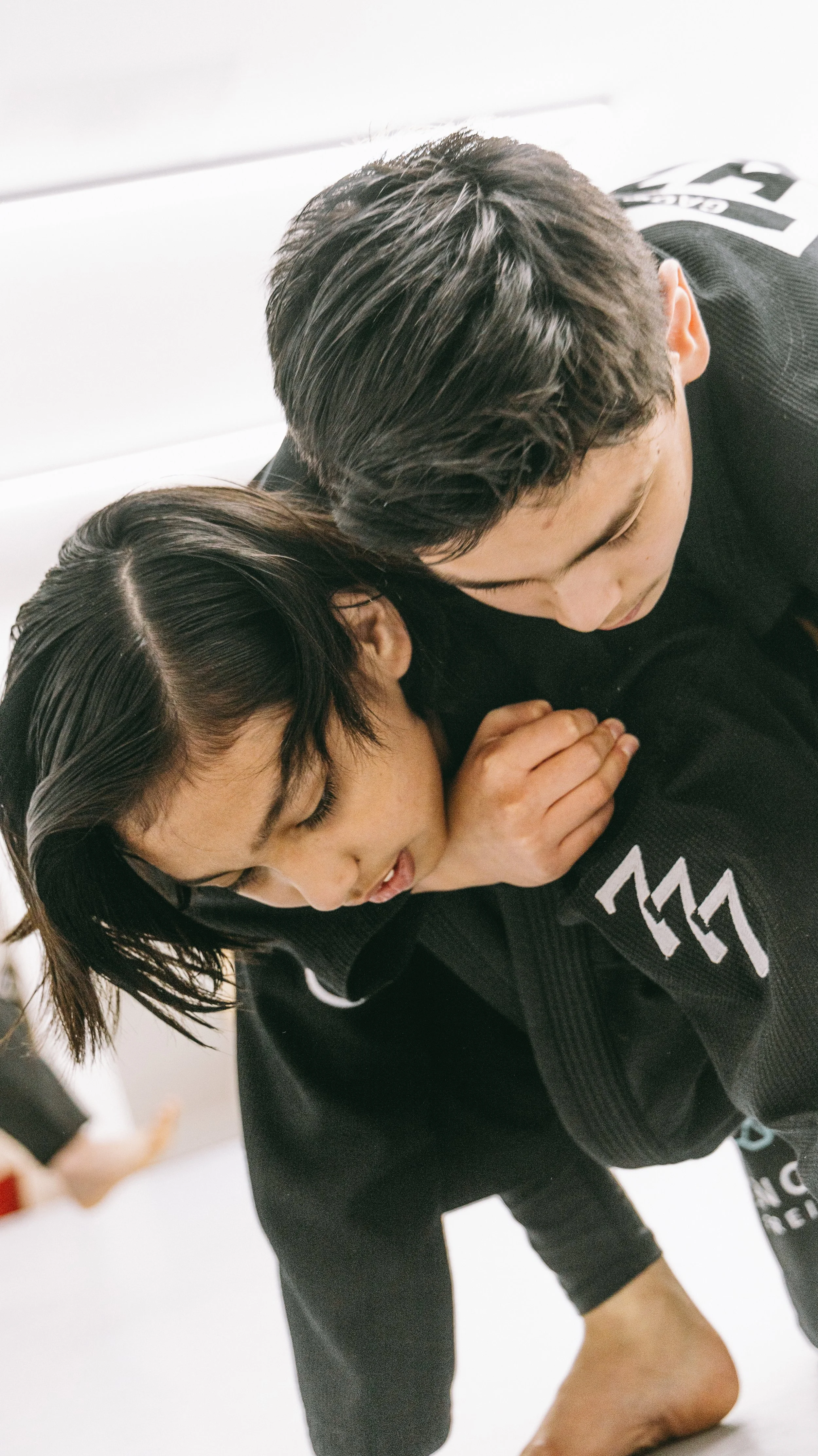
Jiu Jitsu gives kids a place to build that capacity in a structured way. The mat is a controlled environment where your child can test themselves, fail safely, and try again. It’s a place where they learn personal responsibility in a way kids can actually understand. If they don’t listen, they don’t improve. If they don’t show control, they don’t get trusted with harder rounds. If they don’t respect partners, the room doesn’t work.
Those are real lessons, and kids feel them.
At Houzn, we care a lot about culture because culture is the container that makes these lessons land the right way. We want kids to be tough in the sense that they can handle adversity, but we don’t want them to be hard in the sense that they become careless with others. Our goal is a kid who can hold their own and still treat people the way they’d like to be treated. That’s one of our core values for a reason.
When parents ask me what confidence looks like long-term, I tell them to watch for small, boring wins. The kind that don’t make for flashy videos, but make for a stronger kid.
It looks like your child being willing to try a new activity without needing to be “good” on day one. It looks like fewer tears after mistakes, or tears that come and go faster. It looks like them being able to speak up with adults, even if they’re nervous, because they’ve practiced doing hard things in front of a coach. It looks like less fear of looking silly. It looks like better recovery after setbacks.
That’s the dividend of learning to struggle safely.
Jiu Jitsu puts kids into “problem” positions on purpose. Not to scare them, but to teach them that there is a way forward even when the moment feels tight. When a child learns how to breathe in a bad position, build frames, make space, and escape, they’re also learning something deeper: “I can be uncomfortable and still think.”
That skill is rare now. A lot of modern life trains kids to avoid discomfort. If something is hard, we switch it. If something is boring, we scroll. If something is frustrating, we quit. Then we wonder why kids have such a low tolerance for challenges.
Jiu Jitsu is a counterweight. It teaches a child to stay with the problem long enough to solve it.
That doesn’t mean every class is heavy or intense. Kids classes should be fun. They should feel welcoming. But “fun” doesn’t mean “easy,” and it definitely doesn’t mean “no standards.” The fun in jiu jitsu comes from progress. It comes from the moment something clicks. It comes from realizing, “I couldn’t do that last month, and now I can.”
Confidence is built one rep at a time.
If you’ve never watched how a child changes over a few months of consistent training, it can surprise you. Early on, many kids rely on speed or excitement. They move a lot, but not on purpose. They hold their breath. They get frustrated quickly. Over time, with good coaching, you start seeing a different kid. They slow down. They listen. They choose better moments. They accept corrections. They tap without drama. They start taking pride in doing things the right way.
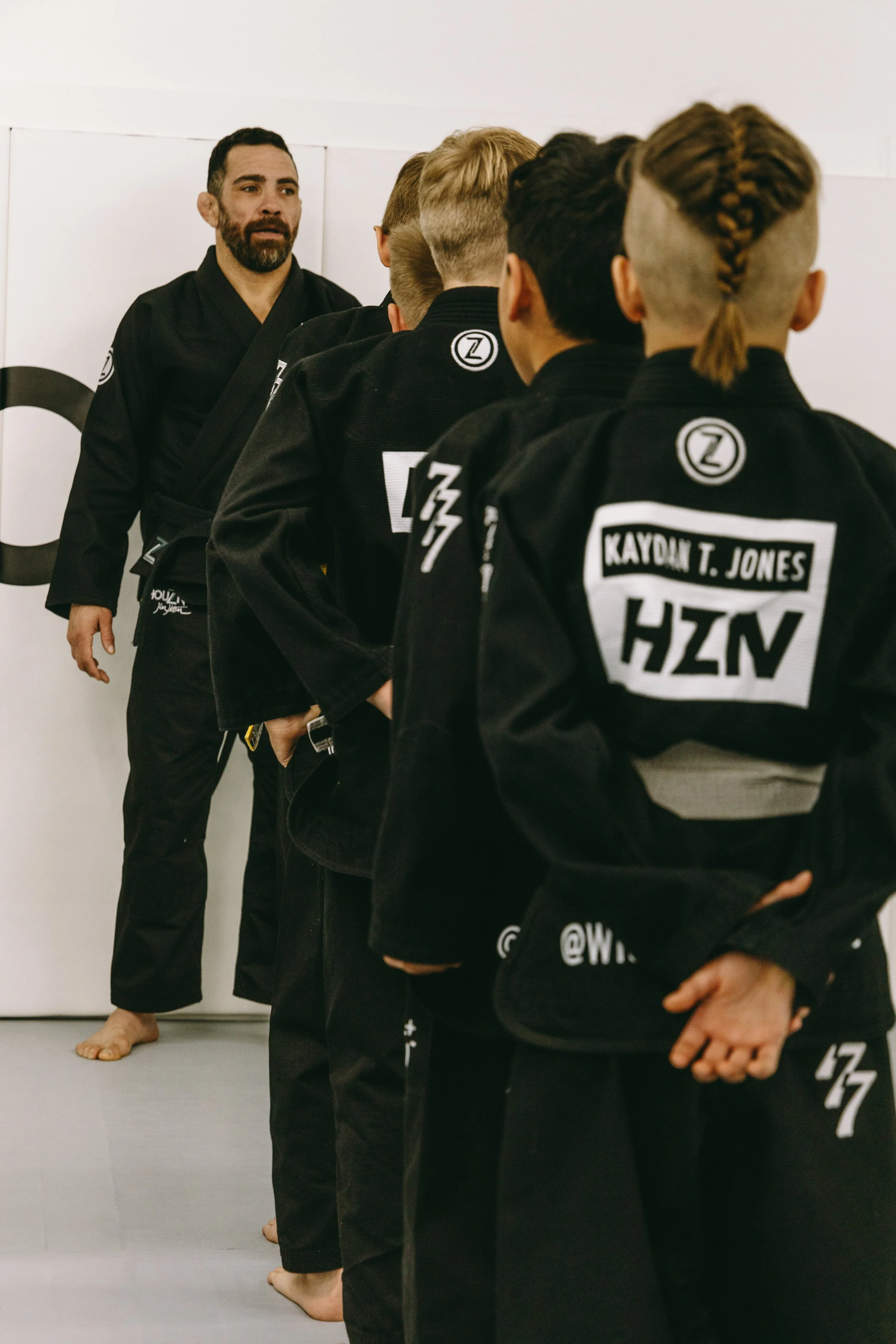
If your child is shy, you can also support them by not forcing them to perform socially right away. Let them build trust with the environment. Consistency is the best social lubricant. If your child shows up regularly, the room becomes familiar, and familiar reduces anxiety. Over time, they start talking more because they feel safe.
If your child is high-energy, you can support them by framing control as a skill, not a punishment. Instead of, “Stop being wild,” you can say, “Show me you can control your body the way coach asked.” That turns it into a challenge they can take pride in.
If your child is strong-willed, you can support them by framing coachability as strength. “Strong kids can take feedback.” “Leaders listen.” Again, you’re pointing their identity toward growth.
One more thing parents appreciate hearing is that confidence rarely grows in a straight line. Kids have seasons. Some weeks they feel unstoppable. Some weeks they feel behind. Sometimes they’re dealing with school stress, sleep changes, or friendship drama, and that shows up on the mat. That doesn’t mean they’re regressing. It means they’re human. Jiu jitsu gives them a stable place to practice showing up anyway.
That’s one of the reasons we talk about personal responsibility so much in our culture. Not responsibility as guilt, but responsibility as power. If your child learns, early, “My actions matter, my choices matter, my effort matters,” they become harder to break. They stop waiting for motivation. They build a relationship with discipline.
And discipline is the road to achievement. Not just on the mats, but everywhere.
If you want a clear picture of what confidence looks like for your child right now, grab your kids coach after class or ask for a conference with the coach. We’ll tell you what we’re seeing, what to expect next, and one simple focus that will make the next stage easier.
That pride is healthy. It’s not ego. It’s self-respect.
This is also where our approach to progress matters. In kids jiu jitsu, promotions should reflect more than attendance. At Houzn we follow the IBJJF kids belt system, and stripes are earned. Four stripes are needed before a belt change, and we look at a few simple things: whether your child has put in at least 24 hours of practice, whether they can apply what we teach with a real partner, and whether their behavior shows maturity and respect.
Why does that matter for confidence? Because when your child earns something that’s real, they feel it. They know the difference between a participation trophy and a hard-earned stripe. That stripe becomes a story they tell themselves: “I can work for something and get it.” That story is a big part of how confidence forms.
Now, there’s a parent side to this too. Sometimes parents unintentionally put pressure on confidence. They want to help, but the message lands wrong.
If a child says, “I lost,” and the parent responds with a long technical analysis or a frustrated tone, the child hears, “I’m disappointing you.” If the parent tries to rescue them by saying, “It doesn’t matter,” the child hears, “We don’t talk about hard things.” If the parent tries to pump them up by saying, “You’re the best,” the child hears something that doesn’t match their experience, and it can actually make them doubt themselves more.
A better approach is to praise the process.
When you praise effort, composure, and coachability, you build identity around things your child can control. You also teach them what confidence actually is. Confidence isn’t “I win.” Confidence is “I do the work.”
So after class, keep it simple. Tell them what you saw. “I liked how you kept trying.” “I liked how you listened when the coach corrected you.” “I liked how you stayed respectful even when you were frustrated.” That kind of feedback is powerful because it reinforces the behavior that leads to growth.
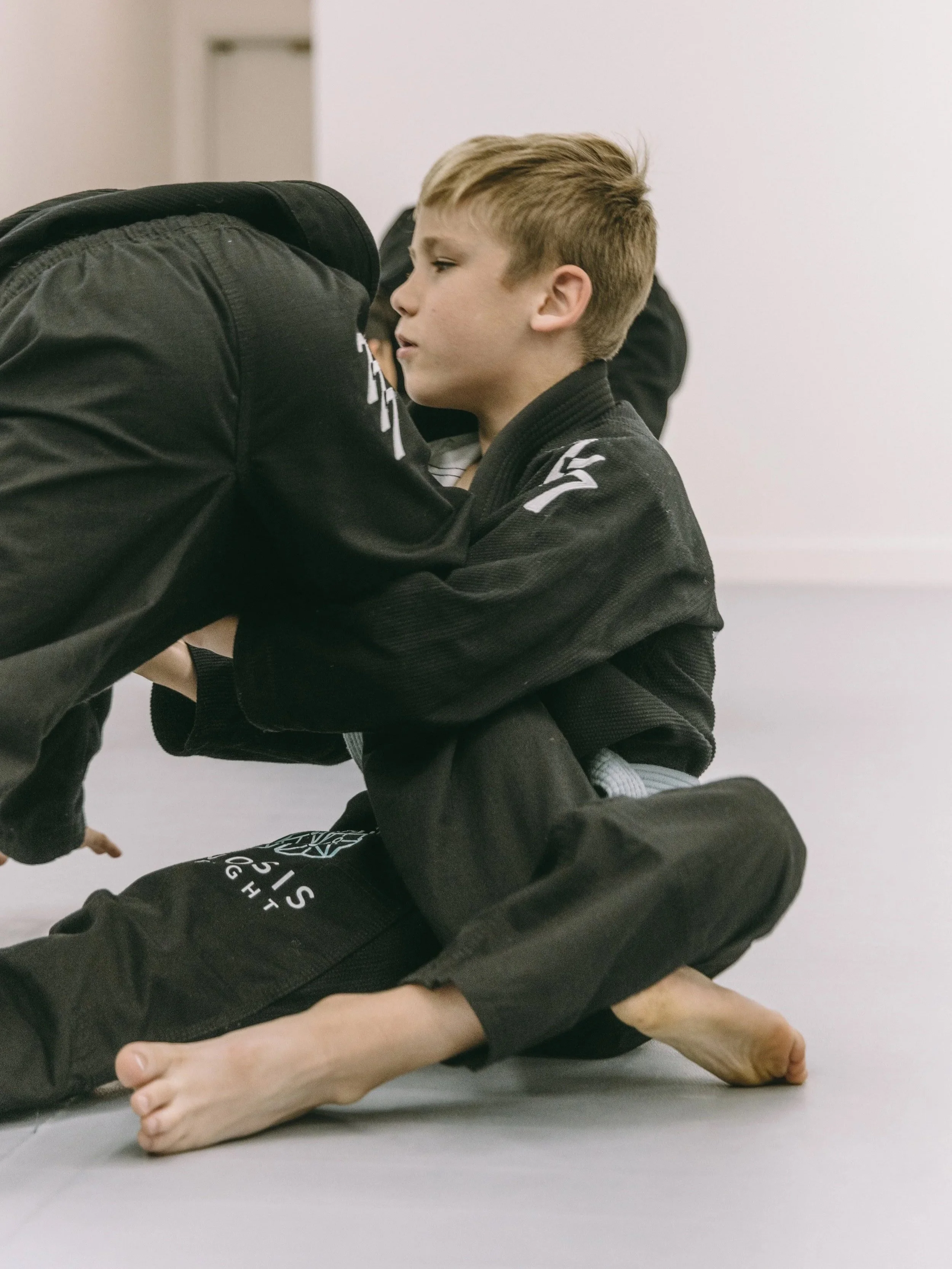
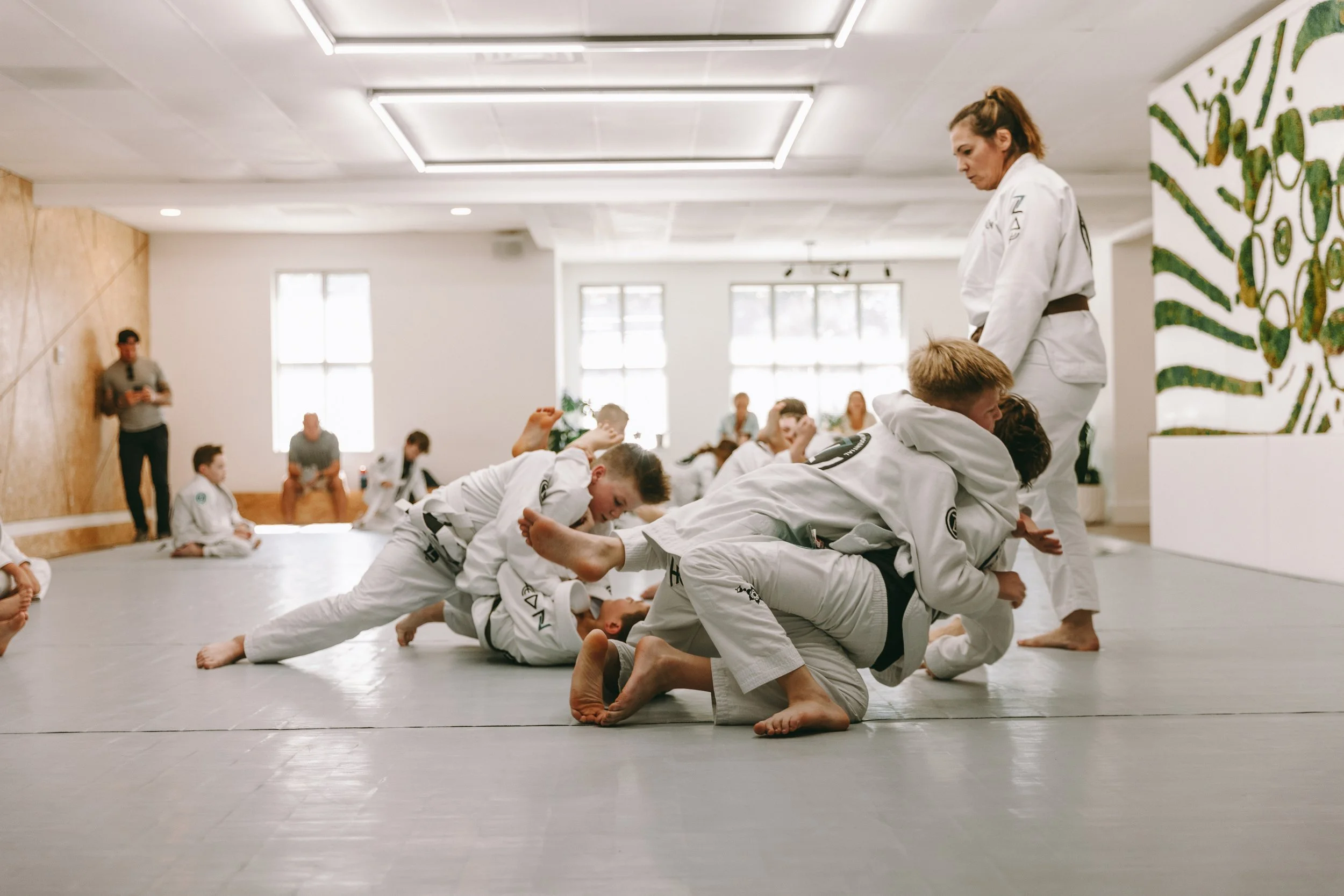
Learning to Lose in Kids Jiu Jitsu (A Healthy Skill for School and Life)
Kids don’t need to “win all the time” to build confidence. In fact, one of the best lessons in kids jiu jitsu is learning to lose safely—tapping, resetting, and trying again without shame. This post from Houzn Jiu Jitsu Academy in Mount Pleasant, SC (serving Charleston families) explains how Brazilian jiu jitsu for kids builds resilience, emotional control, and respect through controlled challenges. You’ll also learn what parents can say at home to reinforce progress without turning training into pressure.
Many parents want their child to feel confident, but they also hate seeing their child “lose.” That’s a normal parent reaction. We’ve had that same conversation hundreds of times here at Houzn Jiu Jitsu. A mom or dad will hang back after class and say, quietly, “Coach… my kid gets really upset when they get tapped,” or “They hate being on the bottom,” or “They did great until someone beat them, and now they don’t want to come back.”
If that’s your situation, I want you to know two things. First, your child isn’t broken. Second, neither are you for feeling protective. Watching your kid struggle hits a different nerve than watching an adult struggle. It can feel like the world is putting weight on their chest and you can’t lift it off fast enough.
Jiu jitsu approaches confidence differently than most activities. We don’t build it by creating a path where a child always wins. We build it by showing them they can survive hard moments, stay respectful, make good decisions under pressure, and come back again. That’s the kind of confidence that lasts, because it isn’t based on being the best kid in the room. It’s based on becoming the kind of kid who can handle the room.
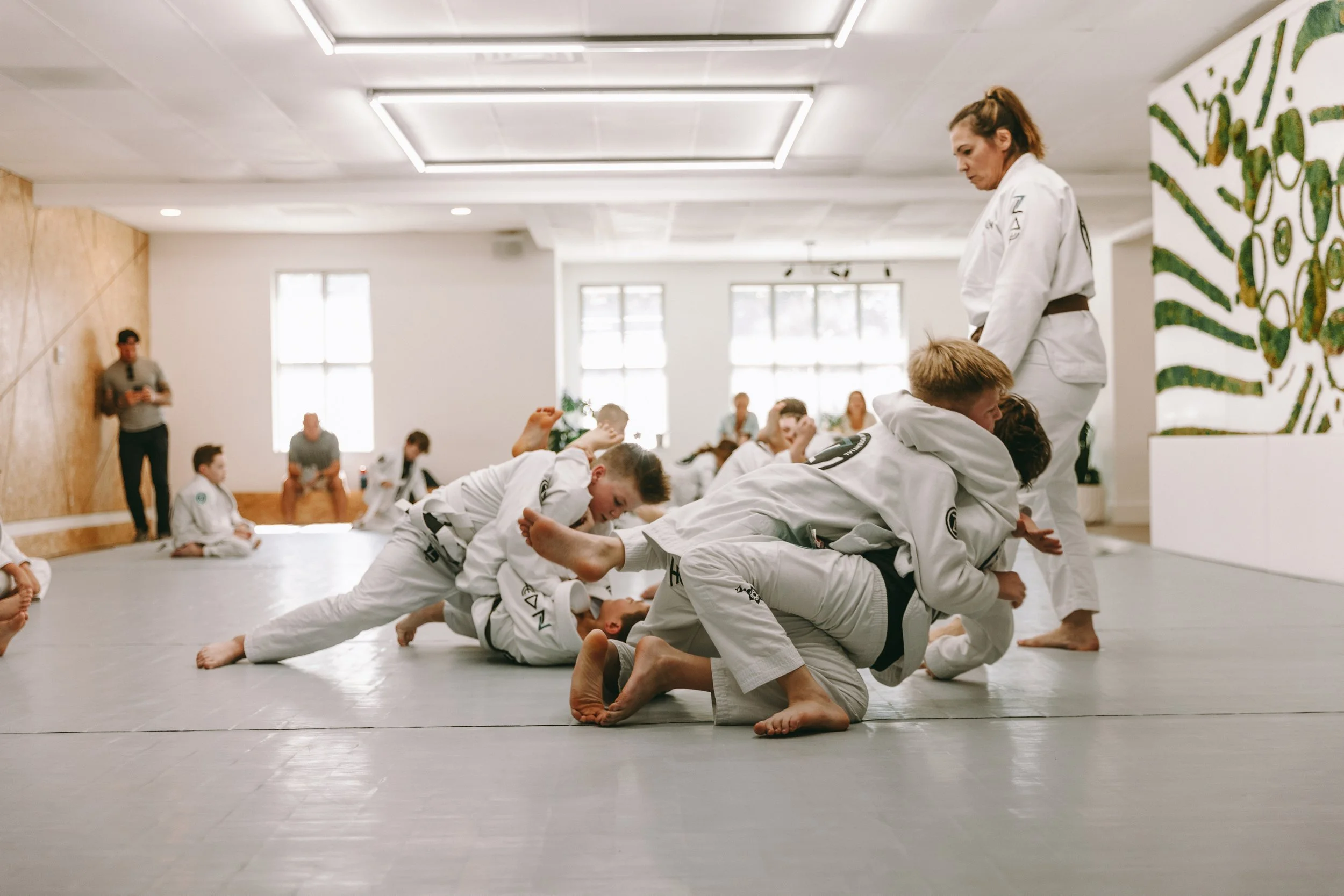
When parents hear that, they usually nod, but the emotional part is still there. So let’s make it simple and real: what does “losing” actually mean in kids jiu jitsu, and why do we lean into it instead of avoiding it?
In a kids class, losing doesn’t look like a scoreboard. It looks like getting stuck in a position and not knowing how to move. It looks like getting swept and ending up underneath. It looks like being controlled by a training partner who feels stronger or more technical. And sometimes it looks like getting tapped.
For a lot of kids, especially early on, those moments feel personal. A child doesn’t think, “I lost a position.” They think, “I lost.” And when you’re seven, nine, or eleven, “I lost” can quickly turn into “I’m not good at this,” or “Everybody saw me,” or “Coach is disappointed,” even when none of that is true.
This is where the culture of the room matters. At Houzn, we’re serious about safety and we’re serious about character. We don’t allow the mat to become a place where kids get laughed at, singled out, or treated like their value depends on their performance. Jiu jitsu is a proving ground, but it’s not a humiliation ritual. It’s a place to build personal responsibility, self-control, and a steady kind of courage.
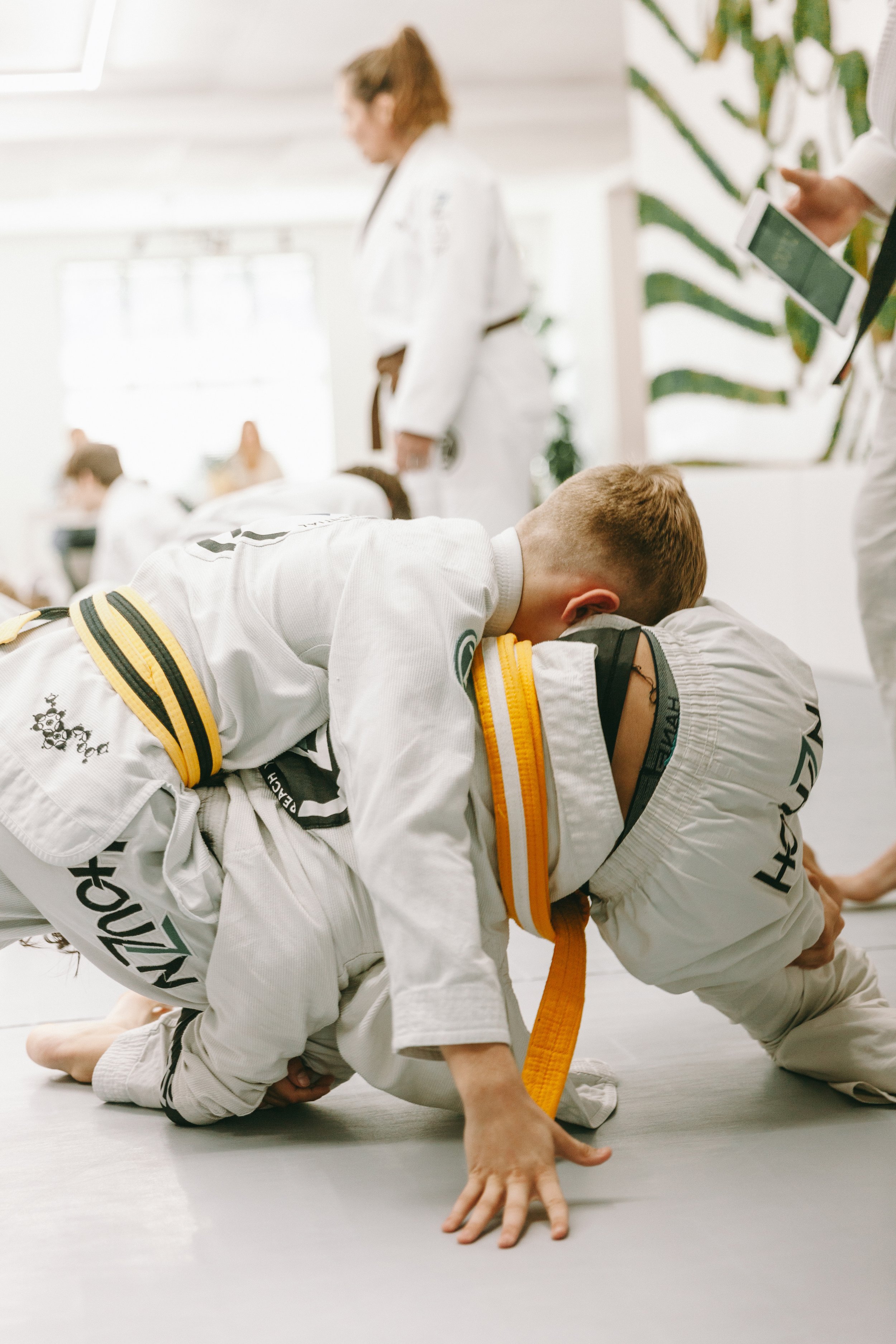
Over time, if your child stays consistent, something shifts. They start to understand what those tough moments actually are. They’re feedback. If your child keeps getting stuck in side control, it doesn’t mean they’re weak. It means they’re missing a detail. If they keep getting swept when they stand up, it doesn’t mean they’re hopeless. It means their base and posture need work. If they keep getting caught in the same submission, it doesn’t mean they “can’t do jiu jitsu.” It means we now know exactly what to practice.
That’s one of the reasons jiu jitsu is so effective for building confidence. It’s honest. It gives instant information. And when you train in a healthy environment, that honesty doesn’t tear you down. It builds you.
Now let’s talk about the tap, because this is the part that parents either love right away or worry about at first.
In jiu jitsu, tapping is how we say, clearly and safely, “That’s enough.” It’s the simplest safety system in martial arts, and it’s also one of the best life skills a child can learn. When a child learns to tap early and tap without shame, they’re learning how to recognize a limit before something breaks. They’re learning how to communicate under pressure. They’re learning that you can be calm even when you’re uncomfortable. And they’re learning how to reset and keep going without turning it into drama.
That “reset” piece is huge. Most kids don’t need more intensity in their life. They need better emotional control. They need practice in the middle space between exploding and quitting.
A lot of kids, when they feel behind, go one of two ways. They go into panic mode and fight harder and harder until they get frustrated, angry, or reckless. Or they shut down and check out because it hurts to try when you might fail. Neither of those habits helps a child in school, in friendships, or later in life. Tapping teaches a third option. You acknowledge reality, you choose safety, and you start again.
Some parents hear “tap” and worry it teaches their child to give up. It doesn’t. The kid who taps appropriately usually becomes more resilient, because they’re not carrying fear. They know they have choices. They learn that a bad position isn’t the end of the world; it’s just a problem to solve. And they learn that there is no shame in protecting your body and trying again.
There’s also a deeper layer that shows up as kids mature. Tapping teaches boundaries. A child learns that they are allowed to say “stop” in a clear way, and that good people respect it. That is a powerful lesson, especially in a world where kids often feel like they have to tolerate discomfort to fit in. On our mats, they learn respect for others and respect for themselves at the same time.
This is also why we don’t chase “always winning” as the goal.
When a kid always wins early, they often stop exploring. They stick with whatever works and avoid the places where they feel uncertain. They can become dependent on being “the good one,” which sounds nice until the day they aren’t. Then the whole identity gets shaky. Their confidence was built on results, not on growth.
The kids who struggle and stay with it often become the most capable long-term. They learn problem-solving because they have to. They learn patience because there is no shortcut. They learn composure because the mats keep asking them to breathe and think when they’d rather rush. And they learn humility, which isn’t about being small; it’s about being teachable.
That’s one of our core values at Houzn. Discipline is the road to achievement. Not the kind of discipline that feels like punishment, but the kind that builds a person from the inside. A child who learns to show up, listen, practice, and improve one piece at a time is learning how to create their own results. That lesson goes way beyond jiu jitsu.
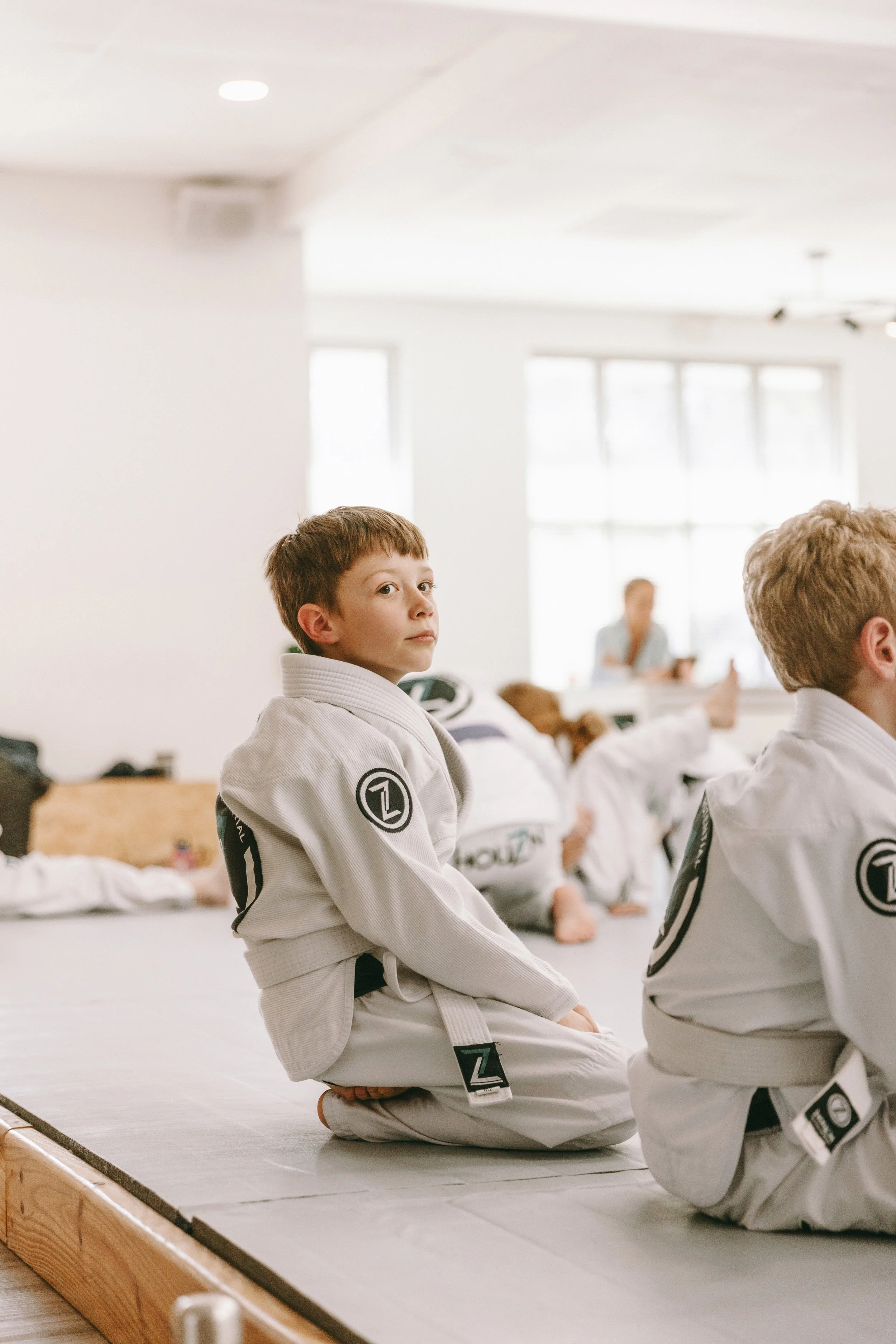
If your child is sensitive, you may need a little more guidance around how to talk about losing. Sensitive kids usually aren’t trying to be difficult. They’re often highly aware, highly self-critical, and quick to feel embarrassment. When they get tapped, they might feel like they disappointed you. Even if you didn’t say a word, they might still carry that story.
The best thing you can do is normalize it in a calm, matter-of-fact way. “Everyone gets tapped” is one of the most helpful sentences you can say, as long as you say it gently. You’re not dismissing their feelings. You’re taking them out of the spotlight. You’re reminding them they’re part of the process, not the exception to it.
The next thing is to praise the right moments. Praise recovery. If they got tapped and re-engaged, that’s a win. If they were frustrated and still finished the round respectfully, that’s a win. If they tried the escape you’ve been working on, even if it didn’t work, that’s a win. When you praise effort and decision-making, you help them build process-based confidence. Process-based confidence doesn’t collapse when things go wrong.
What tends to backfire is turning the drive home into an interrogation. I understand why parents do it. You want to help. You want information. But for many kids, a detailed play-by-play feels like reliving the worst parts of class. They might not have the words to explain what happened, or they might feel like they’re being evaluated. That can turn a normal tough day into a bigger emotional event.
A better approach is to keep it simple. Ask one question and then let them lead. “What did you work on today?” or “What was one thing you did better?” If they want to talk, listen. If they don’t, let the class be the class and let home be home. Your job isn’t to be their second coach. Your job is to be their safe place.
As coaches, our job is to challenge them without overwhelming them. A well-run kids program doesn’t throw a child into chaos and call it toughness. We scale the room. We match partners carefully. We teach rules that protect everyone. We correct behavior, not with shame, but with clear expectations. We create an environment where kids can learn personal responsibility and still feel supported.
One practical tool that helps a lot is giving a child a single focus for a few weeks. Not “win more.” Not “don’t get tapped.” Something they can control, like breathing before they move, keeping their elbows in, building their frames on bottom, or standing up with posture. A child who has one clear job shows up differently. They’re less likely to spiral because they’re not trying to solve everything at once. They’re building a brick, not trying to build the whole house in one night.
If you’re wondering when you’ll see the benefits at home, you’ll usually notice them in ordinary moments first. Your child might quit less quickly at homework. They might handle losing a game with less intensity. They might take feedback from a teacher without melting down. They might still get frustrated, but the recovery is faster. They might even start using the language of training without realizing it: “I’m going to try again,” or “I need to practice,” or “That was hard, but it’s okay.”
That’s the real transfer. Jiu jitsu becomes a framework for life. Pressure happens, you breathe, you find a solution, you reset, you keep going. That’s what we mean when we say confidence is trained. It’s not a pep talk. It’s a skill.
There’s also something important happening beneath the surface. In a healthy program, kids learn morality and truth in a practical way. They learn what it means to be honest about where they are, without making excuses. They learn that personal responsibility isn’t a punishment; it’s freedom. When a child realizes, “If I practice this one thing, I get better,” they start to understand that they are not stuck. They can create change. That’s a powerful idea for a kid to carry.
So if losing is becoming a sticking point, don’t wait until it turns into “I don’t want to go anymore.” Grab your kids coach after class or ask for a quick conference. We can help you choose a simple focus for the next few weeks, and we can adjust how we coach your child inside the room so they’re challenged in a way that builds them instead of flooding them.
Most of the time, the solution isn’t making the training easier. It’s making the training clearer. Clear goals, good partners, steady coaching, and the right words at home. That’s how a sensitive child becomes a strong one, without losing who they are.
At Houzn Jiu Jitsu Academy, we’re here to help your child reach their potential, not just on the mat, but in the way they carry themselves through life. And sometimes that starts with learning how to lose one small moment, take a breath, and come back.
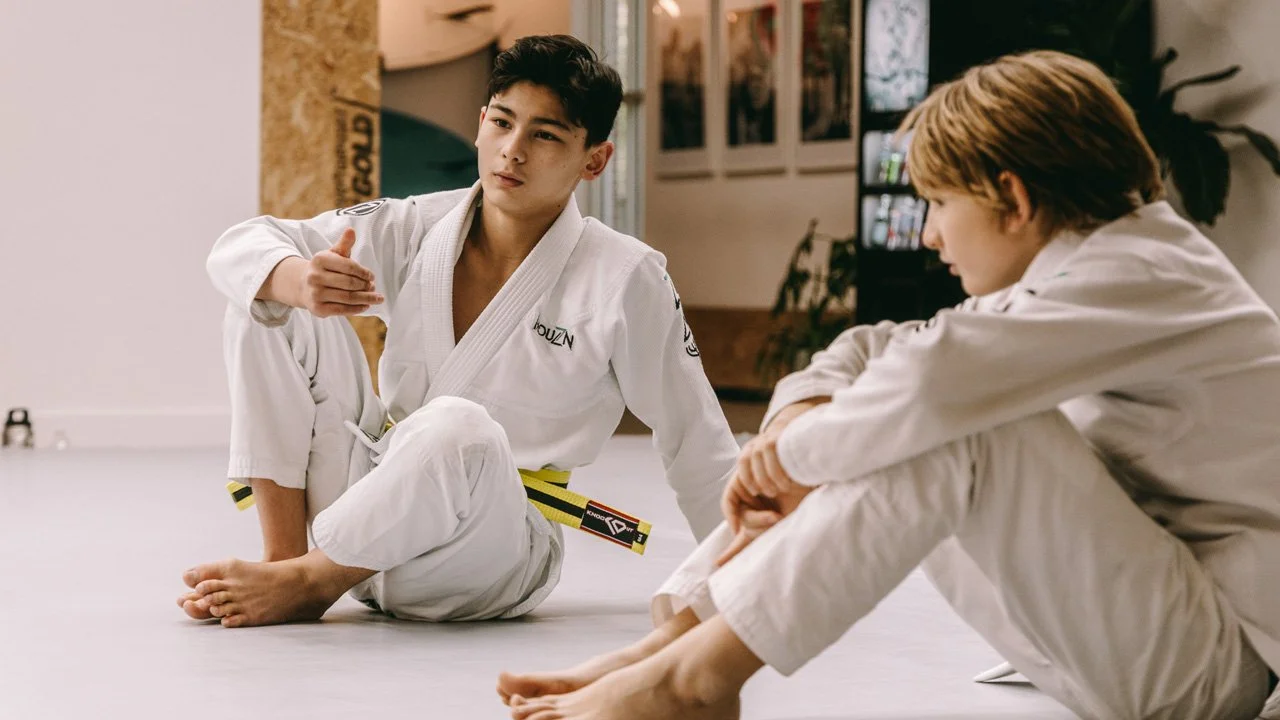
How Kids Earn Stripes in Brazilian Jiu Jitsu: Practice Hours, Skill, and Behavior
Stripes in kids jiu jitsu shouldn’t be random—and they shouldn’t be only about time. At Houzn Jiu Jitsu Academy in Mount Pleasant, SC (serving Charleston families), kids earn stripes based on at least 24 hours of practice, their ability to apply skills, and their behavior and respect on the mat. This post explains how the IBJJF kids belt system works, why children progress at different speeds, and how parents can support steady growth without comparing their child to others.
One of the most common parent questions in kids jiu jitsu is: “When do they get their next stripe?”
It’s a fair question. Most parents aren’t asking because they’re impatient or trying to rush anything. They’re asking because they care. They want to know their child is learning, growing, and not getting left behind. They also want something they can point to that feels concrete, especially when jiu jitsu can look messy from the outside. Kids tumble, scramble, laugh, sometimes freeze, sometimes surprise you. It doesn’t always look like “progress” the way a school grade or a soccer goal looks like progress.
So let’s make it simple and clear. At Houzn, stripes are not mysterious, and they’re not random. They’re a way for us to recognize real development in a way kids can feel and understand.
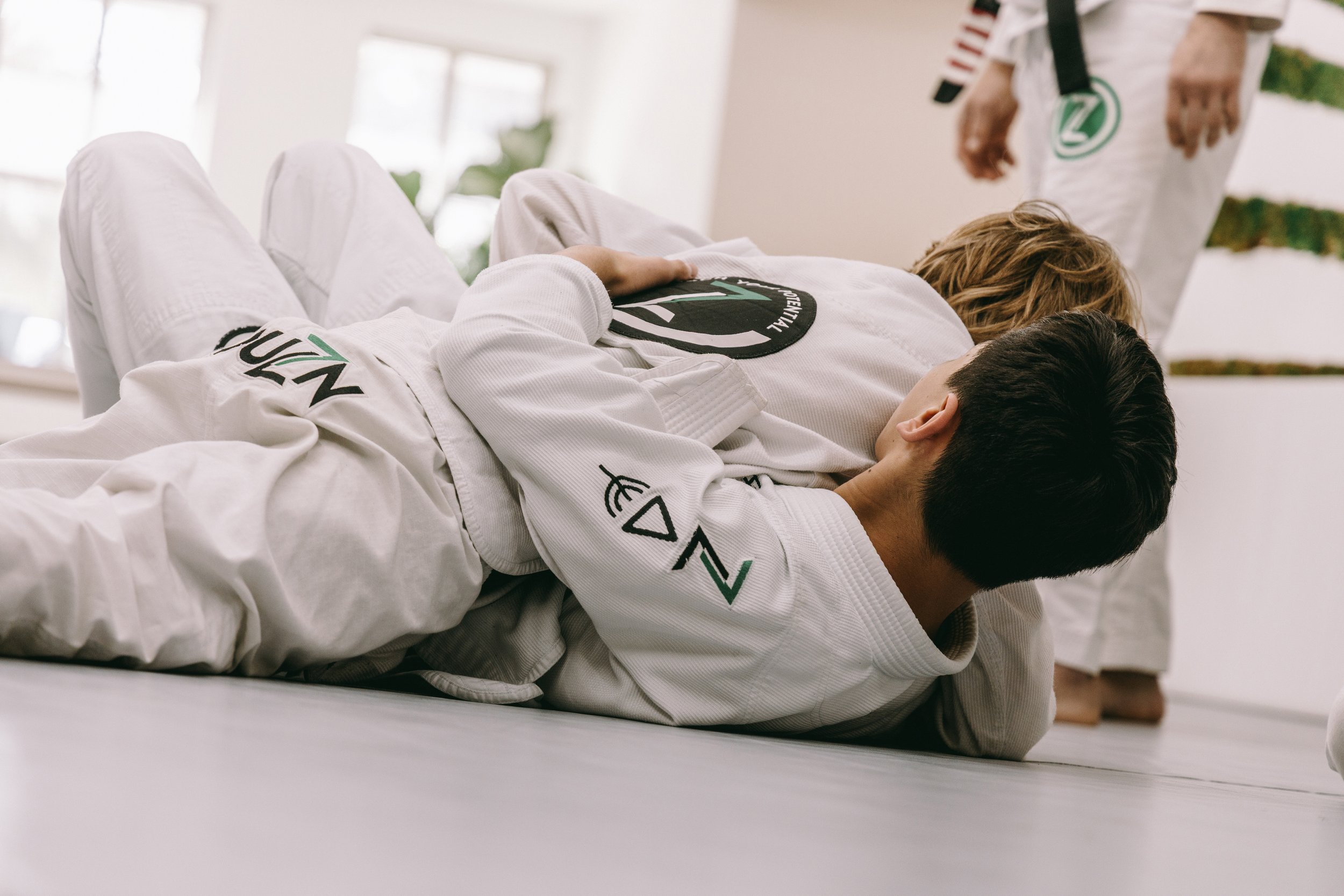
Stripes are not a popularity contest. They’re not about who is naturally athletic. They’re not about who “wins” the most rounds in class. And they’re definitely not something we hand out to keep families happy. That kind of system might feel good for a week, but it hurts kids in the long run because it teaches them that rewards come from being seen, not from building skills and character.
Stripes are a tool. They help kids stay motivated through a long learning curve while we reinforce the habits that actually make them better on the mat and more confident off the mat. When we put a stripe on a belt, what we’re really saying is: I see your effort. I see your improvement. I see your maturity. That last part matters more than most people realize. Kids don’t just “learn jiu jitsu.” They learn how to handle challenge, frustration, close contact, and feedback. Those things are part of the art, whether we say it out loud or not.
At Houzn, we use the IBJJF kids belt colors. That matters because it gives families a structure that’s respected and consistent across Brazilian jiu jitsu. If you move, travel, visit another academy, or compete, you’ll recognize the system and they’ll recognize yours. It keeps things honest and it keeps expectations realistic.
Between belts, we use stripes, and a child earns four stripes before moving to the next belt. Think of stripes as mile markers. Kids need them. Jiu jitsu takes time. There’s a lot to learn, and progress often happens in little jumps. If a child trains for months and feels like nothing changes, they start to wonder if they’re “bad at it.” Stripes help prevent that. They create a rhythm of acknowledgment while we keep our standards steady.
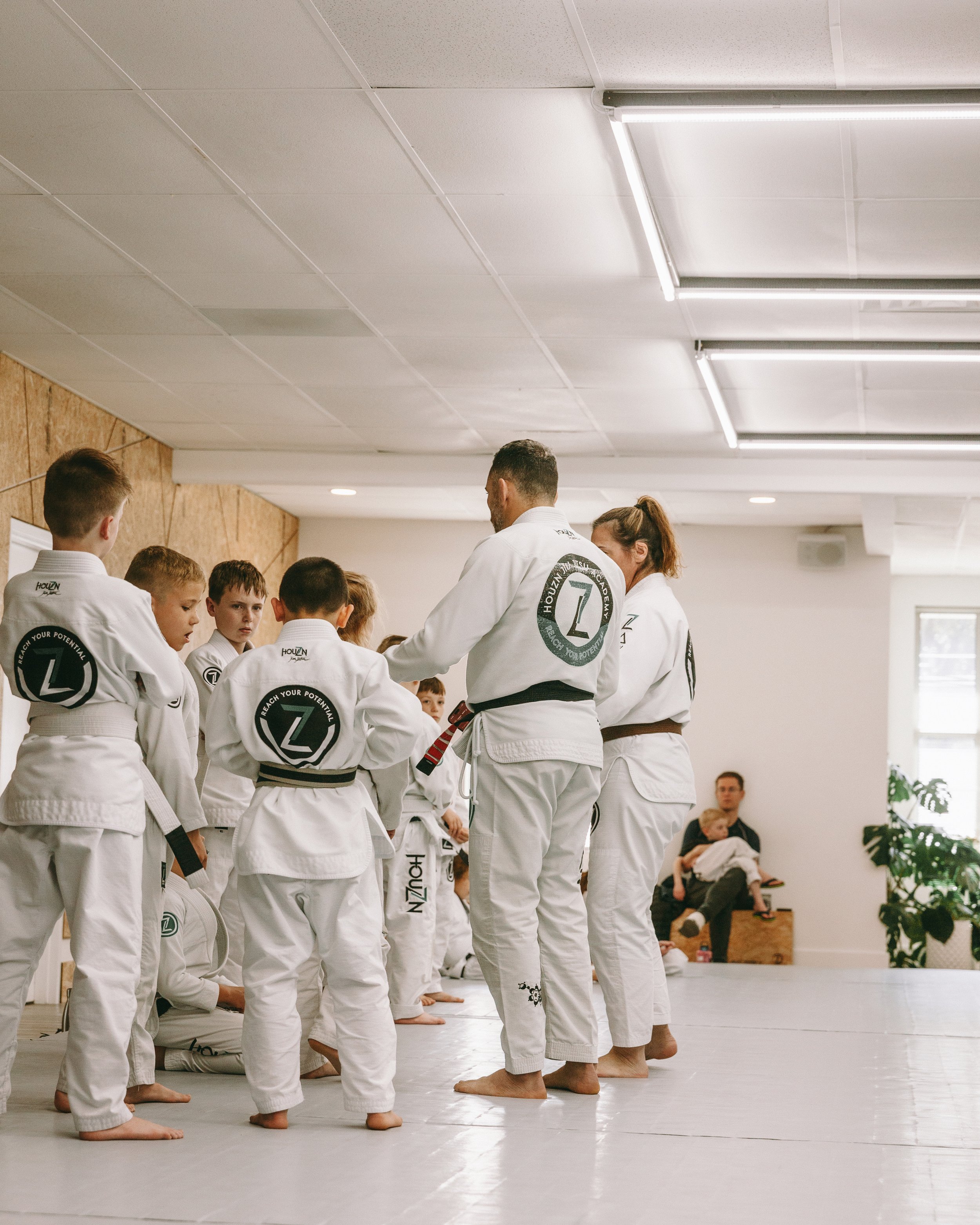
Now, what does it actually take to earn a stripe at Houzn?
We look at three main criteria. We don’t treat them as separate “boxes” where a kid can ignore one and make up for it with another. We look at the whole picture.
First, we look for at least 24 hours of practice.
We do this because it protects kids from what I call “promotion by calendar.” Skills require repetition. There’s no shortcut around time on the mat. Two kids could both have been enrolled for three months, but one trains once a week and the other trains three times a week. If we promoted them the same just because the calendar says so, the stripe would stop meaning anything.
Tracking hours is also fairer for families. Some weeks you’re traveling. Some weeks school is heavy. Sometimes a kid is sick. Life happens. Hours give us a better measurement of actual training exposure, and over time it smooths out the ups and downs.
Second, we look for the ability to apply skills learned.
This part is important, and it’s also where parents sometimes misunderstand what we’re looking for. We are not looking for perfect technique. We’re not looking for a child to move like an adult. Kids’ bodies are still developing. Their attention is still developing. Their emotional regulation is still developing. Expecting “perfect” would be unfair, and honestly it would make training tense instead of fun.
What we look for is recognition and intent. Do they recognize the situation we’ve been working on? Do they attempt the right response with real effort? If they get the move “wrong” but they clearly understood the goal and tried to solve the problem the way we taught, that’s progress. That’s learning. On the other hand, if a child can demonstrate a move when the coach is watching but can’t even attempt it during live rounds, that usually means they don’t own it yet. We help them get there.
A simple example: if we’ve been working on escaping from bottom position, I don’t need to see a flawless escape every time. I want to see them try the right frames, turn the right direction, and keep working even when it’s uncomfortable. That tells me they’re building real jiu jitsu, not just memorizing steps.
Respect shows up in small moments. Do they line up when asked? Do they keep their hands to themselves when the coach is talking? Do they stop when a partner taps? Do they help a smaller teammate feel safe? Do they recover well after losing a round, or do they melt down and quit? These are jiu jitsu skills too, because they’re the skills that let a kid keep training for years.
If you’re wondering why two kids can be the same age and still be on different stripe timelines, that’s normal.
Training frequency matters, but it’s not the only factor. Temperament matters. Some kids are naturally comfortable with close contact and physical problem-solving. Others need time to adjust to the feeling of being held down or squeezed, even when it’s safe. Comfort level matters a lot in the early months.
Growth spurts matter too. A kid who grows three inches in a short period often looks “clumsy” for a while. Their balance changes. Their timing changes. Their coordination needs time to catch up. That doesn’t mean they’re regressing. It means their body is updating and their brain is recalibrating.
Sleep and school stress matter more than people think. A tired kid learns differently. A kid who had a hard day at school may be more emotional on the mat. That doesn’t make them weak. It makes them human. We coach the whole child, not just the technique.
This is why comparing kids is a trap. It’s also why you’ll sometimes see a child who looks “quiet” get promoted before a child who looks “dominant” in sparring. The quiet child might be consistent, coachable, safe, and steadily improving. The dominant child might be relying on strength, avoiding learning, or struggling with control. In a good martial arts program for kids, progress is personal and it’s measured with care.
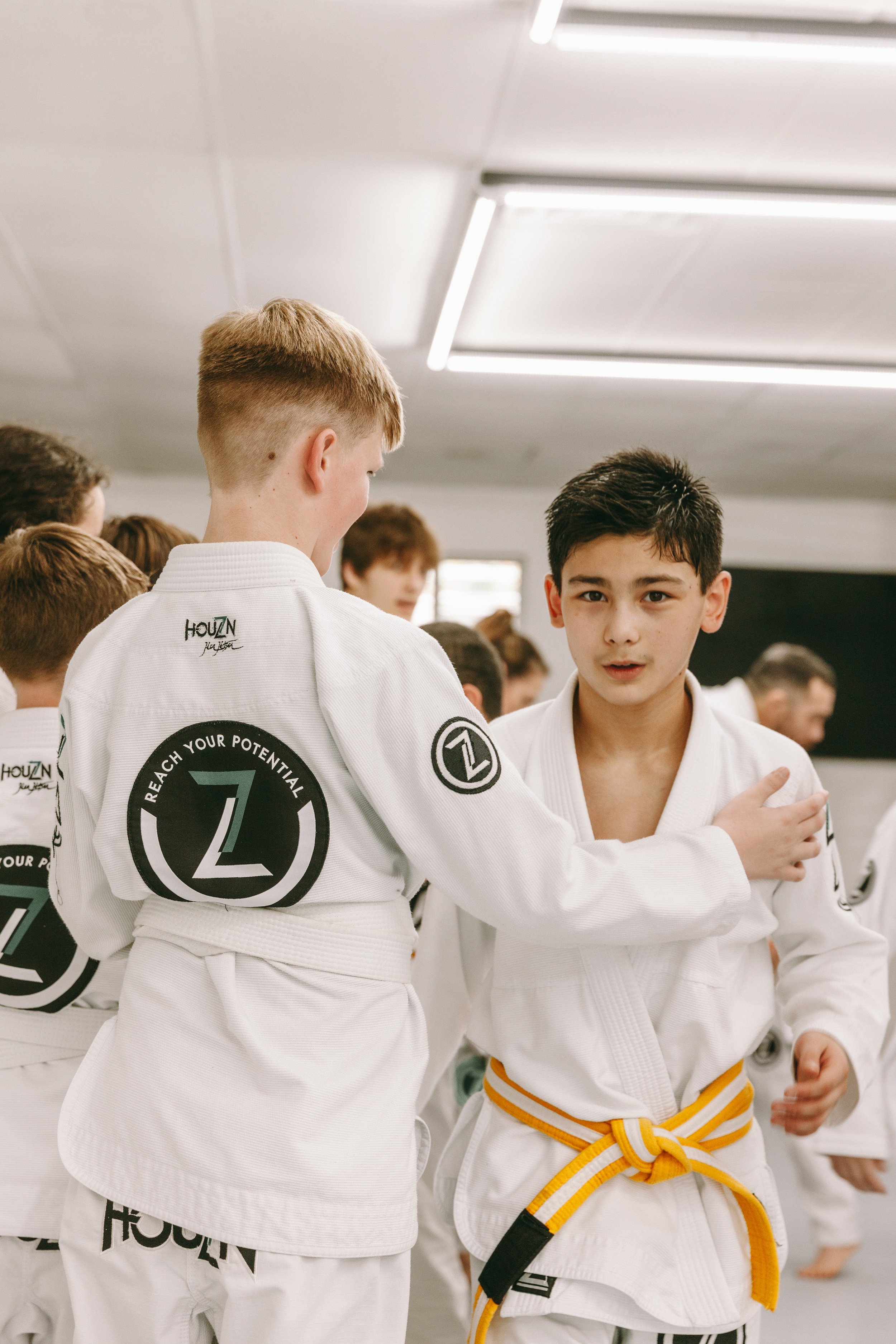
Now, the home question: what can parents do to support stripe progress?
You do not need to coach technique. In fact, most kids do better when their parent stays in the parent role and lets the coach be the coach. What helps the most is supporting routines and mindset.
If you can, protect training days as a normal weekly rhythm. When kids know that jiu jitsu is simply “what we do on Mondays and Wednesdays,” they stop negotiating with themselves. Consistency turns into confidence.
Praise effort and coachability more than outcomes. If a child hears “Good job” only when they win, they’ll start avoiding hard partners and hard situations. If they hear “I’m proud of how you kept trying” or “I liked how you listened and tried again,” they learn to stay steady under pressure. That’s the kind of confidence that lasts.
Ask what they learned, not who they beat. That one small change does a lot. “Who did you roll with?” is fine. “What did coach teach today?” is better. It keeps their attention on learning instead of status.
And celebrate small wins that adults often miss. Listening well. Trying again after getting stuck. Remembering to tap. Being kind to a newer teammate. These are the building blocks that lead to stripes, belts, and real growth.
One last thing that helps: if you’re ever unsure where your child stands, just ask us. You don’t have to guess, and you don’t have to read into what you see from the sidelines.
If you want to know what your child needs for their next stripe, grab your kids coach after class or ask for a short conference. We’ll give you a simple, specific answer based on your child, not based on a generic timeline. And if you’d like, tell us how many days a week you realistically want to train, and we can help you set expectations that feel calm and achievable for your family.
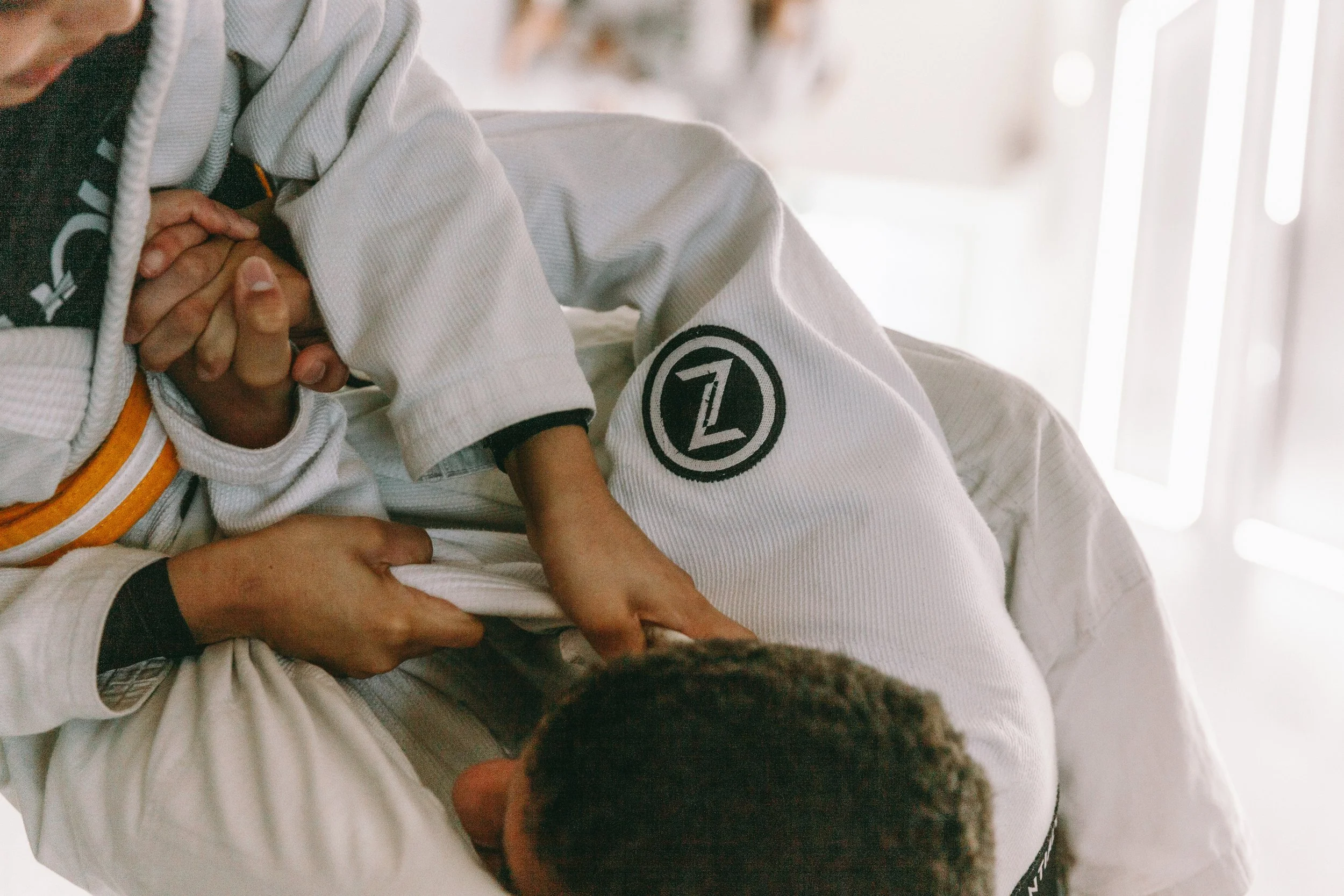
Why Kids Get Frustrated in Jiu Jitsu (and Why It Helps Them Grow)
Frustration in kids jiu jitsu is normal—and often necessary. In Brazilian jiu jitsu for kids, they feel pressure, get stuck, and learn how to breathe, listen, and keep going. This post from Houzn Jiu Jitsu Academy in Mount Pleasant, SC (serving Charleston families) explains what coaches look for when a child is frustrated, how to tell the difference between healthy challenge and overwhelm, and what parents can say at home to build resilience without adding pressure.
Parents often worry when their child comes off the mat frustrated. That makes sense. Nobody wants their kid to feel bad. But in a good kids jiu jitsu program, frustration isn’t a sign the program is failing. It’s often a sign learning is happening.
At Houzn Jiu Jitsu Academy in Mount Pleasant, SC, we see this every week. A kid finishes class with that tight face, or they’re unusually quiet in the car, or they say, “I hate it,” even though you watched them have a solid class. Parents sometimes wonder if we pushed too hard, if their child isn’t built for jiu jitsu, or if the training environment is too intense.
Most of the time, none of those are true. Most of the time, you’re simply seeing a normal part of skill development: the moment a child realizes that wanting to do something and being able to do it are not the same thing yet.
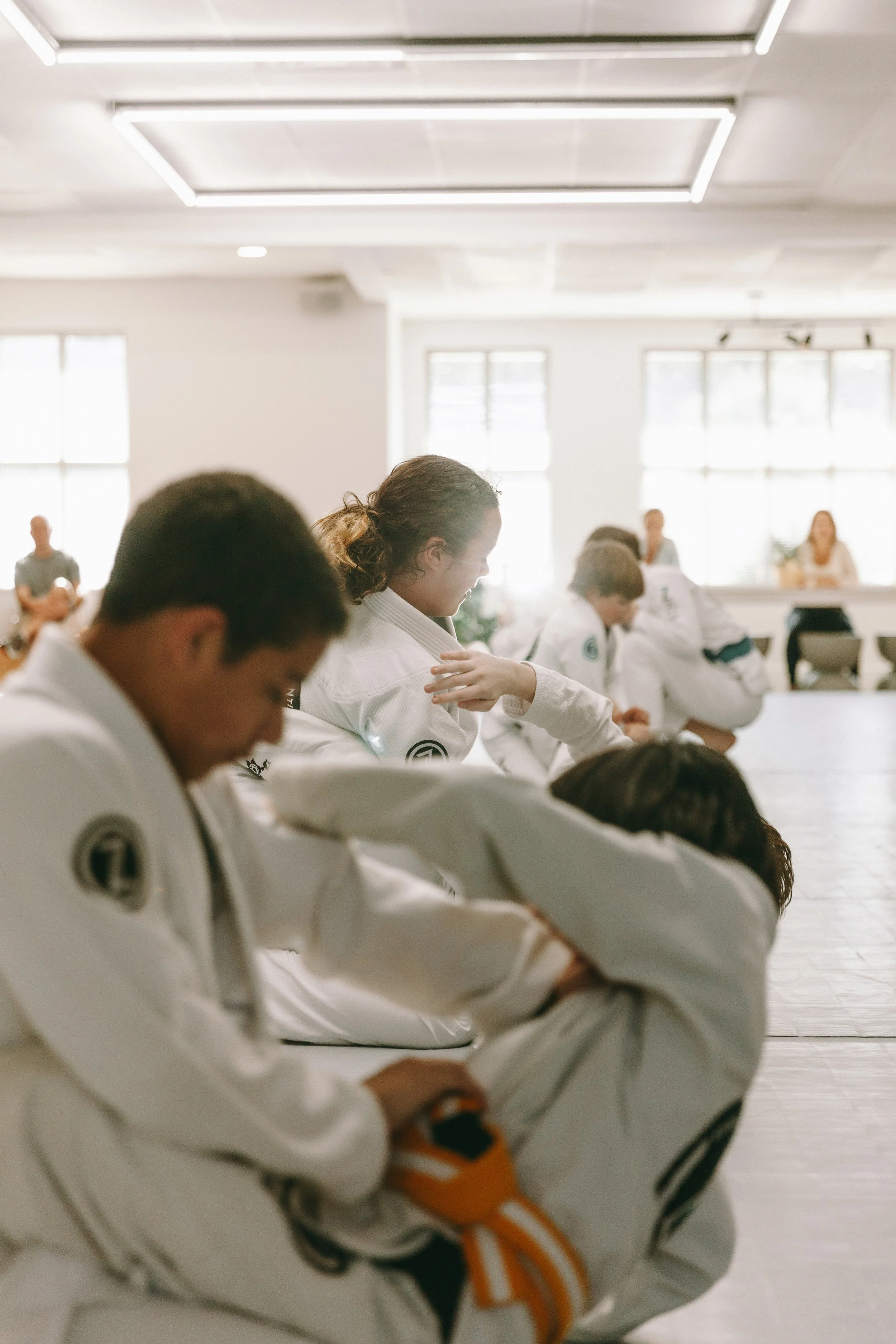
That “yet” is where growth lives.
Jiu jitsu creates an honest kind of learning. There’s no hiding behind being charming, fast-talking, or lucky. If your base is weak, you fall. If your posture breaks, you get controlled. If you reach with your arms, you get off-balanced. That honesty can be frustrating, especially for kids who are used to being good quickly, kids who don’t like being corrected, or kids who feel things strongly.
What matters is what we do with that frustration.
In jiu jitsu, your child meets resistance. Not mean resistance, not bullying, not “toughening them up.” Normal resistance. A partner holds position. A move doesn’t work. A bigger or more experienced student has better timing. A coach gives a correction. The body doesn’t do what the brain wants it to do yet.
That last part is a huge one. Kids often understand the idea before they can perform it. They can repeat the words “elbows in” or “get on your side” and still struggle to make their body cooperate when they’re under pressure. Their brain is trying to run a new program, and their body is still using the old one. That gap is uncomfortable, and kids experience uncomfortable gaps as frustration.
If a child has never had to stay present inside that gap, they’ll try to escape it. Some kids escape by quitting. Some escape by getting silly. Some escape by blaming the partner, blaming the coach, blaming the rules. Some escape by melting down. None of those reactions mean your child is “bad.” They mean your child is human, and they don’t have a practiced strategy for this kind of pressure yet.
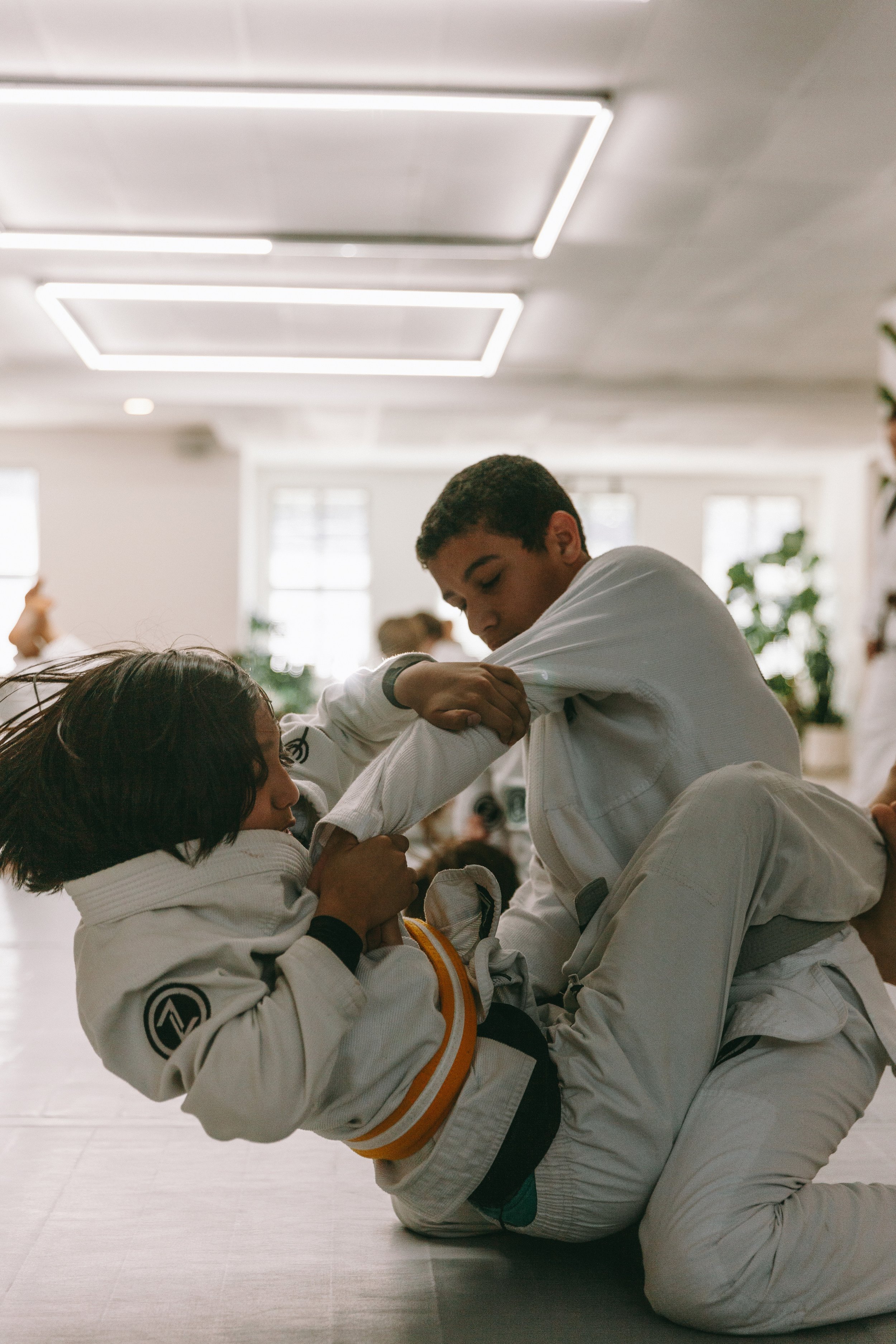
We train a better option: breathe, listen, try again.
A lot of parents think jiu jitsu teaches moves. It does. We teach real technique, and we care about details. But the deeper training is learning how to manage feelings under pressure. That’s the part that transfers to school, sports, friendships, and home life.
When your child is mounted and can’t move, they feel something. When a newer kid passes their guard, they feel something. When we correct them in front of the group, they feel something. They don’t get to avoid that feeling by walking away from the situation. They have to learn to function with it.
That’s emotional control, but it’s not the kind you can lecture into a child. You can’t speech a kid into resilience. You can only give them repeated, safe opportunities to practice being uncomfortable and still staying engaged.
In kids jiu jitsu, that practice happens in small, manageable doses. We show a technique. They try it. It doesn’t work. They feel frustration. We help them adjust. They try again. It works a little better. Their body learns. Their confidence becomes real because it’s tied to competence.
This is also why jiu jitsu can be such a good fit for kids who struggle with confidence. The mat doesn’t reward pretending. It rewards calm effort. Over time, kids start to trust themselves because they’ve been in hard spots and found a way out. That’s not hype. That’s earned.
It also helps to understand that frustration is often the first visible sign that your child has stopped coasting. Early on, many kids can get by on enthusiasm. Everything is new, the coach is fun, and they’re learning simple movements that work on other beginners. Then they hit the next stage, where the room gets more mixed. They roll with kids who have better timing, or they start doing live rounds where things aren’t scripted. Their old tricks stop working. That’s when frustration shows up.
In my experience, that stage is a fork in the road. If the child learns that frustration is a signal to quit, they’ll carry that pattern everywhere. If they learn that frustration is a signal to slow down, breathe, and keep trying, they get a lifelong advantage.
So what should “healthy frustration” look like?
Healthy challenge usually looks like frustration, then re-engagement. Your child might look annoyed for a moment, then they get back in line. They might say, “I can’t do it,” then after a quick correction, they try again. They might lose a round, then immediately ask, “What did I do wrong?” That’s a kid learning.
Overwhelm looks different. Overwhelm is shutdown, panic, or repeated dysregulation that doesn’t improve over time. It might look like a child refusing to participate for long stretches, melting down in a way that takes them a long time to recover from, or becoming so anxious about failing that they stop trying. Overwhelm can also show up as aggression that keeps escalating, especially if the child feels trapped and doesn’t have the tools to regulate.
The difference isn’t always obvious to parents in the moment, because both frustration and overwhelm can look like tears. The clue is what happens next. Does the child return to learning with support? Or do they spiral and stay stuck there?
This is where coaching matters. At Houzn, we’re not just watching technique. We’re watching patterns. We’re watching how a child responds to correction, how they handle losing, how they treat partners when they’re frustrated, and whether they can settle back into the class rhythm. We also match kids carefully in training, because the right partner can create a healthy challenge, and the wrong partner can create unnecessary stress.
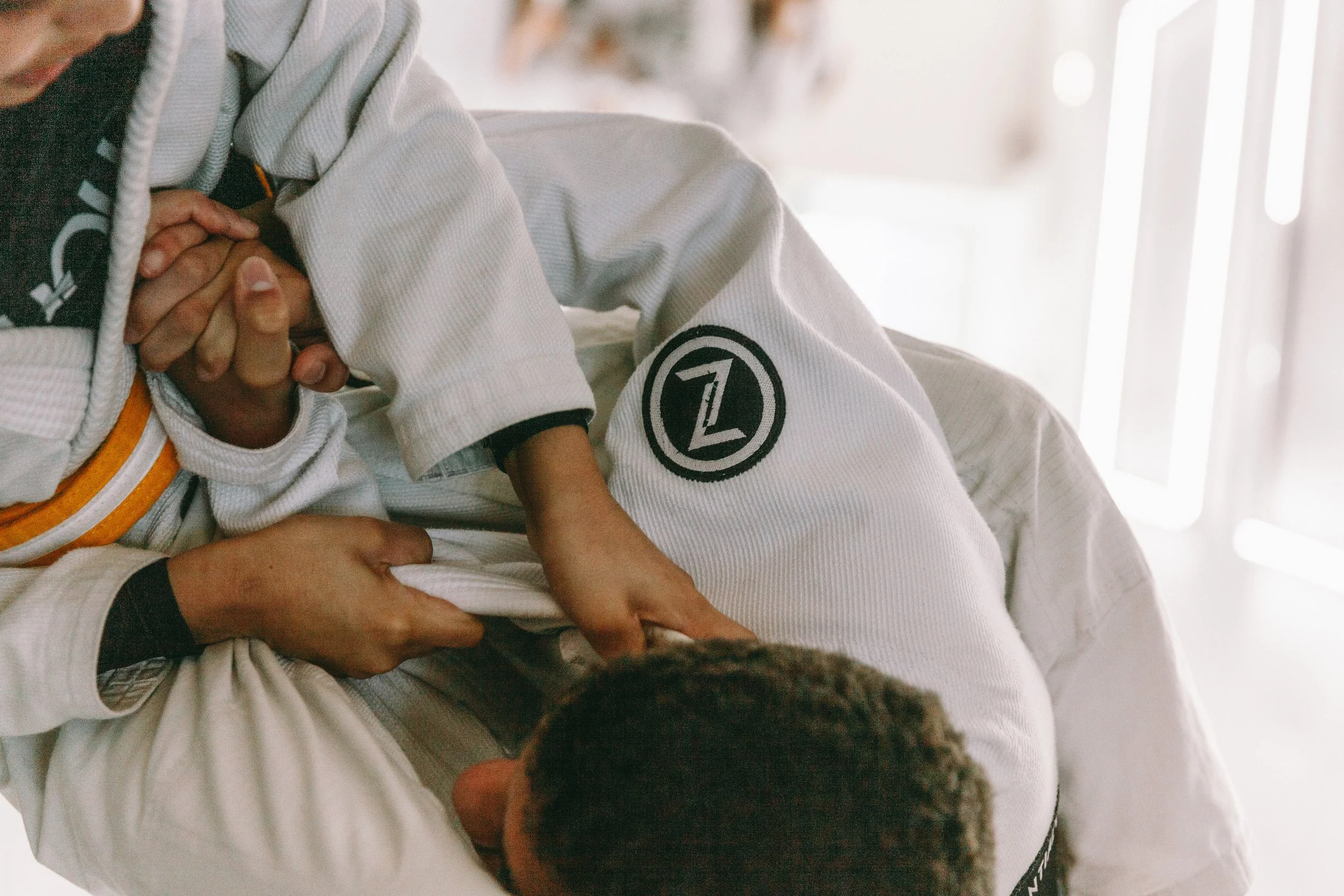
If your child is frustrated, it helps to remember that jiu jitsu is a contact problem-solving sport. It’s not like memorizing spelling words where the answer is either right or wrong. In jiu jitsu, you can do something “right” and still fail because the other person did something right too. That’s a big mental shift for kids, especially kids who are perfectionists.
It’s also why we emphasize process over outcome. The goal is not “win every round.” The goal is to do the right thing more often, with better timing, under more resistance. That’s how skill is built.
There’s another layer here that parents don’t always see: jiu jitsu exposes energy management. A frustrated child often uses too much energy too fast. They hold their breath. They try to muscle out. They thrash. Then they get tired, and fatigue makes emotions worse. When we teach a child to breathe and use frames and move with purpose, we’re not just improving their technique. We’re reducing the emotional spikes that come from exhaustion and panic.
If you want a simple picture, think about how adults feel when they’re stuck in traffic late for something important. The situation isn’t dangerous, but it’s pressure without control. That’s what being pinned can feel like to a kid at first. Jiu Jitsu teaches them, over time, “You’re not trapped. You have steps. Start with the first step.”
That’s why “breathe, listen, try again” is more than a motivational phrase. It’s a practical sequence. Breathing gives the body a chance to calm. Listening gives the brain a direction. Trying again builds the skill. Kids who repeat that sequence for months start doing it automatically, and that automatic response is what parents usually mean when they say, “I want my child to be more resilient.”
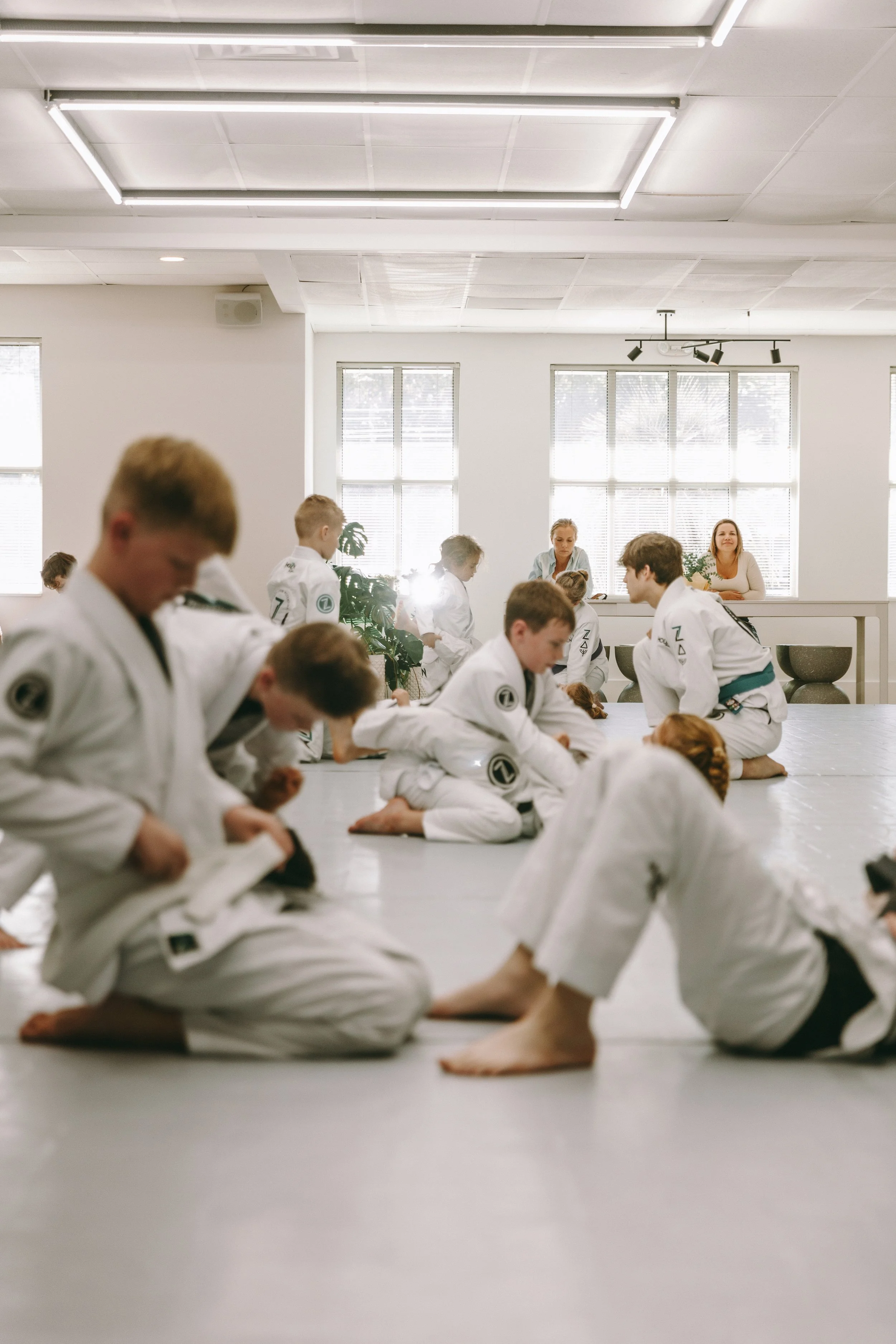
Now, what can you do as a parent when your child is frustrated after class?
First, keep your feedback simple. The car ride home doesn’t need a technical breakdown. It doesn’t need you to solve the whole problem. Most kids are still emotionally “hot” right after training. If you give a long talk, it can feel like piling on. If you criticize, even gently, it can make them feel like they disappointed you. If you over-comfort, it can accidentally teach them that frustration is an emergency.
What works well is calm, short, steady language. You can say, “I saw you work through something hard.” You can say, “I’m proud you didn’t quit.” You can ask, “What did coach tell you to focus on?” That keeps the focus on effort and learning, and it sends a clear message that frustration is normal and manageable.
Second, resist the temptation to negotiate quitting in the moment. Many kids say “I’m done” when they’re frustrated, not because they truly want to quit, but because they want relief. If we teach them that big feelings instantly change the plan, we make it harder for them to build the skill of staying engaged. A better approach is to validate the feeling and keep the routine stable. Something like, “I hear you. That was hard. Let’s get some water and we’ll talk to coach about what to work on next class.”
Third, let the coach coach. If you’re unsure whether your child is dealing with healthy challenge or overwhelm, don’t guess. Grab your kids coach after class or ask for a quick conference. Tell us what you’re seeing at home and what your child says about class. We can tell you what we’re seeing on the mat and adjust the training plan if needed. Sometimes the fix is as simple as pairing them differently, giving them one clear focus for a few weeks, or helping them understand that everyone gets stuck and that it’s part of training.
When frustration is handled well, it becomes one of the biggest reasons kids stay long term. They look back a few months later and realize, “That thing that made me mad doesn’t bother me anymore,” or “I used to get stuck there and now I can escape.” That’s a real confidence builder because it’s measured against their old self, not against someone else.
If you take one idea from this, let it be this: frustration isn’t the enemy. Avoiding frustration is the enemy. Frustration, in the right environment, with the right coaching, is a signal that your child is stretching into new skill.
If frustration is coming home with your child, don’t guess—grab your kids coach after class or ask for a conference with the coach. We’ll help you read what’s happening and give you a simple plan that fits your child.
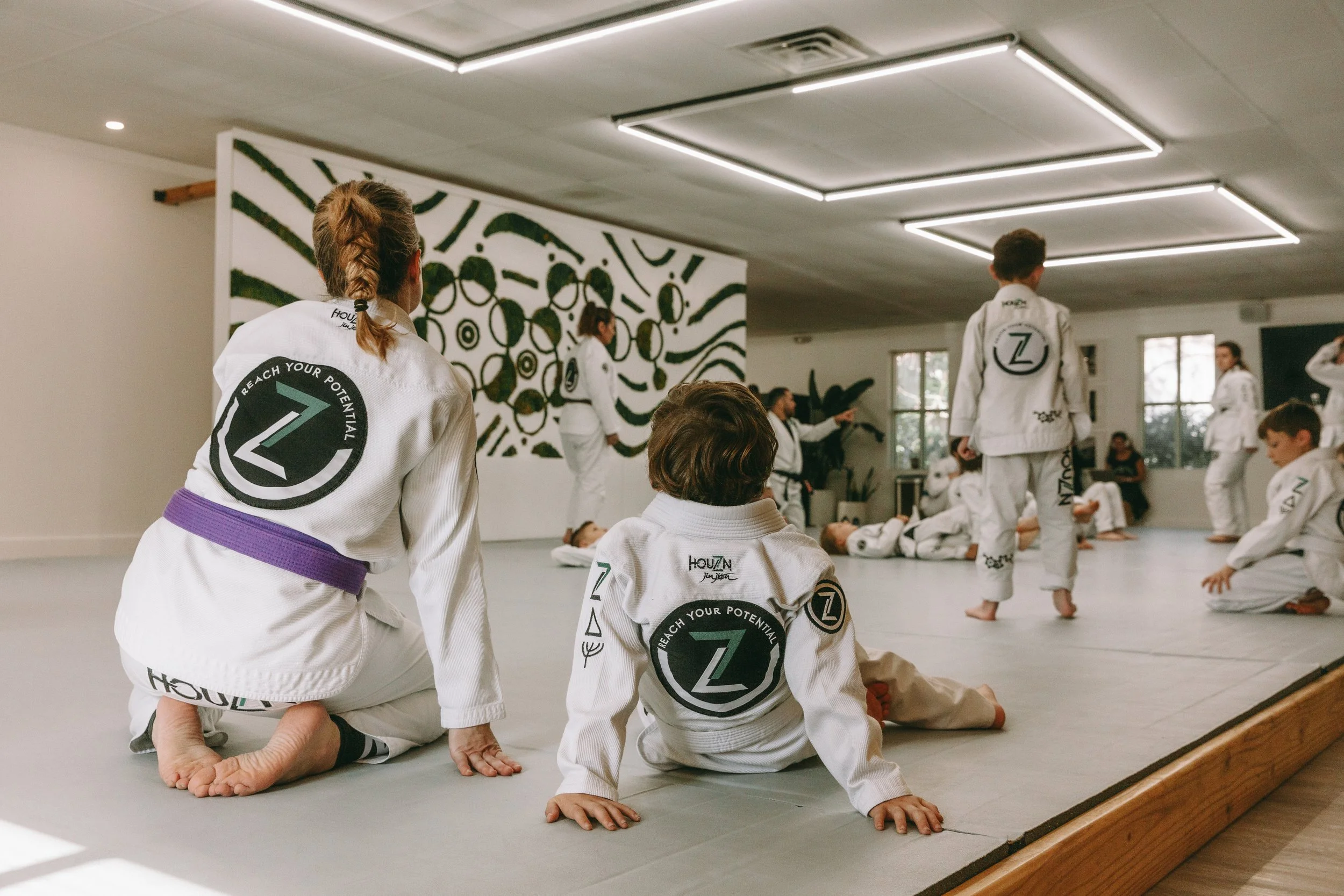
Brazilian Jiu Jitsu for Kids: Why the First Months Feel Hard—and Why That’s Healthy
In kids jiu jitsu, progress usually doesn’t look like winning. Early progress looks like showing up again after a tough class, listening under pressure, and trying even when it feels awkward. This parent guide from Houzn Jiu Jitsu Academy in Mount Pleasant, SC (serving Charleston families) explains what real improvement looks like in Brazilian jiu jitsu for kids, why frustration is part of the process, and how to notice growth at home without adding pressure. If your child is shy, uncoordinated, or easily discouraged, this will help you understand the long learning curve—and support it.
If you’re new to kids jiu jitsu, you might be wondering what you’re supposed to measure. In many sports it’s obvious: points, goals, speed, “starter vs. bench.” In Brazilian jiu jitsu for kids, it’s not that simple—especially in the beginning.
That’s not a problem. It’s one of the reasons jiu jitsu works so well for kids. It teaches them how to build real skill, not just short-term performance.
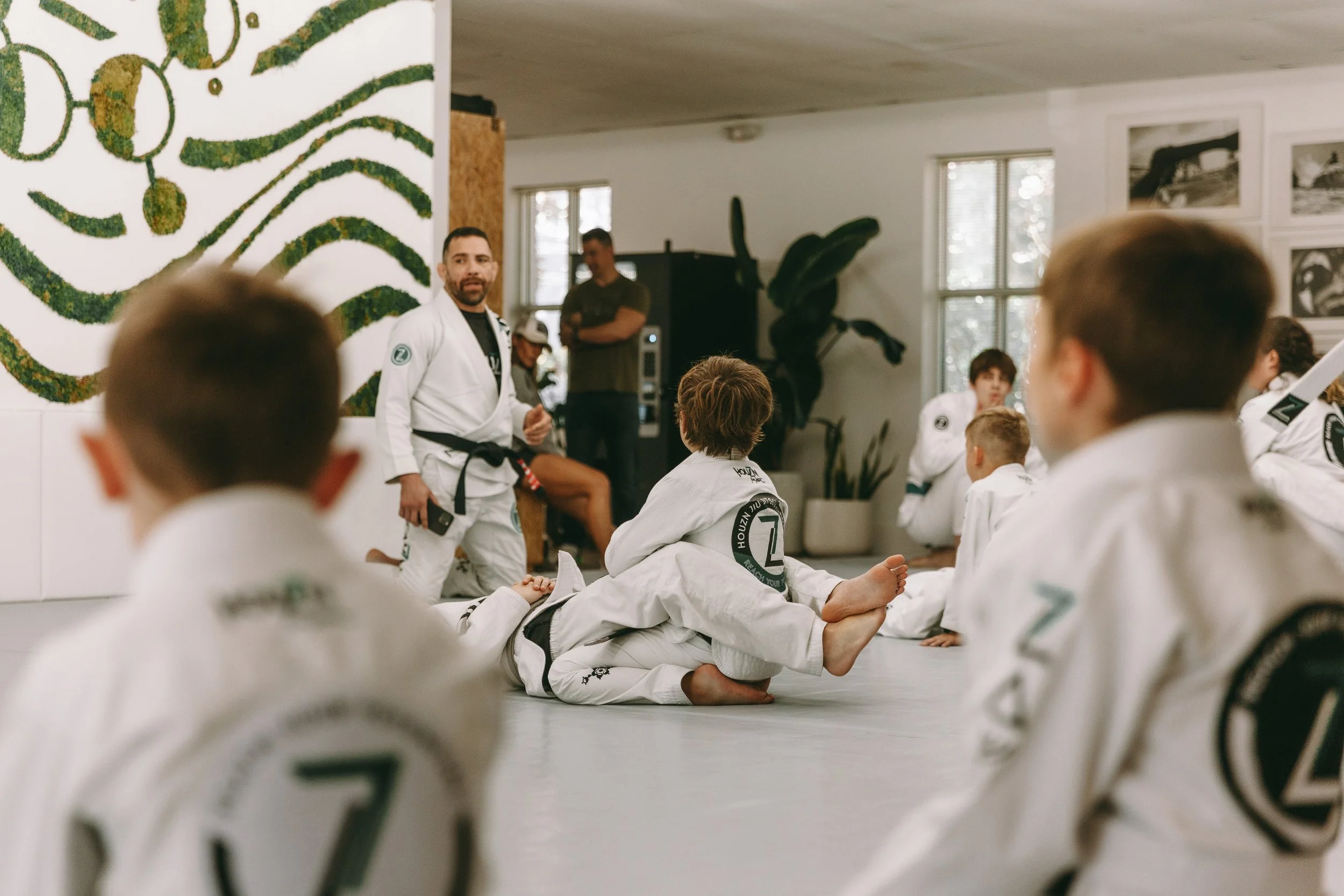
Why jiu jitsu feels different right away
Jiu jitsu puts kids in close, controlled contact with another person. They have to manage their body, their emotions, and their attention all at once. That can be a big adjustment for Little Warriors (3–5), and it can still be a big adjustment for a shy 12-year-old who’s never done a contact sport.
So those early nerves, awkwardness, and “I don’t know if I like it yet” moments are often a sign that jiu jitsu is doing what it’s supposed to do: exposing your child to a challenge in a safe environment.
The biggest misunderstanding: “Progress = winning rounds”
The fastest way for a kid to get discouraged is for the adults around them to focus on wins and losses.
Because in class, “winning” is not a clean metric. Sometimes a child “wins” because their partner is new. Sometimes they “lose” because their partner has trained longer. Sometimes the coach is telling one kid to focus on defense while the other kid is told to focus on offense.
If you measure the wrong thing, you’ll miss real growth.
What coaches look for in the first month
In the first month I’m watching for signs that a child is learning how to learn.
Can they line up and follow directions?
Can they control their hands and feet with a partner?
Can they handle correction without melting down?
Do they try again after a mistake?
Can they be respectful when they’re frustrated?
Those skills matter because they’re the foundation for everything else: self-defense, confidence, and calm under pressure.
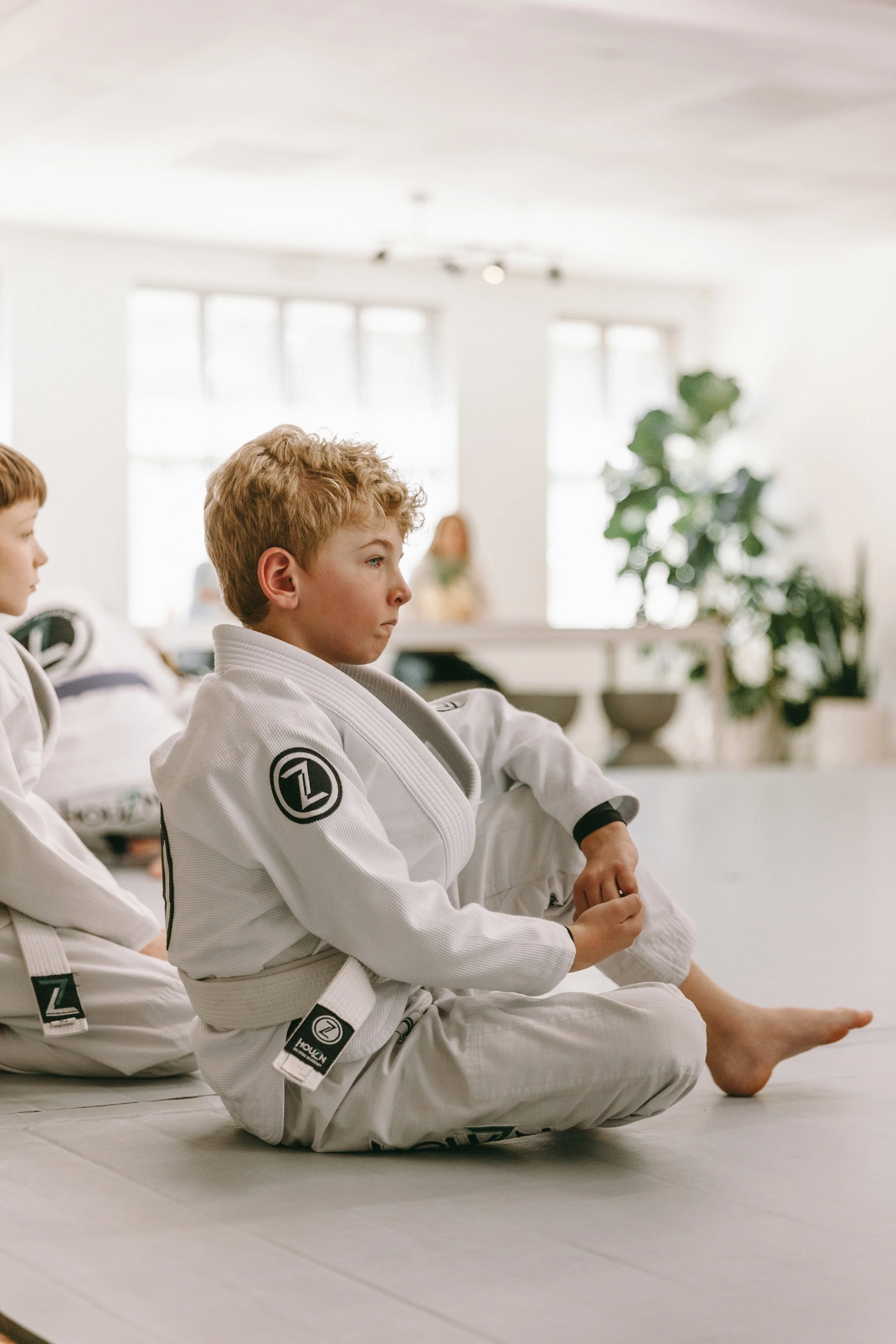
A better scoreboard: recovery
A simple way to track progress is to ask: is my child recovering faster?
When they get stuck, do they keep working a little longer?
When they lose a game at home, do they settle sooner?
When they get corrected at school, do they handle it with less drama?
Those are the same “muscles” we train on the mat.
What to say when your child says “I’m not good”
This is common, and it usually means: “This feels hard and I don’t like feeling behind.”
Try:
“Jiu jitsu is hard at first. That’s normal.”
“I’m proud of you for staying with it.”
“What’s one thing you learned today?”
That helps them shift from identity (“I’m not good”) to process (“I’m learning”).
The long game is the benefit
The reason martial arts for kids works isn’t because it’s easy. It’s because it’s structured discomfort. It’s a safe place to practice courage, respect, and frustration tolerance over and over until it becomes part of who they are.
This week, keep it simple—keep showing up. And if you want a clear picture of your child’s progress, grab your kids coach after class or ask for a conference with the coach.
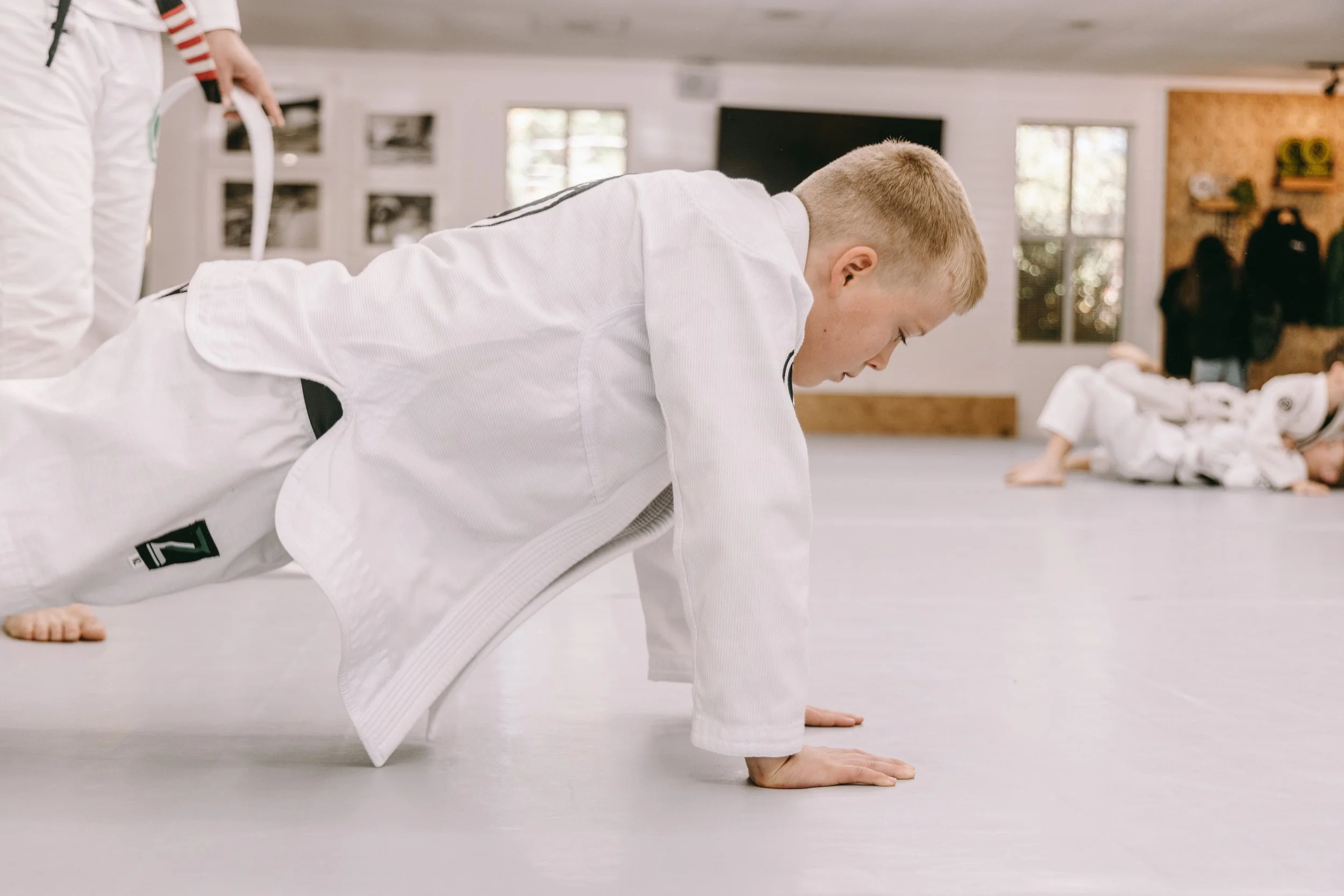
Experiential Learning: Building Confidence Through Jiu Jitsu and the Waldorf Method
Just as the Waldorf education method emphasizes experiential learning, psychiatrist William Glasser emphasizes that we retain significantly more of what we experience compared to what we read or hear. Jiu Jitsu embodies this principle, allowing children to actively engage and learn through real-life practice. Each challenge on the mat builds not only physical skills but also confidence in their abilities. This hands-on experience fosters a strong sense of self-worth and resilience. If you want your child to build lasting confidence and character, consider enrolling them in our Jiu Jitsu Homeschool program today. Experience firsthand the transformation that comes from experiential learning. Sign up for a trial class and take the first step toward building a confident future!
In today’s fast-paced world, building confidence and resilience in children is more important than ever. One fascinating way to achieve this is through our Jiu Jitsu homeschool program, which aligns beautifully with the Waldorf experimental learning approach.

The Waldorf method emphasizes storytelling and hands-on experiences to engage children deeply. Just like a captivating tale that inspires, our Jiu Jitsu classes create a narrative of growth and transformation. Children learn not just movements, but the story of perseverance and self-discovery that comes with mastering a new skill.
In Jiu Jitsu, students face opponents, not as enemies, but as partners in a dance of strategy and technique. This environment mirrors the Waldorf approach, where students learn through play and collaboration. As they practice, they learn to navigate challenges, developing resilience like characters in their favorite stories who overcome obstacles to achieve their dreams.
Using simple and supportive words, we cultivate a space where children feel safe to express themselves. Just as in a Waldorf classroom where lessons unfold organically, our program allows students to learn at their own pace. They discover their strengths, building self-esteem with each success on the mat. The euphoric moment of surprising themselves with a new technique teaches them that growth often comes from stepping out of their comfort zone.
Moreover, Jiu Jitsu reinforces core values such as respect, discipline, and teamwork—principles at the heart of Waldorf education. Each class serves as a chapter in their educational journey, offering not only physical skills but life lessons that will carry them through various adversities.
Encouraging your child to join our Jiu Jitsu program can be a significant step towards fostering these essential life skills. Give your child the opportunity to thrive both on and off the mat. Enroll them in our program today, and watch as they grow in confidence and resilience, equipped to face any challenge with grace and determination. Don’t miss out on this transformative experience—take the leap and register now!
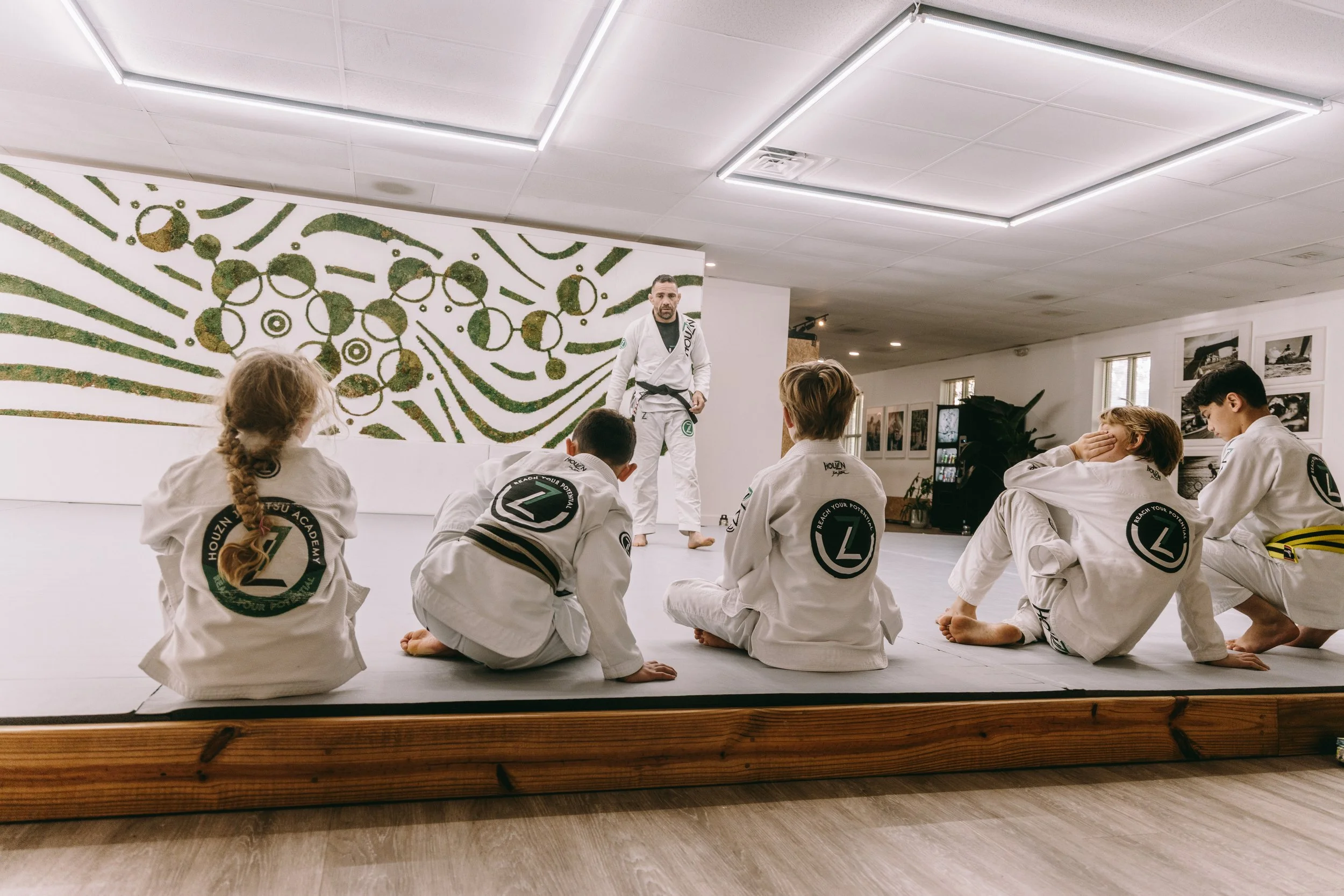
Strengthening Body and Mind: How Jiu Jitsu Enhances Character for Homeschoolers
Jiu Jitsu is more than just a martial art, it’s a powerful tool for homeschoolers that fosters physical education and character development. In our program, children learn essential skills like self-defense, resilience, and respect while gaining confidence in themselves. Through engaging classes, they not only improve their physical fitness but also discover the importance of standing up for themselves in various situations. As they progress, they’ll build lasting friendships and develop a solid foundation of strength and courage. Enroll your child today and watch them flourish in both body and mind. Start this empowering journey now!

Across the world, children are exploring new paths of education. As homeschoolers, you have the unique opportunity to tailor your child’s learning experience. One wonderful avenue to consider is Jiu Jitsu, not just as a physical activity, but as a vital tool for character building and personal development.
Jiu Jitsu provides a blend of physical education and life skills. Try to picture your child stepping onto the mat, learning the fundamentals of self-defense while also discovering the importance of respect, discipline, and perseverance. Each roll and each sparring session teaches them more than just techniques; it teaches them how to stand up for themselves, to face challenges head-on, and to build resilience.

As they practice and improve, students cultivate friendships built on mutual respect and support. Instructors guide them to set personal goals, reinforcing the idea that hard work leads to progress. This nurturing environment is rooted in the Montessori philosophy of learning, where children are encouraged to take charge of their education and grow at their own pace. They will learn to navigate conflicts, not with aggression, but with confidence and strategy. This skill extends beyond the Academy and into their daily interactions, empowering them to advocate for themselves and others.
Furthermore, the community aspect of Jiu Jitsu enhances social skills, providing your child with opportunities to forge friendships, work within a team, and learn from peers. This supportive environment contributes to their emotional and social development, reinforcing the idea that they are not alone in their journey.
As you consider what’s best for your child’s physical education, think about the valuable lessons Jiu Jitsu can impart. Enrolling your homeschooler in our program is an investment in their character and well-being.
Don’t miss this chance to enrich your child’s life! Sign up for our Jiu Jitsu homeschool program today and watch as they transform into a confident, resilient individual. Together, let’s build a foundation of strength that lasts a lifetime!
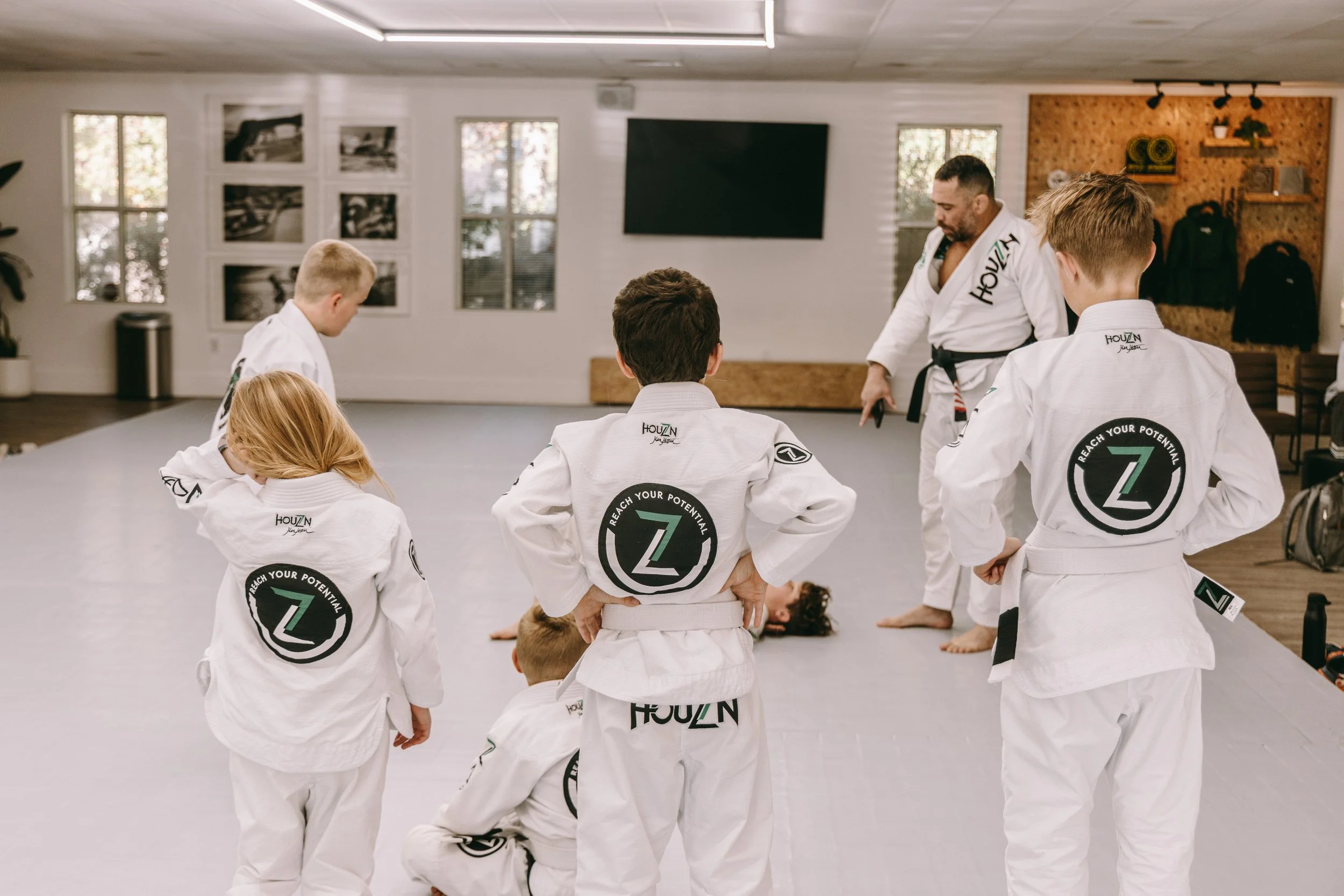
From Homeschool to Mat: Building Resilience and Confidence through Jiu Jitsu at Houzn
Houzn's innovative homeschool program integrates the dynamic discipline of Jiu Jitsu to empower children with resilience, confidence, and physical strength. This unique approach combines academic excellence with martial arts, fostering personal growth and holistic development. Students learn valuable life skills, like discipline, focus, and perseverance, while enhancing their physical fitness and coordination. Through engaging lessons and guided practice, children build confidence and self-esteem in a supportive environment. Houzn’s program not only enriches academic learning but also instills important values, preparing young learners for life's challenges as they develop into well-rounded individuals. Enroll now to unlock your child's potential.
Imagine your child gaining resilience, strength, and problem-solving skills, all while making new friends and staying active. At Houzn, we've created a Jiu Jitsu homeschool program like no other, where learning goes beyond the classroom. Here, fitness meets life lessons, and every day becomes an opportunity to grow.

Guided by the renowned Rafaello Oliveira, a former pro athlete with over 20 years of coaching experience, your child will be learning from one of the best in the field. His commitment to teaching goes beyond techniques. He focuses on nurturing life skills, helping students face challenges, and turning losses into lessons. Rafaello's unique approach ensures that kids don't just come to have fun, they learn resilience and perseverance.
We understand that homeschooling can be a journey filled with trials and creativity. Our program is designed to complement this journey by focusing on important life skills through Jiu Jitsu. At Houzn, we've made a conscious choice: instead of offering just a place to play, we've created a place to grow, learn, and evolve. And that makes all the difference.
Our students dive into the art of Jiu Jitsu, where each roll on the mat teaches them more than just martial arts. It teaches them to tackle challenges head-on, see mistakes as stepping stones, and build the courage to stand up again and again.
Parents consistently tell us how surprised they are at the positive changes they see in their children. They develop not only physically but also mentally and emotionally. You’ll find your child more disciplined, confident, and ready to face any challenge life throws their way.
Ready to Embark on This Journey?
Don't miss an opportunity to get your child enrolled in a program that's crafted for their growth and success. Reach out to us today and take the next step towards empowering your child with skills for life. Sign them up for Houzn's Jiu Jitsu homeschool program now and watch them blossom!