
When parents ask me about discipline, they’re usually asking about something very specific. They’re not asking for a tougher kid, or a perfectly obedient kid, or a kid who never has a hard day. They’re asking, “How do I help my child listen, follow directions, and control themselves—without our whole house turning into a negotiation?”
That’s a real question. If you’ve been stuck in the loop of repeating yourself, raising your voice, taking things away, feeling guilty, and then doing it all again tomorrow, you’re not alone. Parenting is already demanding. Add school stress, screens, irregular sleep, big emotions, and a growing body that wants to move, and it can feel like you’re constantly managing behavior instead of building character.
This is one of the reasons kids jiu jitsu can be such a good fit, especially when the program is coached the right way. At Houzn Jiu Jitsu Academy, we care about discipline, but we don’t chase “perfect behavior.” We train something more durable: self-control. The kind that shows up when nobody is watching. The kind your child can carry into school, sports, friendships, and eventually adulthood.
Discipline starts to click when we separate it from compliance.
A child can be compliant in one environment and chaotic in another. Plenty of kids “hold it together” at school and melt down at home. Some kids behave around one teacher but push every boundary with another. That doesn’t mean they’re manipulative or broken. It means compliance is often situational. It depends on the external pressure in the room.
Compliance usually comes from fear of consequences, or from wanting to please someone, or from the child sensing they’ll get a reward. Those things can work short-term, but they don’t build a steady inner compass. When the pressure is gone, the behavior disappears.
Discipline is different. Discipline is internal. It’s the ability to do what needs to be done even when your mood doesn’t match, even when you’re excited, even when you’re frustrated, even when you’d rather do literally anything else. It’s not stiff or robotic. It’s freedom through structure. A disciplined kid isn’t a kid who never moves. It’s a kid who can move and still stay in control.
Brazilian jiu jitsu is a powerful place to train that, because it gives kids real-time feedback. Not in a harsh way. In an honest way.
On the mat, if you don’t listen, you miss the detail and you struggle. If you don’t respect space, you bump into someone and the coach resets you. If you go too hard, your partner doesn’t want to train with you and the coach steps in. If you freeze and panic, you learn to breathe and problem-solve. Jiu Jitsu is a conversation, and the body doesn’t lie. Over time, kids start learning that their choices have consequences, and that they can choose better.
That’s the heart of personal responsibility. Not blame. Ownership.
A well-run kids jiu jitsu class also has something many families are missing in daily life: consistent structure. And I don’t mean “strict for the sake of strict.” I mean predictable rhythms that create safety.
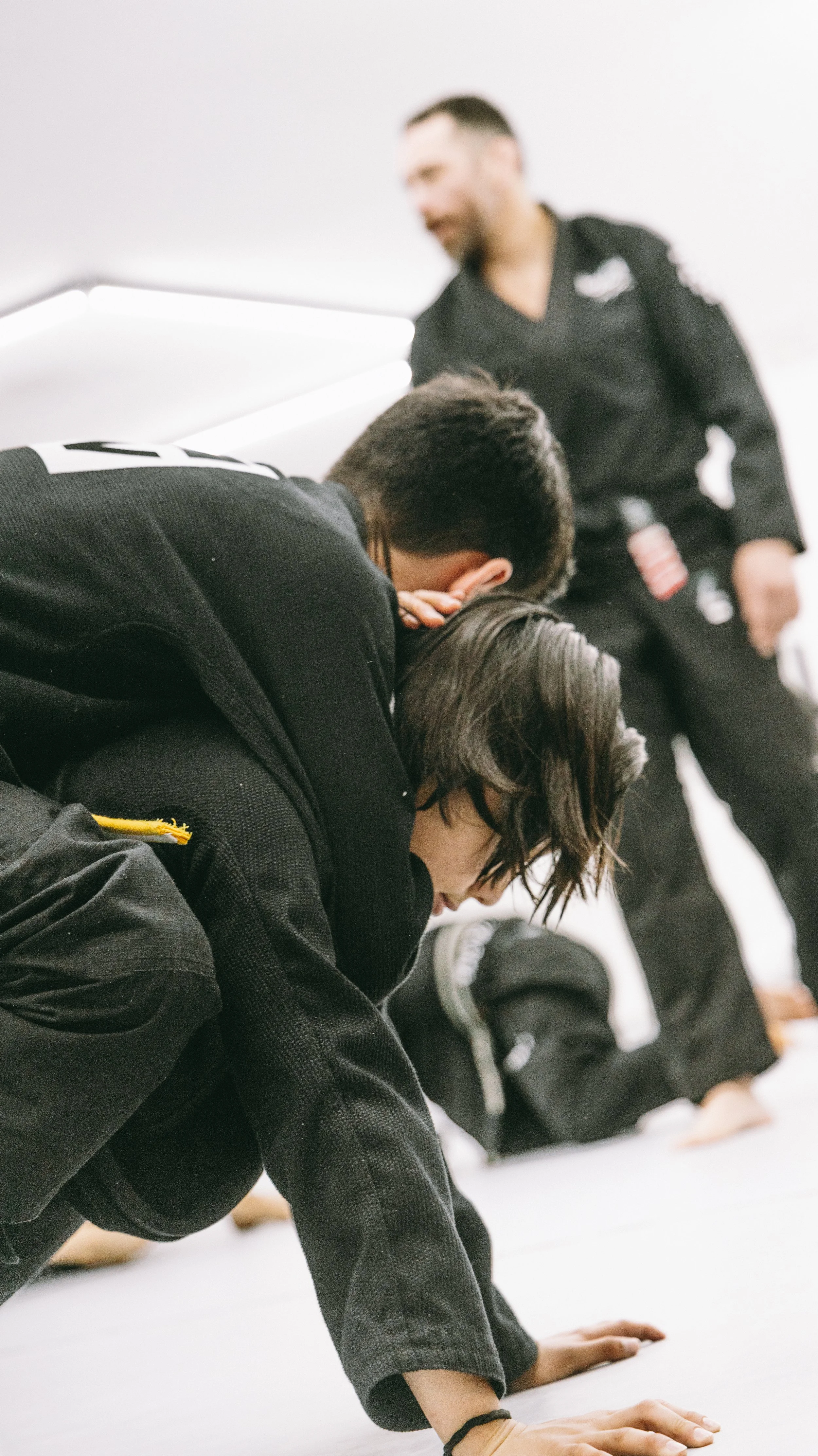
A good kids class is basically a blueprint for self-control. The class begins the same way most days. Kids learn to line up when asked, not because we want little soldiers, but because it’s the fastest way to get order in a room full of energy. They learn to keep their hands to themselves while the coach is talking, because attention is a skill. They learn to follow multi-step directions, because life is full of sequences: shoes on, backpack, lunchbox, out the door. They learn to practice safe intensity, because they’re going to feel excitement and competitiveness in life, and they need to learn how to steer that intensity instead of being steered by it.
And they learn to stop immediately on the coach’s cue.
That last one matters more than most parents realize. “Stop when told” is a safety skill, and it’s a life skill. It’s the difference between a kid who can play rough safely and a kid who escalates. It’s the difference between a child who can handle conflict and a child who gets stuck in a reaction. On the mat, stopping on command keeps partners safe. Off the mat, it shows up as impulse control.
Parents sometimes ask me, “Will jiu jitsu help my child stop hitting, stop roughhousing, stop acting out?” The honest answer is that jiu jitsu doesn’t magically erase big emotions or high energy. What it does, when coached well, is give those emotions and that energy a clear channel.
High-energy kids often aren’t “bad.” They’re under-trained in impulse control and over-loaded with energy. They can be bright, kind kids who simply have a nervous system that runs hot. And modern life doesn’t always give them what they need. Recess gets shorter. Outside time gets replaced by indoor time. Physical risk gets removed, and then we’re surprised when energy turns into chaos at dinner.
Jiu Jitsu lets kids move. It gives them permission to wrestle, to use their bodies, to feel pressure and resistance in a safe environment. But it also draws a line around that movement. There are rules. There are partners. There is respect. There are consequences that are immediate but not shaming. We correct the behavior, not the child’s identity.
Over time their nervous system learns something important: I can be intense and still be in control.
That’s why Jiu Jitsu can be especially helpful for kids who struggle with focus, who are impulsive, who get overwhelmed, or who have a hard time transitioning. We can’t promise a diagnosis changes, and we don’t pretend the mat is therapy. But we do see the same pattern again and again. Kids who have trouble sitting still in a chair often do very well with learning that happens through movement. They learn by doing. They learn with their hands. They learn with immediate feedback.
Discipline in kids Jiu Jitsu isn’t one giant “aha moment.” It’s trained in small, repeatable moments.
It’s the moment your child wants to keep talking, but they choose to look at the coach.
It’s the moment they want to rush ahead, but they wait until they’re told.
It’s the moment they get tagged or swept and they feel embarrassment, but they take a breath and try again instead of quitting.
It’s the moment they’re told, “Reset,” and they reset without a fight.
These moments look small. But small moments stacked over months are how a child becomes steady.
If you’re a parent reading this, one of the best things you can do is adjust what you measure. A lot of parents look for a dramatic change fast. They want to know, “Will this fix the problem?” What I recommend instead is watching for small, realistic changes that tell you the skill is growing.
At home, you might notice they transition faster when asked to do something. It might not be instant, but the delay gets shorter. You might notice they can wait a little longer without melting down. You might see them accept corrections with less argument, or recover from “no” a little quicker. You might catch them taking a breath before reacting, even if they still get upset afterward. Those are meaningful wins. That’s discipline showing up.
And one of the most overlooked wins is how a child handles being uncomfortable.
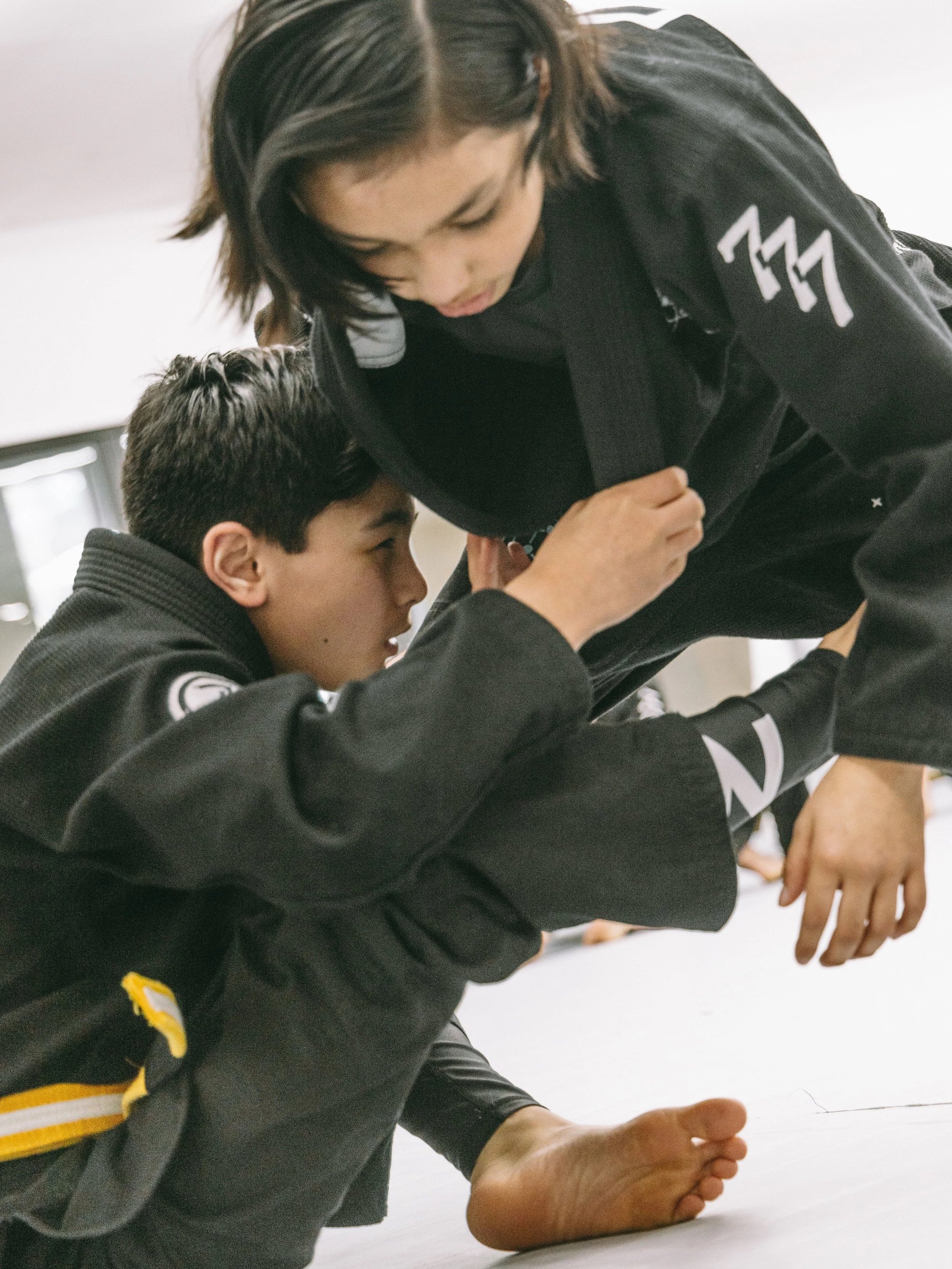
Jiu Jitsu gives kids controlled discomfort in a safe setting. They get pinned. They get pressure. They get tired. They have to deal with frustration. They have to deal with losing tiny battles in training. When they learn to stay calm in those moments, it carries over. The kid who learns, “I can be uncomfortable and still make good decisions,” becomes a kid who can handle a hard test, a tough conversation, a bad day, or a disappointment without falling apart.
That’s confidence through competence. Not confidence as a pep talk.
Now, there’s a part of this conversation that matters for parents: how you support discipline at home without becoming the coach.
Most kids do not want their parent coaching technique in the kitchen. And honestly, it’s not your job. Your job is to be the parent, and to keep the home relationship clean. The best way to reinforce what we do on the mat is to reinforce principles, not moves.
Simple phrases work because kids can remember them. “We listen to the coach.” “We keep our hands to ourselves.” “We reset and try again.” Those are transferable. They apply to school, to the playground, to siblings, to sports teams, and to dinner.
You can also support discipline by helping your child show up consistently. Consistency is where the real results come from. If you can build a routine where Jiu Jitsu is “just what we do,” you take willpower out of the equation. And if your child is having a hard week, that’s often the week they need structure the most.
One more thing I’ll say as a coach: discipline grows best in an environment that is both warm and firm.
Warm without firm turns into chaos. Firm without warmth turns into fear. Kids need to know the adult in charge cares about them and also means what they say. That balance is what we aim for at Houzn. We hold standards. We correct. We also encourage, guide, and keep kids safe. We’re not trying to “break” a child. We’re trying to build a child who can handle themselves.
If you’re in the Mount Pleasant area and you’re looking into Brazilian Jiu Jitsu for kids, it’s smart to ask specific questions when you visit a school. Ask how they handle safety. Ask what happens when a child can’t stop messing around. Ask how they pair kids up. Ask how they teach a new child who’s nervous. A kids program isn’t just about technique. It’s culture. And culture shows up in the details.
If you want a simple strategy for your child’s age group, whether they’re in Little Warriors, Young Warriors, Warriors, or Juvenile, grab your kids coach after class or ask for a conference with the coach. We’ll help you connect mat routines to home routines in a way that fits your child’s personality. Discipline isn’t a fight you have to win every night. It’s a skill your child can build, one rep at a time.