
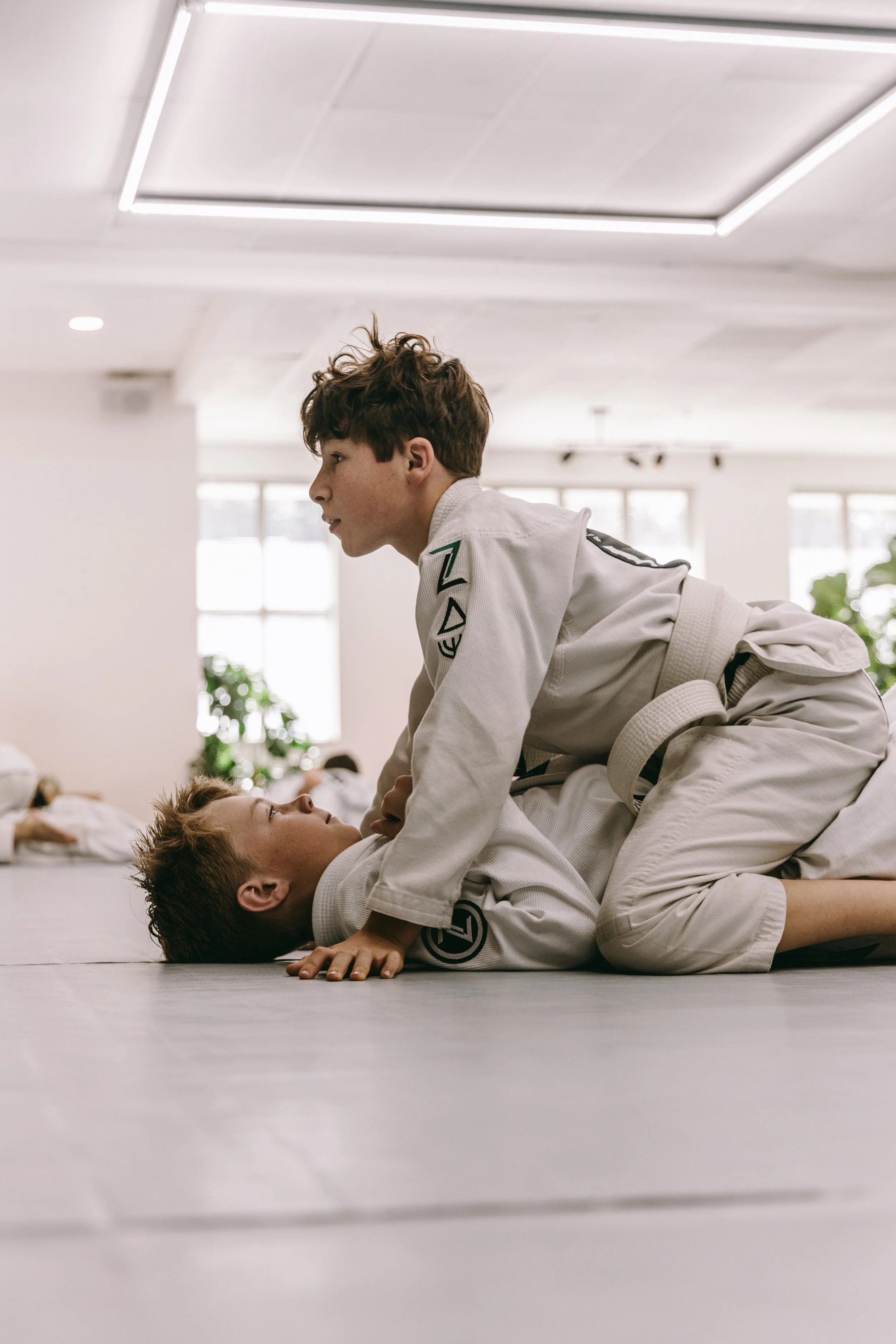
If you want your child to stay in Jiu Jitsu long enough to truly benefit from it, praise the things they can control: effort, attention, and follow-through. Outcomes—taps, rounds, stripes, “being the best”—come and go. But a child who learns to keep trying, listen to coaching, and be a good partner has the foundation to improve for years.
That approach also tends to reduce unnecessary pressure at home. You don’t have to pretend losing doesn’t matter. You just don’t have to make it the main measure of whether training is “working.”
At Houzn Jiu Jitsu Academy in Mount Pleasant, SC, we see this play out every week in kids Jiu Jitsu class: the students who last aren’t always the ones who look the most talented on day one. They’re often the ones who learn how to practice.
Why “winning” is a shaky goal for kids
Even in a great class, outcomes can be misleading.
Your child might “win” a round because they’re bigger than their partner, because the partner is brand new, or because the partner is working on defense and intentionally giving space. They might lose a round because they’re trying something new, because they’re paired with someone experienced, or because they’re tired that day.
If the main message a child hears is “winning = good” and “losing = bad,” Jiu Jitsu turns into a weekly judgment instead of a long-term skill. Some kids respond by getting overly intense. Others withdraw, avoid hard partners, or decide they’re “not good at it.”
That’s not a character flaw. It’s a predictable response to a scoreboard that doesn’t actually measure learning very well.
A better target: controllables
A simple way to think about encouragement is to separate “controllables” from “uncontrollables”.
Kids can control whether they try the technique again. They can control whether they listen when a coach gives a correction. They can control whether they use appropriate control with their partner and stop immediately when asked.
They cannot fully control who they’re paired with, how their partner moves, whether they have an off day, or how long it takes their body to coordinate a new movement.
When parents focus on controllables, kids tend to feel less trapped by the fear of failing. They’re more likely to engage with the learning process instead of protecting their ego.
What the book adds: confidence comes from earned competence
A practical idea from Raising Mentally Strong Kids is that kids grow stronger when adults guide them toward responsibility, problem-solving, and building real ability over time. That builds confidence that has a foundation.
In Jiu Jitsu, “earned competence” is very literal. A child can’t talk their way into an escape. They have to practice it, forget it, re-learn it, and gradually get more consistent.
So instead of only saying “Good job,” it’s often more helpful to name what they did that led to learning.
If your child stuck with a drill when it was frustrating, that matters. If they stayed respectful with a partner even when they felt competitive, that matters. If they took a correction without shutting down, that matters.
None of this is about delivering perfect praise. It’s about pointing your child toward the habits that will make them better, whether they get tapped today or not.
What to say in the car after class
Many parents want to support their child but don’t want to interrogate them. That’s a good instinct.
Some kids love debriefing. Others need quiet. Either is fine. If your child is open to talking, simple questions can keep the focus on learning instead of outcome.
You can ask what they worked on, what felt confusing, or what they tried again after it didn’t work. You can also ask whether they helped a newer teammate or whether they remembered to use control.
If your child leads with “I lost” or “I kept getting tapped,” you can acknowledge the disappointment and then move to specifics: “What position was giving you trouble?” or “Did you try the first step of the escape we’ve been practicing?”
This matters because it teaches your child that a hard moment is information, not a final verdict.
What progress can look like at home
Parents sometimes tell us they notice small shifts outside the academy. We can’t assume those changes are caused by Jiu Jitsu alone, but we can say this: the habits we practice on the mat can be reinforced at home.
If your child is learning to persist through a tough drill, you can reinforce that by noticing persistence in regular life. That might be retrying a homework problem, practicing an instrument, or staying calm while learning a new responsibility.
Try to connect praise to the process: “I noticed you stayed with it even when you were stuck,” or “You asked for help without giving up.” These statements are specific and true, and they reward effort without turning life into a performance.
Avoiding the two common traps: pressure and rescue
Parents usually drift into one of two patterns when a child struggles.
One is pressure: the child is told they should win, should be tougher, should be more confident, should be like another kid. Even if the parent means well, the child hears that love and approval are tied to performance.
The other is rescue: the parent tries to remove every uncomfortable feeling immediately. The intention is care, but the message can become “You can’t handle hard things unless I fix it.”
The balanced middle is support. You can validate feelings and still keep the expectation simple: we keep showing up, we keep practicing, and we ask for help when we need it.
That fits both good parenting and good coaching.
What to do if your child compares themselves to others
Comparison is normal, especially in group activities. But it can become a fast track to quitting if a child starts using someone else’s progress as evidence that they’re failing.
If your child says, “He’s better than me,” you can agree with the part that’s true without letting it become a verdict. “He has more experience,” or “She’s been doing that move longer,” is a calm, accurate response.
Then bring it back to controllables: “What are you working on right now?” and “What’s one thing you can try in the next class?”
If you’re not sure what the right focus should be, ask an instructor. A short conversation can help you understand what “good effort” looks like for your child’s stage of development.
The role of competition (and why it’s not required)
Some kids enjoy competing. Competition can be a useful way to test skills under stress, but it also increases emotional intensity. It’s not a required path for meaningful progress in martial arts for kids.
If your child competes, the same principle applies: focus praise on preparation, listening, and composure rather than medals. If your child doesn’t compete, they can still build strong habits through regular training.
What matters most is consistency and the quality of practice, not the label on the event.
What we’re aiming for over the long run
Our goal is not to raise kids who never feel discouraged. It’s to help raise kids who can feel discouraged and still return to practice.
That’s why we focus so much on effort, responsibility, and learning. Those are the habits that carry a student through plateaus, belt gaps, growth spurts, and tough partner matchups.
If you want a simple “win” to look for this week, it’s this: your child choosing to re-engage after a hard moment—whether that’s trying again, asking a question, or showing up the next day with a better attitude.
If you’d like help identifying the best effort-based goal for your child right now, talk with one of our coaches after class. We’re happy to help you pick something realistic to notice and reinforce at home.